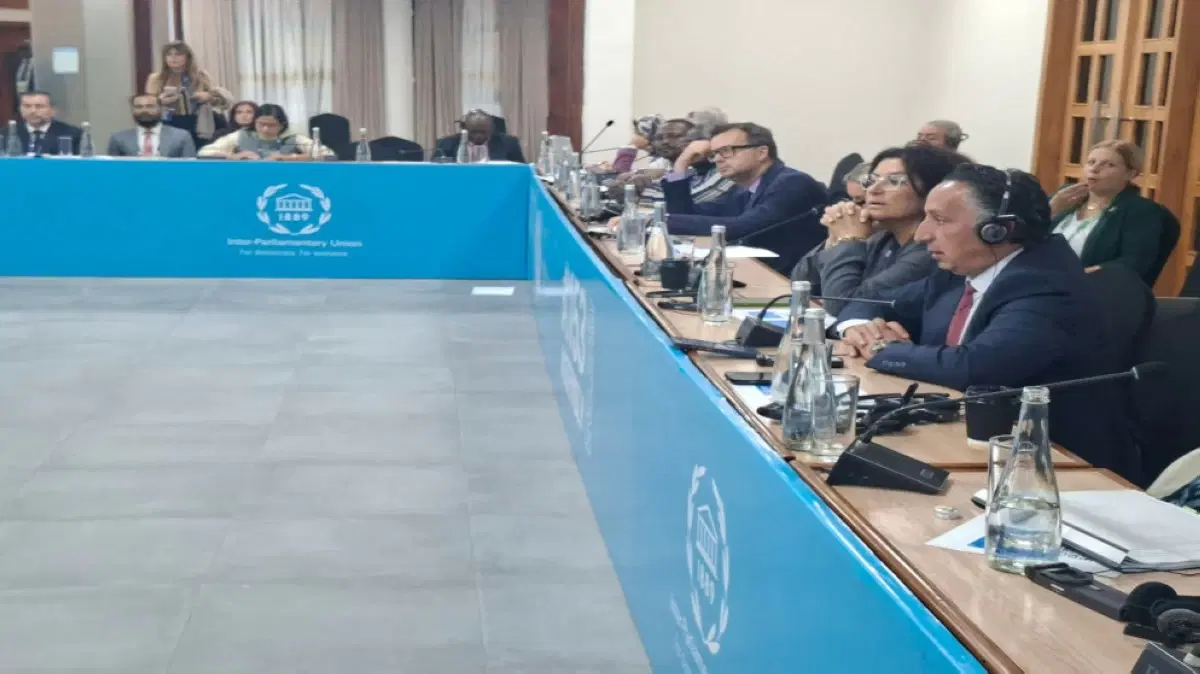
During his speech before the Standing Committee on United Nations Affairs, Deputy Dr. Omar Al-Khalidi confirmed that parliaments are no longer just national institutions for legislation and oversight, but have become an important part of the international work system and the collective ability to face crises, build peace, and achieve development.
Al-Khalidi said that today's world is facing intertwined crises represented by wars, conflicts, terrorism, extremism, economic, food, and water crises, climate change, and the increasing displacement of populations, noting that these challenges do not stop at national borders, and therefore their treatment cannot be national only, but requires real international cooperation and institutions capable of translating international commitments into tangible policies, legislation, and procedures.
He added that the international parliamentary role is highlighted by the essential tools it possesses to face these challenges through legislation, oversight, and parliamentary diplomacy, explaining that parliamentary diplomacy is a space for dialogue, communication, and trust-building and can open channels for discussion even when traditional political communications are more difficult.
He stressed that Jordan believes that security, peace, and development are interconnected, and from Jordan's position in a region facing accumulated political, security, and humanitarian challenges, it emphasizes the importance of supporting political solutions, respecting international law, protecting civilians, rejecting their targeting, and enhancing international cooperation in facing terrorism and extremism.
He emphasized the need to look at the concept of security more broadly, as water, food, climate, energy, and cyber security have all become essential elements of national and humanitarian security, pointing out that climate change is no longer just an environmental issue but an issue of security, development, and stability.
Al-Khalidi confirmed that the enforcement of international humanitarian law must be a collective responsibility, and that international humanitarian law must protect civilians everywhere and that the value of human life should not change according to nationality, geography, or political circumstances, stressing that the responsibility of parliamentarians is to support governments in implementing their international obligations, hold them accountable when they fall short, and enhance parliamentary and community awareness of international humanitarian law.
He said that protecting civilians is not just a political issue, it is a legal, humanitarian, and ethical issue par excellence, noting that the International Parliamentary Union can play a greater role in this field by working more systematically to exchange legislation, expertise, data, best practices, and parliamentary oversight mechanisms, instead of limiting itself to exchanging positions.
He added that the crises facing the world today may not always start with a military conflict, they may start with a lack of water, food and energy disruption, a climate disaster, or a cybersecurity threat.
He explained that parliaments alone cannot end wars or solve global crises, but they can make the law stronger, the dialogue broader, the oversight more effective, the legislation more responsive, and the cooperation between peoples more firmly established, and that a parliamentarian can be a bridge between societies and convey the concerns of peoples to decision-making circles.
He stressed that parliamentary diplomacy is not a substitute for official diplomacy but is a partner to it and a bridge between governments and peoples.
At the end of his speech, he referred to the speech of His Majesty King Abdullah II ibn Al-Hussein at the last session of the United Nations General Assembly, where His Majesty emphasized the need for the international community to bear its responsibilities towards crises and conflicts, enhance confidence in international institutions and agreements, respect international law, and apply it to everyone, and put the facts before us and not leave them behind.
During his participation in the workshop, which was held by the Working Group and Discussion Group on the Role of Parliaments in Enforcing International Humanitarian Law and International Human Rights Law, Deputy Mutaz Abu Rumman said in his speech to the participants: Imagine, for a moment, that the child waiting for safety is your child... What position would you expect from the world?
He added that respecting international humanitarian law and international human rights law is a legal and moral obligation for states, and a basis for protecting people's lives and preserving their dignity.
Abu Rumman quoted what His Majesty King Abdullah II ibn Al-Hussein said in his last speech to the United Nations General Assembly: "If international law can be ignored for decades, what is left of its value? And how can we apply it if we do not even recognize its violations?"
He confirmed that the right of the Palestinian child to life is no less than the right of any child in the world, and that the Palestinian people have the right to live freely, safely, and with dignity on their land, and to obtain their legitimate national rights, and to have their independent state on their national soil.
Abu Rumman called from this podium for a unified position for the International Parliamentary Union and the parliaments of the world to demand a stop to the attacks on civilians in Gaza and the West Bank, to commit to a ceasefire in the Gaza Strip, and to ensure the unimpeded delivery of humanitarian aid.
He stressed the need for this to be accompanied by the protection of medical and journalistic staff, the rejection of forced displacement, and the holding accountable of those responsible for crimes and violations.
He said: The child who needs medicine cannot wait for our disagreements to end, and the mother who fears for her children cannot postpone her fear until we agree.
He added, addressing the participants: From Jordan, I address the peoples of the world: Raise your voices in defense of life; and I address my fellow parliamentarians: Let us carry this call to our parliaments, and turn it into decisions that protect the human being.
He confirmed that the credibility of the defense of human rights is tested when its protection conflicts with interest calculations.
Abu Rumman proposed including a paragraph in the final statement linking the commitment of parliaments to protect civilians with clear legislative, oversight, and financial procedures, to be presented to the next Assembly, so that peoples can know what has been achieved in fulfillment of this responsibility.
He concluded his speech by saying: Let us leave this hall with a clear position, followed by actions that protect life and preserve dignity.
During his participation in the work of the Standing Committee on Sustainable Development, Deputy Yanal Freihat confirmed that justice is the basis of development and that there can be no talk of real sustainability in the shadow of continued occupation.
He continued that the convening of the International Parliamentary Assembly in this promising African continent carries great symbolism; it is a continent struggling to shape its developmental future and face the challenges of sustainable development despite its lack of resources and the depth of its inherited crises.
Freihat added that Africa is actually facing a glaring paradox; it is the least contributor to global carbon emissions, but the most affected by the catastrophic consequences of climate change, from droughts threatening its food security to floods uprooting local communities from their roots.
He called on the participating parliamentary delegations to question with a living parliamentary conscience: How can we talk about'sustainable development' or 'opportunities for all', while entire peoples are deprived of the minimum requirements of human life?
Freihat confirmed that from this international podium, he raises the voice of the Palestinian brothers who are facing the worst forms of human suffering.
He added that our brothers in Palestine, in the Gaza Strip, the West Bank, and Jerusalem, are not looking for green development or artificial intelligence or addressing the climate crisis!!! But they are looking for their basic right to exist, to life, to freedom, security, and dignity.
He asked: How can we achieve 'sustainability' under the yoke of occupation, and in the shadow of the systematic destruction of schools, hospitals, infrastructure, scarce water sources, and agricultural lands from which the occupation uproots trees as it uproots human existence?
Freihat continued that the continued disregard for the application of international humanitarian law in Palestine constitutes a stab in the back of the multilateral work system and the UN's goals of justice.
He affirmed: In Jordan, under the directives and leadership of His Majesty King Abdullah II ibn Al-Hussein, we have never been separated from our Arab and humanitarian depth.
He added: As a country that is one of the largest hosts of refugees in the world, despite being the poorest country on the planet in terms of water resources, and facing major economic challenges as a result of the regional crises surrounding it, we fully understand the cost of the absence of justice on development.
He explained that despite all these challenges, Jordan continues to move forward with its major national projects, encouraging investment in various fields, including alternative energy projects, in addition to empowering youth and women, noting at the same time that Jordan has never wavered, through the historical Hashemite custodianship of the Islamic and Christian holy sites in the Holy City of Jerusalem, from protecting the identity of the Holy City and supporting the steadfastness of the Palestinian people by all humanitarian and diplomatic means.
At the conclusion of his speech, Freihat said: Our parliamentary message from the heart of Africa today is that "Justice is the foundation of development," as a sustainable and prosperous world cannot be shaped if the policy of double standards continues.
He emphasized that it is a parliamentary and moral duty that compels us not only to adopt slogans but also to impose an international political will that ends the injustice of Africa and the exploitation of its resources without reflecting on the development of the lives of its people.
He added: We also need to impose an international political will that ends the occupation and grants the Palestinian people their legitimate right to establish an independent state with Jerusalem as its capital, so that our region and the world can enjoy true stability.
The Jordanian parliamentary delegation continues its busy program of meetings until the conclusion of the Assembly's work, which sees wide participation from the heads and representatives of parliaments of more than 140 countries.