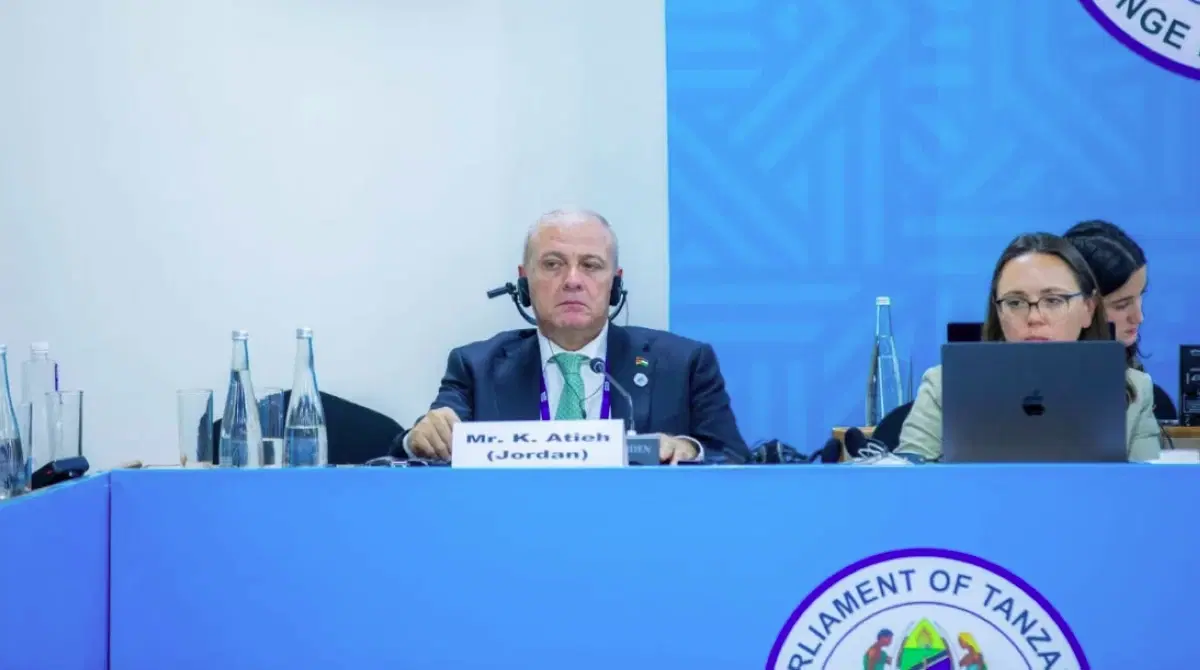
Attiyah: Justice and Peace Require Ending the Israeli Occupation
Amman4 min read
Share
The First Deputy Speaker of the House of Representatives, Dr. Khamis Hussein Attiyah, Chairman of the Jordanian Parliamentary Delegation participating in the 153rd General Assembly of the Inter-Parliamentary Union held in the United Republic of Tanzania, affirmed that peace that is not based on justice cannot be sustainable peace.
This was stated in his intervention today, Monday, during the parliamentary consultation session on "Pathways to Achieving Peaceful Coexistence in the Middle East", with the participation of representatives of parliamentary delegations.
Attiyah said that justice requires ending the occupation, stopping the suffering of the Palestinian people, and enabling them to fully exercise their national, political, and human rights, leading to the establishment of an independent sovereign Palestinian state.
He added: "If we want to talk about peace in the Middle East, we must start with the most important question: How do we achieve justice?"
He continued: "We cannot talk about peace while Israel continues to commit violations, massacres, and genocide, and at the same time ignores UN resolutions and the norms established by international law"
He pointed out that respecting the resolutions of international legitimacy is not a selective option, but rather the basis of the international system, and that any selectivity in the application of the law weakens confidence in international justice and undermines the chances of achieving real peace.
He said that His Majesty King Abdullah II affirmed in his speech at the 81st session of the United Nations General Assembly that what is happening in Gaza can no longer be considered temporary military measures, and that what is happening in the West Bank of expanding settler violence, land seizures, and settlement expansion, is a systematic forced displacement aimed at canceling the idea of a Palestinian state.
He explained that the past years have proven that managing the conflict without addressing its roots does not produce peace, but rather postpones and accumulates crises, clarifying that what is required is to move from statements of condemnation to practical steps that ensure the protection of civilians, hold accountable those who violate international law, end the occupation, empower the Palestinian people to their legitimate rights, and impose sanctions on Israel, alongside the practice of diplomacy in this regard.
He stressed the importance of the role of parliaments and their ability to be a voice for justice, to support dialogue, to pressure towards respecting international law and UN resolutions, and to make human rights and human dignity an essential part of any peace process.
Attiyah reiterated that the Palestinian issue was and will remain a central issue for Jordan, and that Jordan, under the leadership of His Majesty King Abdullah II, continues to defend the rights of the Palestinian people, reject displacement, and adhere to the establishment of an independent sovereign Palestinian state.
He added, the responsibility of parliamentarians today is to make parliamentary diplomacy a tool for pushing towards justice, not just a platform for talking about peace.
The consultation session discussed a number of main axes, including specific parliamentary initiatives that can contribute to preventing conflicts and building peace in the Middle East, disseminating good practices and lessons learned, identifying the contribution of the Inter-Parliamentary Union and its mechanisms in supporting the efforts of parliamentarians aimed at building peace in the Middle East, and generating new ideas to enhance the efforts of parliamentary diplomacy aimed at supporting the prevention of conflicts and achieving peace in the Middle East.
The session also discussed identifying the main risks and challenges that may negatively affect the parliamentary efforts aimed at achieving peace, and studying the feasibility of the Inter-Parliamentary Union undertaking other initiatives, such as a more comprehensive parliamentary consultation or conference, in order to support peace in the Middle East.