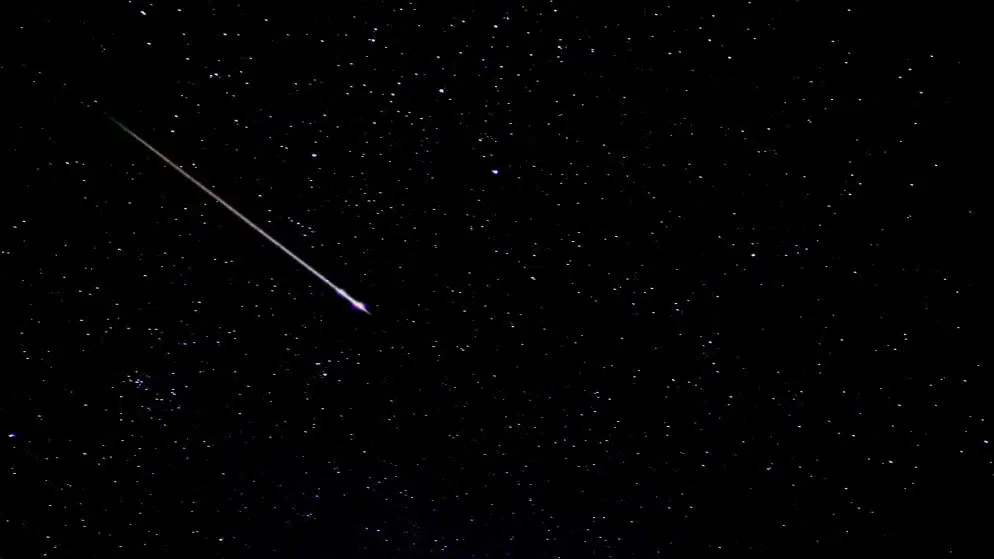
He added that the shower's activity extends for several weeks, usually peaking between October 20 and 22. The meteor rate may reach about 20 meteors per hour under ideal conditions, while the observed rate under normal conditions is lower, with the possibility of seeing meteors continuing during the days following the peak at varying rates.
Al-Sakji pointed out that the Orionid meteors appear to radiate from a radiant point located in the constellation Orion, but they may appear in various parts of the sky, explaining that the chances of observing them improve after midnight until dawn, as the radiant point gradually rises above the horizon.
He indicated that observation conditions during the current period are affected by moonlight, as the moon approaches its full phase on October 26, which may obscure faint meteors and reduce the number of visible meteors, while viewing opportunities improve during the hours when the moon is absent from the sky and in locations far from light pollution.
He emphasized that observing the Orionid meteors does not require telescopes or special astronomical equipment, as they can be seen with the naked eye, advising the selection of dark and open locations, staying away from artificial lighting, and allowing about 20 to 30 minutes for the eyes to adapt to the darkness.
Al-Sakji noted that Halley's Comet, which completes an orbit around the Sun every 76 years, is a source of two annual meteor showers: the Eta Aquariids in May and the Orionids in October, and the comet is expected to return to the vicinity of the Sun in 2061.
He explained that this phenomenon represents a scientific and educational opportunity to understand the relationship between comets and meteors, and how celestial bodies leave traces of fine particles in space that Earth crosses periodically, resulting in annual meteor showers.
In a related context, Al-Sakji pointed out that the sky of Jordan and the Arab world witnessed at dawn on Thursday, October 22, an astronomical scene that combined the planets Mars and Jupiter and the star Regulus, in a striking apparent arrangement in the eastern sky before sunrise, which could be seen with the naked eye, coinciding with the peak activity of the Orionid meteor shower.