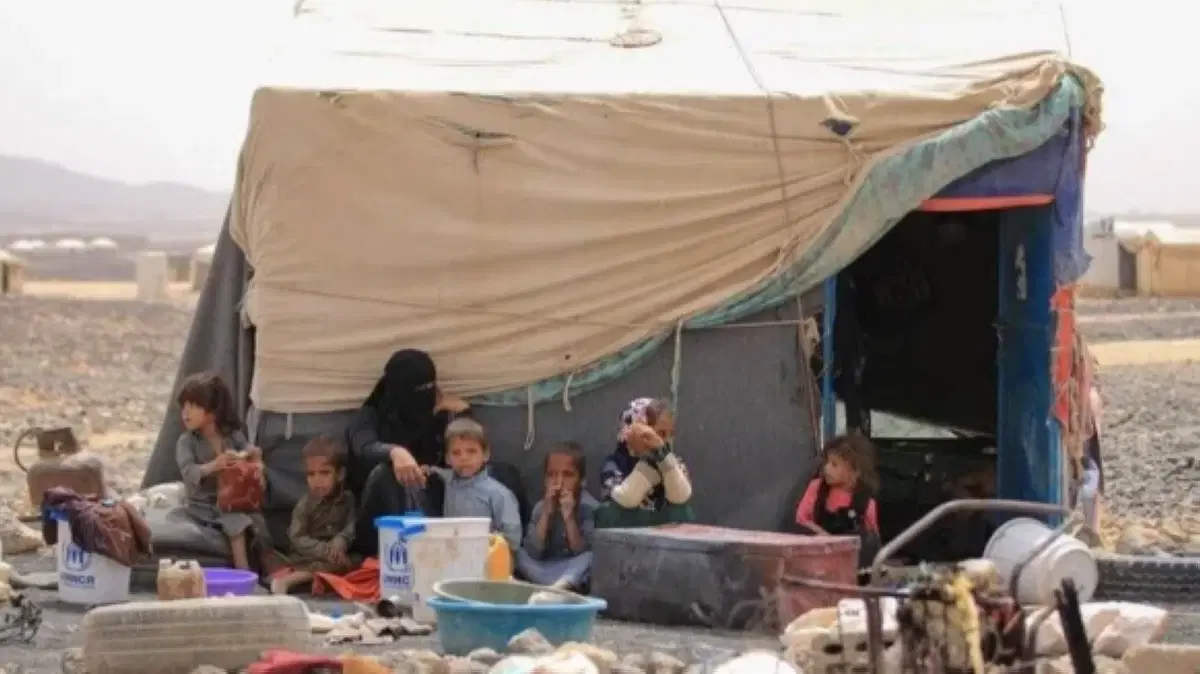
Netanyahu rejects the return of northern West Bank camp residents to their homes
Agencies5 min read
Share
Israeli Prime Minister Benjamin Netanyahu said on Tuesday that he refuses to allow the residents of refugee camps in the occupied northern West Bank to return to their homes, confirming that the Israeli army will continue to control the area and remain there.
This came during his inspection of the "seam line" area between Israel and the Palestinian territories in the West Bank, according to a video clip released by Netanyahu on Tuesday evening and circulated by Hebrew media, including the newspaper "Israel Hayom."
Netanyahu said: "I am here with the Minister of Defense (Israel Katz) and army officers in what is called the seam line area, and behind me is the Tulkarm refugee camp, the former refugee camp (in the northern West Bank), which is a stronghold of terrorism. The Israeli army entered and cleared it under our directives, and did an excellent job, not just here."
Netanyahu commented on an order issued by the Israeli Supreme Court on Sunday, in which it demanded that the government provide a timetable for completing the necessary steps for the return of Palestinians whom the Israeli army forced to displace from the Jenin, Tulkarm, and Nur Shams camps in the occupied northern West Bank, and to discuss ways to accelerate their return.
Since the beginning of 2025, the Israeli army has prevented thousands of Palestinians whom it forced to displace from the three camps from returning to their homes, despite repeated demands to allow them to do so.
The Israeli Prime Minister said: "I heard that the Supreme Court wants to return the residents, no, these are not residents, but saboteurs," adding: "The Israeli army is the one that will control this area and remain in it."
He continued: "There will be no Arab army west of the Jordan, but rather the Israeli army will be here."
Late last September, the head of the right-wing opposition "Yisrael Beiteinu" party, Avigdor Lieberman, sparked widespread controversy among Israeli right-wing leaders and parties after calling for reaching an understanding with Jordan under which it would assume security and administrative responsibility for Areas "A" and "B" in the West Bank, as part of what he called an "Israeli-Jordanian confederation."
The "Oslo II" agreement, signed between Israel and the Palestine Liberation Organization in 1995, classifies the West Bank territories into three areas; Area "A" is under full Palestinian control, while Area "B" is under Israeli security control, with Palestinian civil and administrative control.
As for the third area, "C," it is under full Israeli civil, administrative, and security control, and constitutes about 60 percent of the West Bank's area.
Netanyahu continued: "We maintain our control from the Jordan River to the sea, this is our state and this is our control."
He added: "I would like to tell you that there are warnings, this is true, as our enemies are considering testing us during this period leading up to the elections. I warn them that we are prepared for any scenario, including what is called a 'guns coup'."
The "guns coup" is a term that has recently emerged in Israel, referring to the possibility of Palestinian security services in the West Bank turning their weapons against Israel.
Netanyahu added: "The Israeli army presented to me and the Minister of Defense a strong and tight plan, and in the event of that (a guns coup) happening, I suggest to our enemies not to test us, because you will face a force you have never dreamed of."
He concluded by saying: "We will continue to maintain Israel's security here at the seam line and everywhere, and we are establishing settlements, as we have established more than 104 (during the current government), along with many farms, and we are protecting the security of the State of Israel."
Netanyahu's warnings coincide with the intensification of the election campaign ahead of the Knesset elections scheduled for October 27, the first since the events of October 2023 and the devastating war that followed in the Gaza Strip.
During the last few weeks, Netanyahu has intensified his presence on the security file within his election campaign, presenting himself as the "most capable of confronting" what he describes as "security threats," in an approach that observers said re-employs one of the most prominent pillars of his previous election campaigns.
In contrast, the opposition accuses Netanyahu and his government of using the security file for electoral purposes, and holds them responsible for the failures that preceded the October attack, as well as the decline in Israel's international standing during the years of the war.
Last month, opposition leader Yair Lapid criticized security messages issued by Netanyahu regarding the possibilities of attacks ahead of the elections, saying that "there is no reason to put the public in a state of panic," and that security and army bases "are not an arena for election videos."
In October 2023, the "Hamas" movement attacked military bases and Israeli settlements adjacent to the Gaza Strip, and captured soldiers and settlers, stating at the time that its attack came in response to continuous Israeli violations against Palestinians and holy sites, foremost among them the Al-Aqsa Mosque.
Following that, Israel launched a devastating war on the Gaza Strip on October 8, which resulted in the death of more than 74,000 Palestinians and the injury of more than 175,000, in addition to widespread destruction in the Strip, before a ceasefire agreement entered into force in October 2025.
Despite the agreement, Israel continued to launch attacks on Gaza, where 1,498 Palestinians have been killed by Israeli fire since the start of the ceasefire, and 5,306 others have been injured, while its forces continue to control large parts of the Strip, according to Palestinian data and international reports.