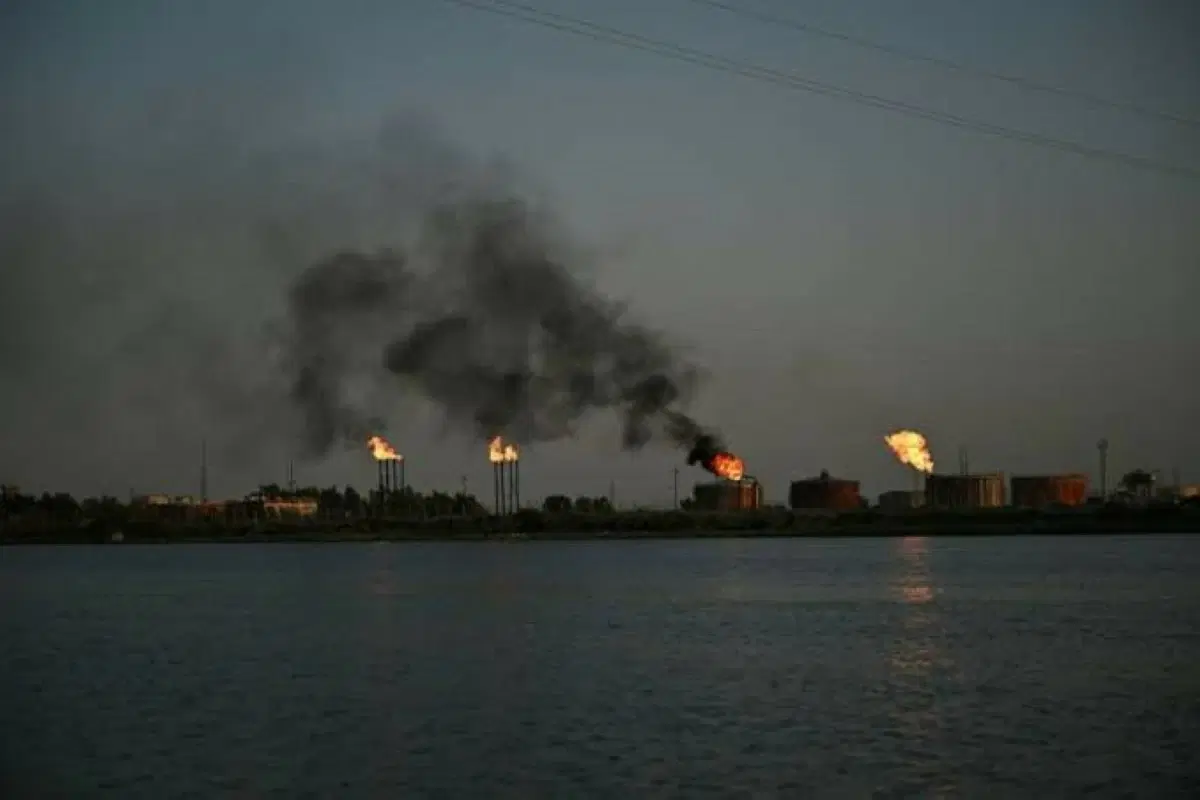
In Basra, southern Iraq, fuel tankers are idle, workers speak of wage cuts and layoffs, and the pace of activity in the ports is slow... The war in the Middle East is leaving clear marks here and strangling the Iraqi economy.
Fawzi, 22, who asked not to be fully identified and works for a private maintenance company at an oil field in Basra—the country's main oil export hub and its only maritime outlet—says, "The field is stopped... We are not extracting oil, so what is there for us to maintain?"
His company first cut salaries by 20 percent, then by half before proceeding to lay off dozens of employees, according to him.
Fawzi now comes to work only 15 days a month, spending most of his time waiting to be assigned tasks that rarely come.
He says: "I haven't done anything for a month."
Many in Basra have reported layoffs or wage cuts at private companies operating in oil fields and ports after their operations shrank.
A large segment of Basra's population relies for its livelihood on the oil sector, which is suffering globally from the repercussions of the war in the Middle East and the conflict over the Strait of Hormuz.
Before the war that erupted with a US-Israeli attack on Iran at the end of February, Iraq—which derives about 90% of its revenue from oil sales—was producing about four million barrels of oil per day and exporting an average of 3.4 million barrels, most of it from Basra via the Strait of Hormuz, which is vital for global energy supplies. However, the waterway crisis forced Iraq to stop production in most of its fields after their storage tanks became full.
Iraq resorted to exporting via Syria using tanker trucks and via Turkey through a pipeline, but these quantities represent only a small fraction of what exports via Hormuz used to be.
Experts call for the necessity of Iraq diversifying its economic sources to protect itself from energy market fluctuations... but achieving this is not easy in light of a weak private sector, a struggling banking system, as well as mismanagement and infrastructure that has been dilapidated by decades of crises.
In Basra, tanker trucks have filled parking lots; some remain empty, while others have been waiting for weeks in the hope of offloading their crude oil cargo onto ships.
After a sharp decline in Iraqi oil exports following the closure of the Strait of Hormuz, they returned to rise slightly, recording more than three million barrels in the first week of September, according to the ship-tracking platform "Kpler".
According to the Ministry of Oil, the average daily crude oil export since the beginning of September has reached around 2.6 million barrels per day.
But Iraq has recently been forced to sell oil at low prices, according to an official.
Consumer prices in Iraq have risen, and constant fear in the markets has led to a decline in the value of the dinar against the dollar. Foreign currency reserves have also dropped by about $20 billion, according to the official.
Iraq relies heavily on foreign currency generated from oil sales to finance imports, stabilize the dinar, and pay the salaries of public sector employees and retirees, who make up about 20 percent of the population of more than 46 million.
As a result of the decline in oil revenues, the authorities have been forced to resort to domestic borrowing.
Economic expert Ali Al-Mawlawi says the government hopes it can continue borrowing for several months, but it is "likely betting on reaching a solution to the conflict before the end of this year."
He adds that the recent recovery, albeit partial, in oil exports has given it "some time" and helped it pay salaries on time, albeit "with a limited delay," explaining that "the urgent matter is to ensure it can continue to do so."
Iraq imports most of its needs, from food and medicine to electronic devices and natural gas.
But today, at the Umm Qasr commercial port, which used to be bustling with cargo ships and employees, activity seems almost non-existent. Only a few ships are docked at the northern port, including a cargo ship flying the Iranian flag and another that port employees said had crossed the Strait of Hormuz coming from China.
The northern port administration was heavily counting on the start of operations at three new berths equipped with the latest technologies, but for now, silence prevails.
In addition to a number of layoffs and wage cuts, government port employees have lost monthly incentives linked to port profits.
The director of the northern Umm Qasr port, Captain Salem Jabbar Hussein, says, "The port of Umm Qasr and the rest of Iraq's ports have been greatly affected by the ongoing war," noting some recovery during the past period after some ships began using an alternative route to Hormuz.
However, he believes that "real work (will return) with the opening of the Strait of Hormuz."
The war has its repercussions on the markets of Basra, where activity has declined significantly.
Zaid Hadi (36), an owner of an electronics store, says his sales have dropped by half, attributing this to high shipping costs, wage cuts, job losses, and the departure of many foreign employees from the oil sector.
He adds that "the citizen has become afraid to spend his money at the beginning of the month for fear that his salary will be delayed."
Amir (35), who used to work for a private safety company at an oil field, says salaries were initially cut by 40 percent, before stopping completely for many. The company has even started assigning multiple tasks to a single employee.
He says, "In Basra, we rely on the port and oil, and now both are stopped."