Oil and electricity exchange halted.. What is the future of energy between Jordan and Iraq?
Amman10 min read
Share
The two energy exchange paths between Jordan and Iraq are currently halted; Iraqi oil has not reached the Kingdom since the beginning of the current year 2026, and conversely, Jordanian electricity has stopped reaching the Al-Rutba district in western Iraq, while both sides are discussing the resumption of crude supply and the expansion of the electrical interconnection project between the two countries.
Since the beginning of 2026, not a single shipment of Iraqi crude oil has reached Jordan, after the Kingdom imported about 2.75 million barrels during 2025, while discussions between the two sides have not yet reached an agreement to restore the movement of tankers that were transporting approximately 10,000 barrels per day to the Jordan Petroleum Refinery.
On the other hand, the supply of electricity to the Al-Rutba district from the Jordanian grid has stopped, following the reconnection of the district to the Iraqi national electricity system via Al-Qaim, with the intention to later complete the interconnection line between the two countries and increase its capacity to 500 megawatts, according to Iraqi officials.
Iraqi oil is halted.. Why hasn't it returned?
Data from the Iraqi Oil Marketing Company "SOMO" shows that Iraq exported 2.748 million barrels of crude oil to Jordan during last year, despite the complete suspension of supplies for three months during the year.
In the months that saw supply operations, the quantities hovered around 300,000 barrels per month, equivalent to approximately 10,000 barrels per day.
Jordan imports Iraqi oil under a memorandum of understanding between the two countries that stipulates supplying the Kingdom with about 10,000 barrels per day of Kirkuk crude, with a margin of increase or decrease of 15%. These quantities covered about 7% of Jordan's oil needs.
The arrangements between the two countries include compensating for quantities that cannot be supplied, a mechanism previously used when transport operations were halted.
A source in the Ministry of Energy had previously confirmed that the quantities that do not reach the Kingdom are being compensated for in accordance with the memorandum of understanding.
However, calculating all the quantities that have not reached Jordan since the beginning of the year as due quantities is not done automatically, as determining the volume of quantities to be compensated requires an official settlement between the two sides.
When calculating supply on the basis of 10,000 barrels per day, approximately 300,000 barrels per month were supposed to reach Jordan.
An informed source told "Al-Mamlaka" that the Iraqi side requested to change the specification of the oil sent to Jordan from Kirkuk crude to Basra crude, which necessitated studying the ability of the Jordan Petroleum Refinery to refine the new crude according to the approved specifications.
According to the source, the Jordanian side addressed Iraq at the beginning of the current month to request the specifications of Basra crude, with the aim of studying them and determining the possibility of refining it in Jordan.
Basra crude differs from the Kirkuk crude that the Kingdom was accustomed to importing, while the crude produced in southern Iraq is divided into two main types that are marketed globally: Basra Light crude and Basra Heavy crude.
The Director General of the Petroleum Refinery, Hassan Al-Hiari, confirmed in his response to "Al-Mamlaka" inquiries that communication is taking place at the private sector level with the Iraqi Marketing Company "SOMO" to determine the types of oil suitable for the Jordan Petroleum Refinery, or to resume supplying Jordan with the Kirkuk oil it previously imported.
The last annual contract for supplying Iraqi oil ended on June 26, 2025, before being extended for three months starting in October and ending last December, with the aim of completing the supply of the agreed-upon quantities, before shipments stopped at the beginning of the current year.
500 trucks were transporting oil
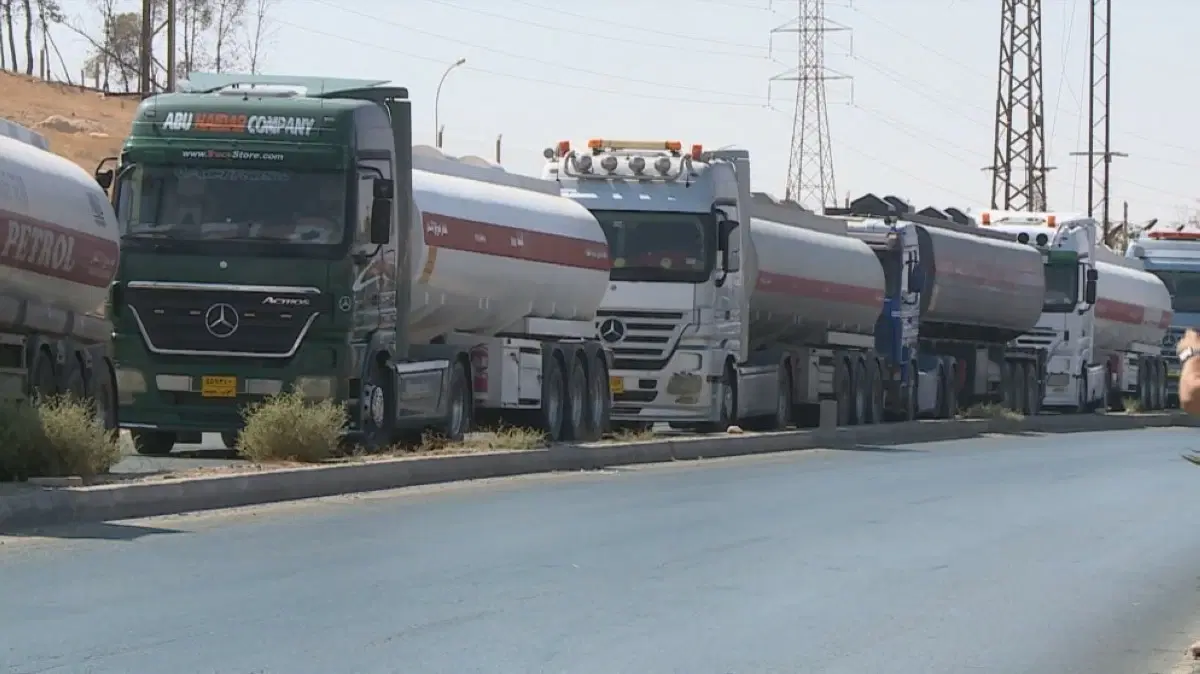
The impact of the oil suspension was not limited to supplies alone, as the transport movement that employed hundreds of trucks on both sides of the border also stopped, according to the approved transport system and in coordination between the relevant authorities via the Trebil-Karameh border.
Tankers were transporting Iraqi crude to the Jordan Petroleum Refinery in Zarqa, while transport operations were distributed between Jordanian and Iraqi companies, with a volume reaching about 300,000 barrels per month in normal months.
The source revealed that the Jordanian trucks that were working on transporting Iraqi crude did not stop working completely, as part of their activity shifted to transport from the Port of Aqaba, which is witnessing a significant increase in the movement of goods heading to Iraq.
The latest data from the Jordan Shipping Association shows the volume of the shift that occurred in transit movement, as the number of containers heading to Iraq via the Port of Aqaba increased from 3,599 containers during the first seven months of 2025 to 37,182 containers during the same period of the current year.
Thus, the increase reached 33,583 containers, an increase of 933.1%, coinciding with the rise in the movement of bulk goods and trucks heading to the Iraqi market.
The source said that the multiplicity of sources for importing crude and petroleum products allowed for the compensation of the quantities that Jordan was receiving from Iraq, and therefore the suspension of Iraqi oil did not affect the availability of supplies in the local market, but it stopped one of the land supply routes that the Kingdom had used over the past years.
Electricity also stopped
At the same time that Iraqi oil stopped moving towards Jordan, the electricity line that was transmitting Jordanian energy to the Iraqi Al-Rutba district also stopped in the other direction.
According to Iraqi officials, Al-Rutba was reconnected to the Iraqi national electricity system via Al-Qaim, after completing energy transmission towers from the Risha line to Al-Rutba-Al-Qaim, so that Al-Rutba receives its electricity needs from the Iraqi national grid instead of the Jordanian line.
The Mayor of Al-Rutba district said that the Jordanian interconnection line is currently stopped until the project requirements are completed, and that the next phase includes completing the connection of the 400 kV line towers.
The Iraqi News Agency quoted the Mayor of Al-Rutba district, Imad Al-Dulaimi, as saying that the completion of the works will allow for discussions between the Iraqi and Jordanian sides to restart the interconnection line with a capacity of up to 500 megawatts.
From the Jordanian side, the National Petroleum Company revealed, in its response to "Al-Mamlaka" inquiries, that the suspension of Jordanian electricity to Al-Rutba came after providing an alternative from the Iraqi grid, while the electrical interconnection project itself remains in place, with a trend to increase its capacity in the next phase to 500 megawatts after completing the infrastructure.
The electrical interconnection project between the two countries aims to exchange energy and enhance the stability of the electrical system. Anbar Governorate was the first phase of the project, while the interconnection comes within a broader Iraqi plan to diversify electricity import sources and reduce reliance on a single source, in addition to interconnection projects with Turkey and the Gulf states.
How did the interconnection begin?
On September 26, 2024, the Iraqi Ministry of Electricity, represented by the Central Region Electricity Transmission Company, signed the second amendment to the electrical energy sales contract with the Jordanian Ministry of Energy and Mineral Resources, represented by the National Electric Power Company.
The agreement included renewing the supply of electrical energy to the Al-Rutba district on the 132 kV voltage grid, via the Jordanian grid from the Risha area in Mafraq Governorate.
The agreement was signed on the Jordanian side by the Director General of the National Electric Power Company, Amjad Al-Rawashdeh, and on the Iraqi side by the Director General of the Central Region Electricity Transmission Company, Riyadh Oraibi.
The agreement indicated from that time the transition in the future to the 400 kV transmission grid, after completing the construction of the lines and the works required by both sides.
Iraq wants other outlets for its oil
The suspension of Iraqi oil reaching Jordan comes at a time when Baghdad is looking for additional outlets to export crude, in light of the pressures that export routes and maritime traffic in the region have been subjected to.
Iraq relies mainly on southern ports to export its oil, which prompted it to re-examine other options and routes to deliver crude to markets.
Iraq had warned that the continued closure of the Strait of Hormuz could reduce its monthly oil revenues from about $7 billion to $1 billion, while its average exports before the crisis reached about 3.3 million barrels per day.
Iraq has already resorted to other routes to dispose of some of its petroleum products, including supplying about 650,000 barrels per month of fuel oil to Syria for export via the Mediterranean, while exports of Kurdistan Region oil via the Turkish Ceyhan port fell to about 20,000 barrels per day, compared to about 240,000 barrels per day before the crisis.
Member of the Iraqi Parliamentary Oil Committee, Zainab Al-Khazraji, said in a statement reported by the Iraqi News Agency that the Ministry of Oil is working to diversify crude export outlets, and that there is a move towards Jordan, Turkey, Syria, and other countries.
The Iraqi Ministry of Oil also announced earlier that it is working on a new system of pipelines for transporting and exporting crude via two routes: Basra-Haditha-Fishkhabour, and Haditha-Baniyas, as part of efforts to search for additional outlets for oil exports.
Iraqi oil via Aqaba?
The talk about Jordan this time is not limited to re-supplying about 10,000 barrels per day to the Kingdom, as the Minister of Energy and Mineral Resources, Saleh Al-Kharabsheh, had revealed that Jordan received requests to study the possibility of exporting Iraqi crude oil and heavy fuel through the Kingdom's territory.
Al-Kharabsheh said that the relevant authorities are studying these requests according to the available capabilities, and in a manner that takes into account storage capacities and maintaining the strategic stock necessary for the local market, in addition to the capabilities of the Port of Aqaba and the berth designated for receiving and exporting crude oil and its derivatives.
The idea of Iraqi oil reaching Aqaba is not new, as the Iraq-Jordan oil pipeline project has been on the table for years. According to the proposed plans, it would extend for about 1,700 kilometers from southern Iraq to the port of Aqaba on the Red Sea.
Kharabsheh had previously announced the Iraqi Council of Ministers' approval of the project's framework agreement, but the pipeline has not yet entered the implementation phase, in light of challenges related to financing and political and security conditions.
With Iraq returning to search for new outlets for its exports, Jordan and Aqaba are back in the calculations, whether through the long-term pipeline project or through other transport and export options currently being discussed.
After years in which the direction of energy exchange between the two countries was clear—oil moving from Iraq to Jordan, and electricity moving from Jordan to Iraq—both paths have currently stopped on both sides of the border. However, the files on the table between the two countries today have become larger than the quantities that stopped, ranging from negotiations to resume oil supplies, a project to increase the electrical interconnection capacity to 500 megawatts, and exploring the possibility of using Jordan as a corridor for Iraqi oil exports.
Between what has actually stopped and what is being planned for future expansion, the resumption of energy exchange between Jordan and Iraq remains linked to the outcome of the discussions and technical arrangements between the two sides.