"National Petroleum" reduces its losses by 56% to 2.48 million dinars, and gas revenues rise by 35%
Amman4 min read
Share
The Jordanian National Petroleum Company recorded a net loss of 2.48 million dinars during the first nine months of 2026, a decrease of 56% compared to the same period last year, despite a 30.4% increase in its revenues to 14.2 million dinars, while the amortization expenses for unsuccessful wells alone amounted to about 6.59 million dinars, according to the company's interim financial statements.
The financial statements, ending on September 30, 2026, showed an increase in the company's share of natural gas revenues by 35% to 3.31 million dinars, against a decline in revenues from the Hamza oil field by 22.1%, and the recording of no revenues from the Sarhan field, at a time when operating and administrative expenses exceeded 16.5 million dinars.
- Gas revenues rise by 35% to 3.31 million dinars
The company's share of natural gas revenues rose to 3.31 million dinars, compared to 2.45 million dinars during the first nine months of 2025, an increase of about 860 thousand dinars.
Recoverable costs also rose by 30.8% to 9.63 million dinars, compared to 7.36 million dinars, accounting for about 67.8% of the company's total revenues, while its direct share of gas revenues contributed 23.3%.
Thus, recoverable costs and the company's share of natural gas revenues together accounted for about 91% of the total revenues recorded during the period.
- Hamza field revenues decline by 22% and Sarhan has no revenues
In oil activity, revenues from the Hamza field declined by 22.1% to about 333.5 thousand dinars during the first nine months of the current year, compared to 428 thousand dinars during the corresponding period of 2025, a decrease of 94.5 thousand dinars.
As for the Sarhan field, the company did not record any revenues from it during the period, compared to 309.8 thousand dinars during the first nine months of last year.
Thus, the revenues recorded from both fields combined declined by 54.8%, from about 737.8 thousand dinars to 333.5 thousand dinars, a decrease of about 404.3 thousand dinars.
- Operating and administrative expenses exceed revenues by 2.34 million dinars
The financial statements showed an increase in operating expenses by 3% to 14.21 million dinars, compared to 13.79 million dinars during the corresponding period of 2025, while administrative expenses increased by nearly 14% to 2.33 million dinars, compared to 2.05 million dinars.
The total operating and administrative expenses amounted to 16.54 million dinars, exceeding the total revenues of 14.2 million dinars by a difference of approximately 2.34 million dinars.
Despite the rise in expenses, the company reduced its losses by about 3.17 million dinars, with revenue growth at a higher pace than the growth in operating and administrative expenses.
- 6.59 million dinars for the amortization of unsuccessful well expenses
The financial statements revealed an increase in amortization expenses for unsuccessful wells by 7.7% during the first nine months of 2026, reaching 6.588 million dinars, compared to 6.144 million dinars during the corresponding period of 2025, with this item accounting for about 46.4% of the company's total operating expenses, which amounted to 14.21 million dinars.
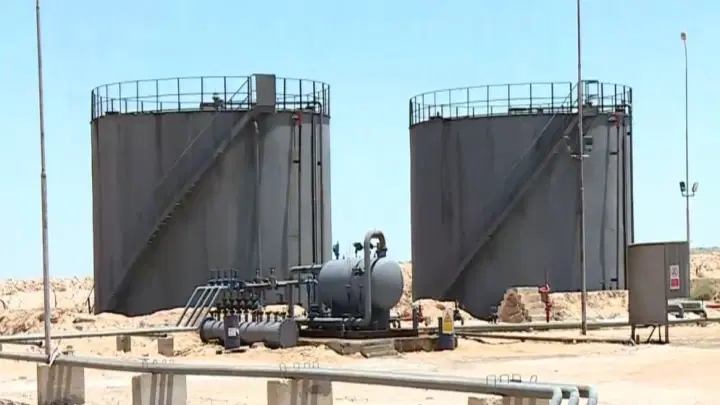
Operating expenses included about 9.04 million dinars for Risha field wells, including amortization expenses for unsuccessful wells, in addition to 2.62 million dinars related to drilling rigs, 1.78 million dinars for the gas station, and 779 thousand dinars for exploration works.
- Contracting to drill 80 new wells
Regarding expansion plans, the company revealed that it has contracted with an external drilling contractor to drill 80 wells over the next four years, in addition to the wells it intends to execute using its own rigs, with the aim of enhancing exploration activities and increasing natural gas production.
The financial statements indicated that studies are being conducted with local and official parties to finance the construction of a 300-kilometer pipeline to connect the Risha gas field to the Arab Gas Pipeline, as part of plans to transport and market the produced gas, in conjunction with efforts to reduce operating costs.
It is noteworthy that the latest comprehensive study to estimate gas reserves in the Risha field, which took 30 months and whose results appeared in 2025, showed that the quantities of gas in the reservoir reached, according to the lowest estimate, 9.39 trillion cubic feet, the extractable quantities 2.852 trillion cubic feet, and proven reserves, according to the lowest estimate, 307 billion cubic feet.