Ministers of Interior and Public Sector Development Follow Up Institutional Culture Assessment in the Ministry of Interior
Amman4 min read
Share
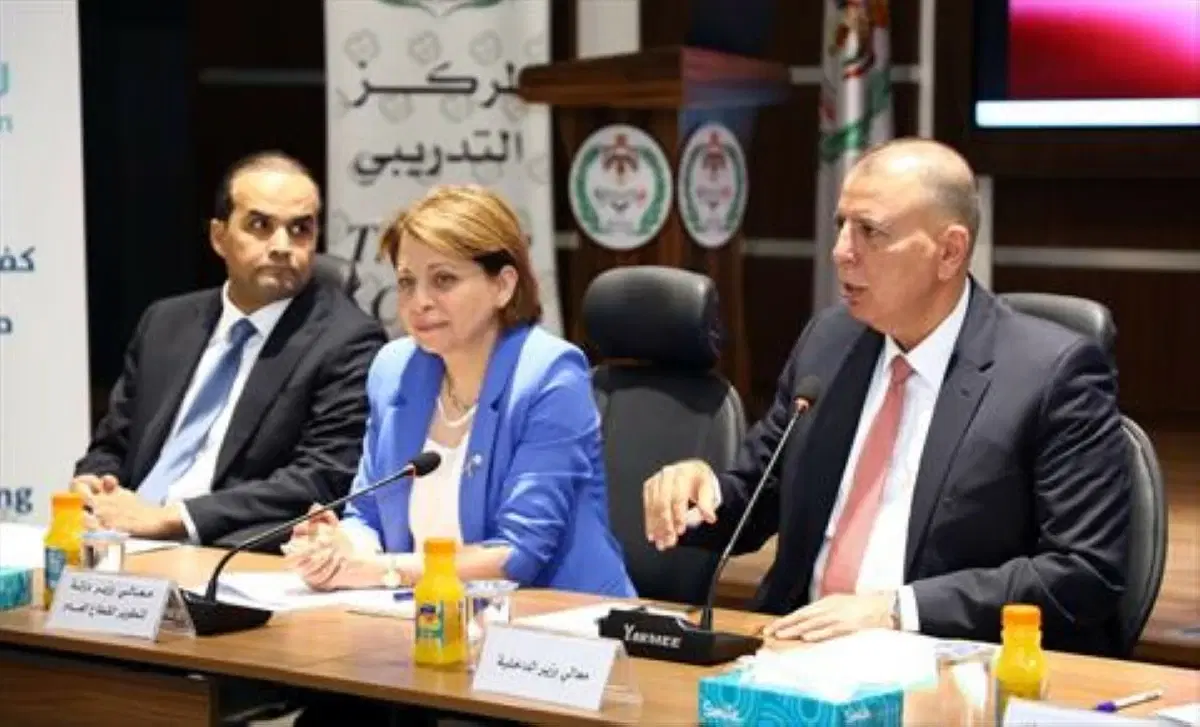
The Minister of Interior, Mazen Al-Farayah, and the Minister of State for Public Sector Development, Engineer Badriya Al-Balbisi, on Monday, at the Ministry of Interior, reviewed the assessment of the institutional culture in the ministry, as part of the second phase of the institutional culture assessment project in the public sector, in the presence of the Secretary-General of the Ministry, Dr. Khaled Abu Humur, and the directors of the directorates.
Al-Farayah stressed the importance of moving forward in modernizing the public sector with all its components, in accordance with the royal visions, alongside the political and economic modernization tracks.
He emphasized the need to root and develop the institutional culture in the public sector, considering it one of the main components of modernizing the public sector, given its active role in the continuity and sustainability of work according to unified and institutional procedures, away from personal tendencies of employees.
Al-Farayah expressed the ministry's keenness to implement the evaluation requirements objectively and effectively, to identify the strengths and weaknesses, determine the possible improvement and development opportunities, and develop appropriate plans to correct them, aiming to reach an advanced level of institutional culture.
For her part, Al-Balbisi said that the methodology of the institutional culture assessment project in the public sector aims to know the current situation and set improvement and development plans, which reflects on enhancing performance and providing the best services to the citizen, stressing that this methodology does not depend on the principle of ranking government departments in terms of the best.
She added that the institutional culture component is one of the components of the second executive program of the public sector modernization roadmap, aiming to change the daily behavior within public institutions, and translate the values and principles on which the departments are based, such as integrity and transparency, into practical practices that serve the citizen.
Al-Balbisi pointed out that one of the outputs of the second executive program for modernizing the public sector is that the government should be centered around the citizen, explaining that this output is not only related to the service provider but also includes those who set legislation and plans, so that all of them are in the service of the citizen and provide the best services to him.
She stressed the importance of the government being integrated, working as a single unit to provide services to citizens, service recipients, and investors, according to the outputs of the executive program for modernizing the public sector, pointing out the importance of translating this output as a value and culture in all public institutions, starting from the employee up to the leadership in any institution.
The Secretary-General of the Ministry of Interior, Dr. Khaled Abu Humur, reviewed the reality of the institutional culture in the ministry and its early keenness to establish the institutional culture, with multiple tools, especially through training plans.
For his part, the Secretary-General of the Public Service and Administration Authority, Yasser Al-Nsour, confirmed that the institutional culture seeks to bring about a change in the approach to providing services to citizens and enhance positive values in the behavior and performance of employees in the public sector.
He pointed out that the first phase of the institutional culture assessment project began last year, targeting 28 government departments, while the second phase targets 24 departments, and seeks to develop a model for assessing institutional culture, explaining that the evaluation process lasts for two days and includes field visits to service provision sites, and meetings with directors of directorates, heads of sections, and a sample of employees.
The project, implemented by the Public Service and Administration Authority in cooperation with the Unit for Managing and Implementing the Public Sector Modernization Program, targets, in its second phase, diagnosing the institutional culture and behavior in 24 government departments, in preparation for identifying the gaps between existing practices and the targeted culture, and developing developmental interventions that suit the needs of each institution.