Minister of Development Participates in the Fourth Session of the Live Independently Initiative for People with Disabilities in Oman
Amman5 min read
Share
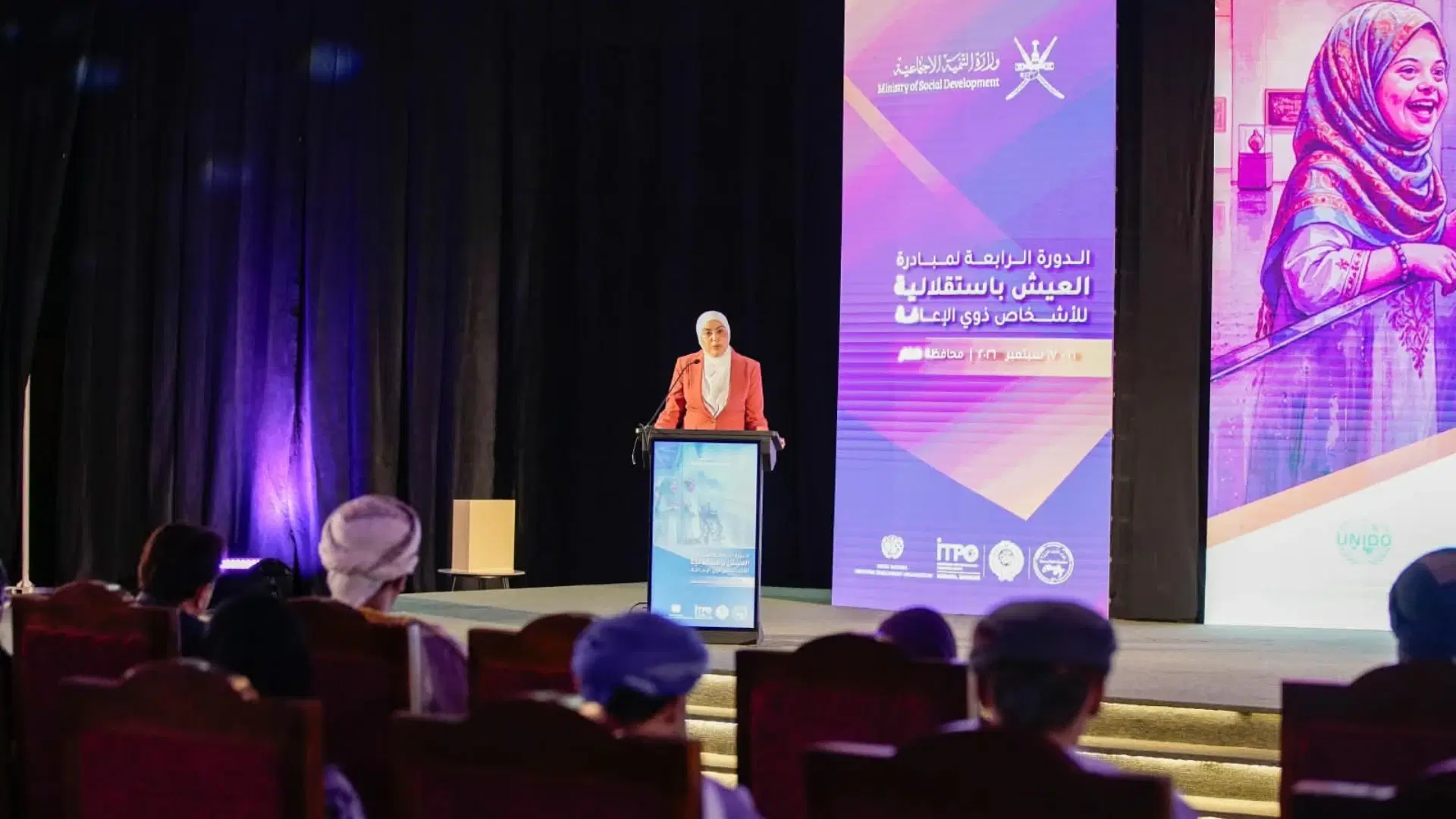
The Minister of Social Development, President of the 45th Session of the Council of Arab Ministers of Social Affairs, Wafa Bani Mustafa, participated today, Wednesday, in the Fourth Session of the "Live Independently for Persons with Disabilities" initiative, hosted by the Sultanate of Oman in Dhofar Governorate under the patronage of His Highness Marwan bin Turki bin Mahmoud Al Said, during the period from September 16-17, organized jointly by the League of Arab States and the Union of Arab Chambers, in partnership with the United Nations Industrial Development Organization "UNIDO".
In her speech during the opening of the conference, Bani Mustafa said that living independently is not limited to providing care and services, but means empowering the person with disabilities to make their decisions, practice their social, economic, cultural roles, and access education, work, services, technology, accessible environments, and participate on an equal footing with others.
She explained that the shared responsibility is to develop social policies based on rights, empowerment, participation, and removing barriers that limit the participation of persons with disabilities, noting that technology, innovation, artificial intelligence, and assistive technologies are gaining increasing importance in enhancing independence, inclusive digital access, and service development while ensuring data security and privacy protection.
She added that these transformations open new horizons for entrepreneurship, economic empowerment, skills development, vocational rehabilitation, and linking training to labor market needs, while involving persons with disabilities in designing solutions and policies that affect their lives.
She stressed that achieving real integration requires enhancing employment opportunities, creating inclusive and flexible work environments, developing partnerships between the public and private sectors, and strengthening social responsibility to support initiatives and projects related to persons with disabilities.
Bani Mustafa said that the convening of the Fourth Session of the "Live Independently for Persons with Disabilities" initiative is an affirmation of Jordan's commitment to continuing its efforts to promote the rights of persons with disabilities, empower them, and ensure their full participation in society, in line with the Second Arab Decade for Persons with Disabilities (2023-2032), which constitutes a strategic framework for enhancing protection, empowerment, and full participation, adding that this is in line with the interest of the Council of Arab Ministers of Social Affairs during Jordan's presidency of the 45th Session in enhancing the response to issues of violence, exploitation, and abuse that persons with disabilities may face.
She pointed out that Arab countries have achieved important steps in developing legislation and policies related to the rights of persons with disabilities, but the current challenge is to translate these rights into a tangible reality, reduce the gap between legislation and implementation, and enhance good governance practices.
She noted that this enhances the ability of policies and programs to keep pace with rapid changes and effectively respond to the needs of persons with disabilities, ensuring their full and active participation in all aspects of life on an equal footing, emphasizing the importance of joint Arab work in exchanging experiences and best practices, promoting cooperation between governments, the private sector, civil society institutions, universities, and international organizations.
She added that Jordan, based on the visions and directives of His Majesty King Abdullah II, believes that persons with disabilities are an essential part of the comprehensive development journey and that empowering them, consolidating their rights, and ensuring their active participation are a fundamental pillar for building a more inclusive and just society.
She continued that in this context, Jordan is consolidating the rights-based approach based on equality, non-discrimination, and inclusion, relying on the Law on the Rights of Persons with Disabilities and the National Strategy for Alternatives to Institutional Care, to support the transition from institutional care to inclusive family and community care.
She pointed to the expansion of early intervention services and day care, targeting an increase in the number of units and centers from 74 in 2026 to 128 by 2028, and enhancing family integration by increasing cases from 700 to 4,134 during the same period.
She highlighted the development of social services through digital transformation and the Jordanian Social Registry, improving the availability of buildings and public facilities, and enhancing inclusive education through the establishment of the Royal Academy for Inclusive Education, reflecting the Kingdom's commitment to translating rights into tangible reality that preserves dignity, enhances independence, and equal opportunities for persons with disabilities.
Bani Mustafa affirmed that Jordan, from its position as the Chair of the session, will continue to support more comprehensive and equitable Arab social policies and translate principles and commitments into practical programs and practices that enhance the independence, dignity, and participation of persons with disabilities.
She noted that the themes of the Fourth Session, which brings together policies, innovation, technology, artificial intelligence, economic empowerment, job integration, social responsibility, and vocational rehabilitation, reflect a trend towards building an integrated system that places independence, choice, and participation at the heart of policies and practices, expressing her hope that the works of the session will contribute to enhancing Arab cooperation and producing practical and sustainable recommendations that open wider horizons for persons with disabilities to live with dignity, independence, and active participation in the development journey.