Lebanese Prime Minister Calls for Activation of Framework Agreement with Israel During Rubio Meeting
Amman3 min read
Share
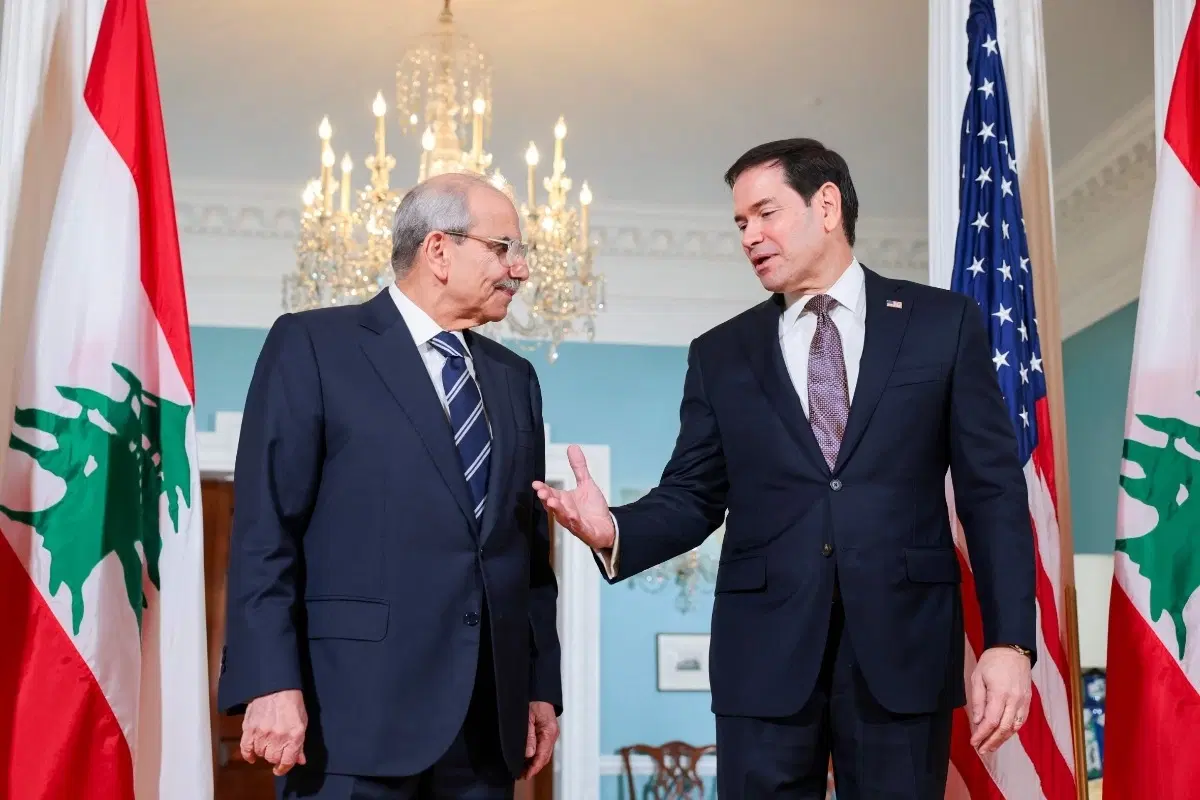
Lebanese Prime Minister Nawaf Salam, during his meeting with US Secretary of State Marco Rubio in Washington on Monday, called for the activation of the framework agreement concluded between the Lebanese and Israeli governments.
The two countries signed a framework agreement on June 26 after five rounds of direct negotiations under US sponsorship, which stipulated the disarmament of Hezbollah and the gradual withdrawal of the Israeli state from the territories it occupies in southern Lebanon, and the deployment of the Lebanese army starting from "pilot" areas.
In accordance with it, the army deployed in July in the western town of Zoutar after the withdrawal of Israeli forces from its outskirts, and reinforced its deployment in the towns of Sreifa and Frun. However, no new areas were agreed upon.
According to a statement issued by his office, Salam stressed the "necessity of moving to the stage of activating the tripartite framework and translating the principles of reciprocity and gradualism into practical steps and tangible results on the ground, leading to the restoration of Lebanon's full sovereignty, the achievement of the complete Israeli withdrawal from Lebanese territory, and the restriction of weapons in the hands of the state over its entire territory"
He emphasized the "importance of setting a clear timeline for implementing the commitments contained in the framework, ensuring the progress of the Israeli withdrawal and the expansion of state authority and the exclusivity of weapons, alongside the establishment of a reliable verification mechanism to monitor the implementation and ensure compliance with the commitments, in order to prevent the use of non-implementation as a pretext to obstruct the path"
Rubio said in a post on the X platform that Washington confirms its "strong support for Lebanon in the context of implementing the tripartite framework agreement, as it is the only path to achieving lasting peace with Israel"
He added that the United States supports "a sovereign, independent, and free Lebanon from the influence of Hezbollah and Iran"
The delay in implementing the agreement came at a time when a new round of negotiations between Lebanon and Israel was postponed to October after being scheduled for September.
The war in the Middle East, which began with a US-Israeli attack on Iran on February 28, extended to Lebanon in early March, with Hezbollah launching rockets at Israel in "revenge" for the death of Supreme Leader Ayatollah Ali Khamenei.
The Israeli state responded with a large-scale air campaign and a land invasion of areas in southern Lebanon.
The pace of violence decreased after the United States and Iran signed a memorandum of understanding in June and the Lebanese and Israeli governments signed the framework agreement. However, Israel continues to launch attacks on southern Lebanon and carries out bombings and demolitions in the towns it occupies.
Hezbollah rejected direct negotiations with Israel and the surrender of its weapons, a position reiterated by its Secretary-General Naim Qassem on Sunday.
Qassem said that "all the pressure on Lebanon today aims to achieve what Israel has failed to do for two years... They want the (Lebanese) army to disarm Hezbollah"
He affirmed his readiness for "dialogue" with the government regarding the weapons, adding, "But first, free the south and let the people return to their homes"
US Ambassador to Lebanon Michael Issa visited the western town of Zoutar in mid-September with the aim of "assessing the situation on the ground and directly observing the progress made and the challenges in the pilot areas", according to a statement by the embassy at the time.