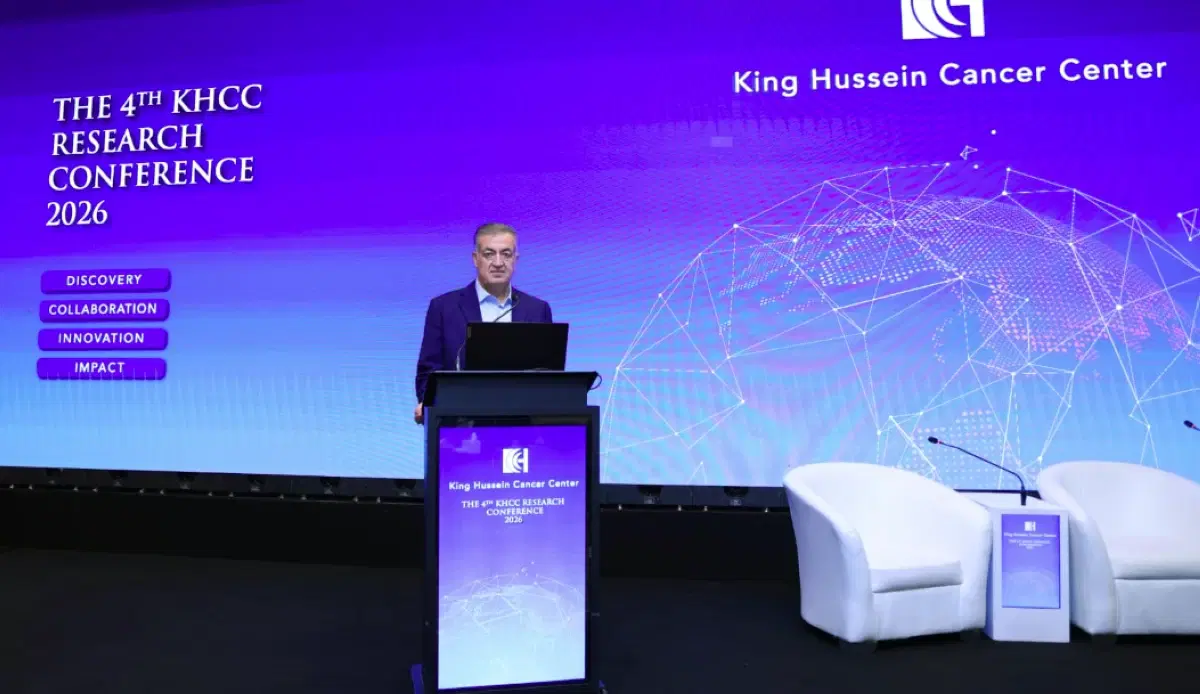
Mansour said that the value of scientific research is not measured only by the number of published papers, but by its ability to make a real difference in clinical practice and improve patients' chances of receiving the best possible treatments.
He emphasized that scientific research constitutes a fundamental pillar in developing cancer patient care, stressing that the center's ambition is not limited to keeping pace with scientific progress, but extends to contributing to its creation and transforming its outputs into more accurate and effective treatments.
He pointed out that Arab research cooperation is no longer an option but a necessity, saying, "Our patients in the region share similar genetic and environmental characteristics, and we cannot always rely on studies conducted on other societies to answer our questions."
He called for building Arab research networks in which expertise is integrated and data is exchanged, giving the region a stronger presence in the global production of medical knowledge.
He said, "In our battle against cancer, it is not enough to ask questions that have not yet found their answers, for every real progress in oncology begins with a question."
On the other hand, the participating papers covered a wide spectrum of specialized topics in the field of oncology, including research on T-cell therapy, early detection, breast, gastrointestinal, and pediatric tumors, bone marrow transplantation and cellular therapy, genomic applications and hereditary cancers, lung, soft tissue, eye, and brain tumors, pharmacy, surgery, supportive and palliative care, nursing, artificial intelligence, and cancer registries.
The conference witnessed a panel discussion titled "Enhancing Collaborative Research in Oncology in the Arab World: Challenges and Opportunities," in which leaders and experts from Jordan, Egypt, the UAE, the Sultanate of Oman, and Belgium participated. The oral research papers were distributed over nine scientific sessions, and a session was dedicated to electronic scientific posters displayed on 15 screens. Researchers with scientific publications were honored, according to the statement.
The statement indicated that Jordanian researchers from various departments of the center, in addition to distinguished researchers from Jordanian universities, participated in the conference, reflecting the strength of local scientific competencies and the center's commitment to research excellence.
It added that the program included an elite group of speakers and experts in scientific research from Jordan and 12 other countries: the United States, Canada, the United Kingdom, Belgium, Egypt, Lebanon, Palestine, the UAE, Saudi Arabia, Qatar, Tunisia, and the Sultanate of Oman.