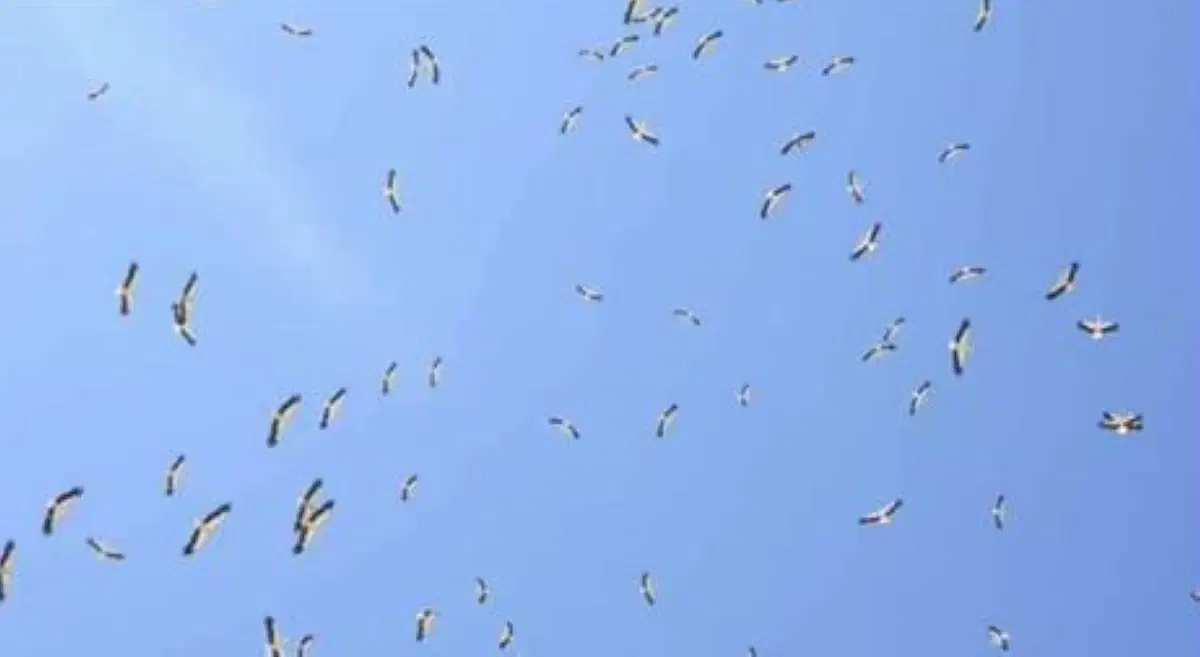
The world celebrates this day this year under a theme that highlights the role of individuals in monitoring birds, documenting sightings, and contributing to their protection. More than 440 bird species have been recorded in the Kingdom, reflecting its distinctive environmental diversity, ranging from wetlands, valleys, and highlands to desert areas. Natural sites, from the Yarmouk Forest Reserve in the north to the Aqaba Bird Observatory in the south, represent important stations for birds to rest, feed, and complete their journeys.
Mohammad Al-Aqra, a bird studies researcher at the Society, said that "the Jordan Valley route is considered one of the most important bird migration paths globally, which gives Jordan strategic importance in global migration movements and makes it a vital station for species that rely on its natural habitats for rest, refueling, and energy recovery." He pointed out that the Society is implementing a program to track the Steppe Eagle using tracking devices, which is considered one of the unique programs in the region, aimed at studying its migration patterns and identifying stopover and resting sites, as well as the areas where it spends the winter.
Al-Aqra explained that Jordan's importance is not limited to being a corridor for migratory birds, but also includes providing breeding and nesting sites. He cited the continued recording of Sooty Falcon nesting in its breeding areas and new records of Pharaoh Eagle-Owl nesting in the eastern desert, noting that these areas "may seem limited in resources, but they harbor species adapted to desert conditions and play an important role in the stability of ecosystems."
Al-Aqra warned of threats facing birds, most notably habitat loss and degradation, water scarcity resulting from drought and climate change, and illegal hunting, in addition to the risks of collision with power lines and electrocution, which particularly threaten soaring birds and large species. He indicated that the Society continues its monitoring programs and scientific studies to identify the most vulnerable species and sites, and to enhance habitat protection within the network of reserves.
For his part, the Director of the Aqaba Bird Observatory, Firas Rahahleh, said that the Society receives frequent calls from citizens reporting birds in need of help, which "reflects a growing community awareness of the importance of protecting birds and embodies the concept of citizen science." He added that protecting birds "is not limited to the efforts of researchers and specialists, but sometimes begins with a photo taken by a citizen or a sighting documented by an amateur," emphasizing that a simple observation from a citizen could turn into scientific information that contributes to protecting a life journey that crosses continents.
Rahahleh explained that the Aqaba Bird Observatory, managed in partnership between the Society and the Aqaba Special Economic Zone Authority, offers a Jordanian model for nature-based solutions by reusing treated water to provide wetland habitats that support birds and biodiversity and contribute to climate change adaptation in light of water scarcity.
At the Azraq Wetland Reserve, its director, Hazem Al-Huraisha, said that the reserve records the arrival of a number of migratory bird species that head to Jordan during their epic journey, including large raptors such as the Marsh Harrier, Black-winged Kite, Steppe Buzzard, Osprey, and Honey Buzzard, as well as songbirds and various types of ducks.
The Royal Society for the Conservation of Nature, through its programs in protection, awareness, environmental education, and ecotourism, emphasizes that bird conservation is linked to protecting habitats and migration routes and reducing the risks that threaten them, which enhances ecological balance and contributes to the sustainability of Jordan's natural wealth for future generations.