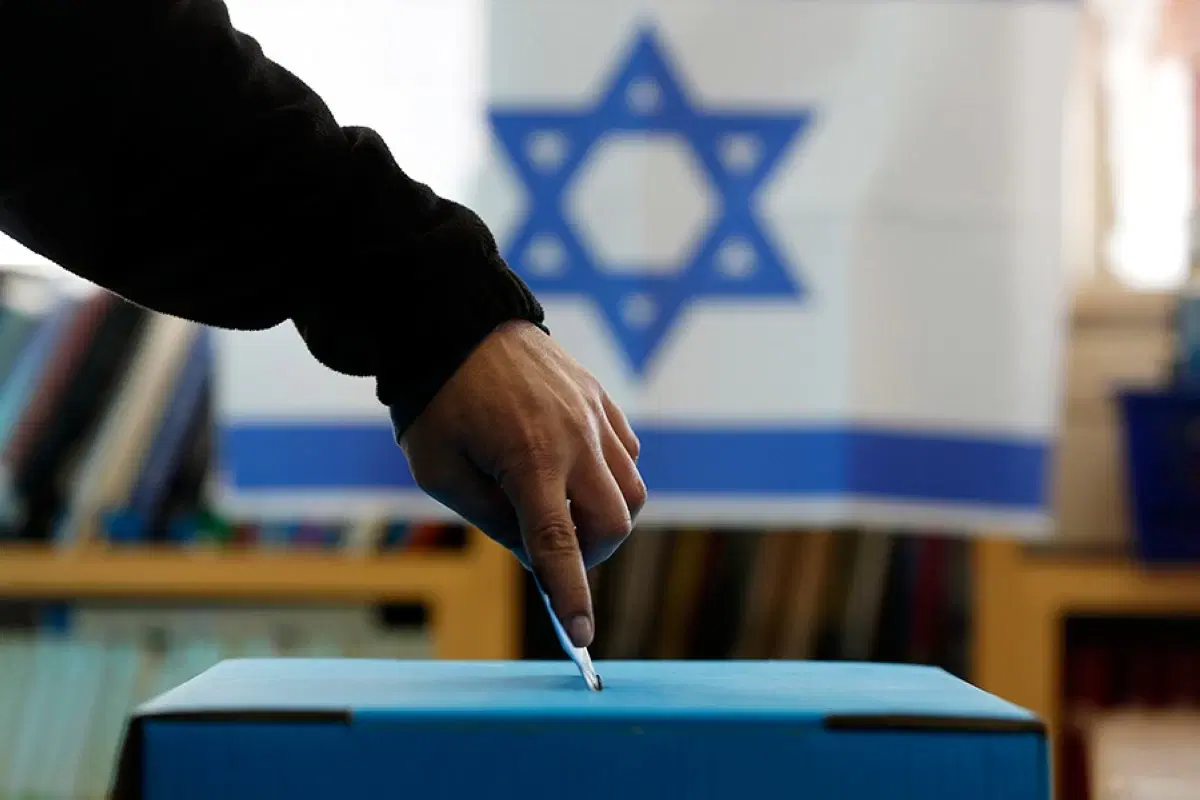
An Israeli public opinion poll showed that the camp opposing Prime Minister Benjamin Netanyahu, including the two Arab lists "Hadash-Ta'al" and "Ra'am", enjoys the support of 50% of the public, compared to 35% for Netanyahu's camp, which includes Ofer Winter's party "Amkha Yisrael".
According to the poll presented by Israel's Channel 12 on Friday evening, these results came in contrast to the trend of polls published during the week, which indicated a narrowing gap between the two camps. The poll showed that 58% of respondents prefer a figure other than Netanyahu to head the government, compared to 34% who support the latter's continuation in office.
Despite this, 11% of respondents remain undecided about which party to vote for, while only 5.4% of them have not made up their minds between the two camps or do not know who they will vote for, with the rest distributed among parties of the same camp. It is estimated that the votes of this group equate to about six seats, which could be decisive in determining the results of the electoral competition.
Three years after the October 7, 2023 attack, the poll addressed the extent to which the revealed failures associated with the attack affected voters' choices. Five percent of respondents said they had intended to vote for Netanyahu's camp, but decided to switch to the opposing camp, compared to 2% who reported that they would move from the Zionist opposition parties' camp to Netanyahu's camp, while 70% affirmed they will vote according to their previous decisions.
Regarding the extent to which the government has addressed the failures preceding the October 7 attack, 67% of participants believed it has not addressed those failures, compared to only 14% who believed it succeeded in doing so. The poll also showed that 48% trust the ability of a government headed by "Yashar" party leader Gadi Eisenkot to fix shortcomings and failures, compared to 30% who trust a government led by Netanyahu to achieve this.
These results reveal a fundamental paradox in the Israeli political landscape; the figures indicate a widespread desire for leadership change, given that half of the respondents support the camp opposing Netanyahu, 58% prefer another prime minister, and a clear majority believes the government has not addressed the failures of October 7. However, this desire does not necessarily mean there is a consensus on changing policies or reviewing the state's strategic path.
Political competition appears largely confined to the question of who will succeed Netanyahu, rather than moving to a deeper debate about Israel's future and its political and security directions, particularly regarding the Palestinian issue.
The dilemma lies in the fact that the opposition seeking to oust Netanyahu does not, according to this framing, offer a clear strategic alternative that addresses the roots of the conflict or presents a different political path, while the right continues to defend its approach based on continued control and settlement expansion, without facing sufficient internal pressure to prompt a review of its choices.
Thus, elections may turn into a mechanism for replacing leaderships and redistributing power among parties, without bringing about a fundamental change in the policies governing relations with the Palestinians, or in the security and political vision adopted by successive Israeli governments. Change in the identity of the prime minister does not necessarily mean a change in the nature of the political system or its priorities, as long as fundamental issues remain outside the scope of actual competition between the two camps.
The danger of this path increases in light of warnings regarding the repercussions of Israeli policies on the state's regional and international standing, its growing isolation, and the deepening of internal divisions regarding the goals of wars, the meaning of security, and the limits of power. The continuation of confrontations, in the absence of a clear political horizon, may deepen contradictions within Israeli society and increase the cost of military, political, and economic attrition.
In light of this, upcoming elections, regardless of their results, do not seem sufficient on their own to produce a real transformation. The electoral battle may end with replacing Netanyahu or renewing confidence in him, but it does not guarantee changing the political system that produced the current approach, nor does it necessarily impose a review of policies toward Palestinians and the region.
The six seats representing the votes of undecideds may be decisive in determining the identity of the winner, but they will not, in themselves, determine the nature of the path Israel will take in the next phase.
The closest scenario, given current data, remains the continuation of polarization between a government clinging to its approach and an opposition that has failed to formulate an integrated alternative, and a society divided between the desire for change and the fear of its repercussions, and between clinging to existing policies despite their increasing cost. In the long run, possibilities remain open between continued internal erosion and the exacerbation of contradictions, or a deeper transformation forced by a major crisis that exposes the limits of the current approach and prompts a reconsideration of the political and security axioms governing the state.
Ultimately, the most important question remains: Can Israel turn the elections into an opportunity for a genuine review of its policies and choices, or will it settle for reproducing the same scene, re-electing itself once again with different faces?