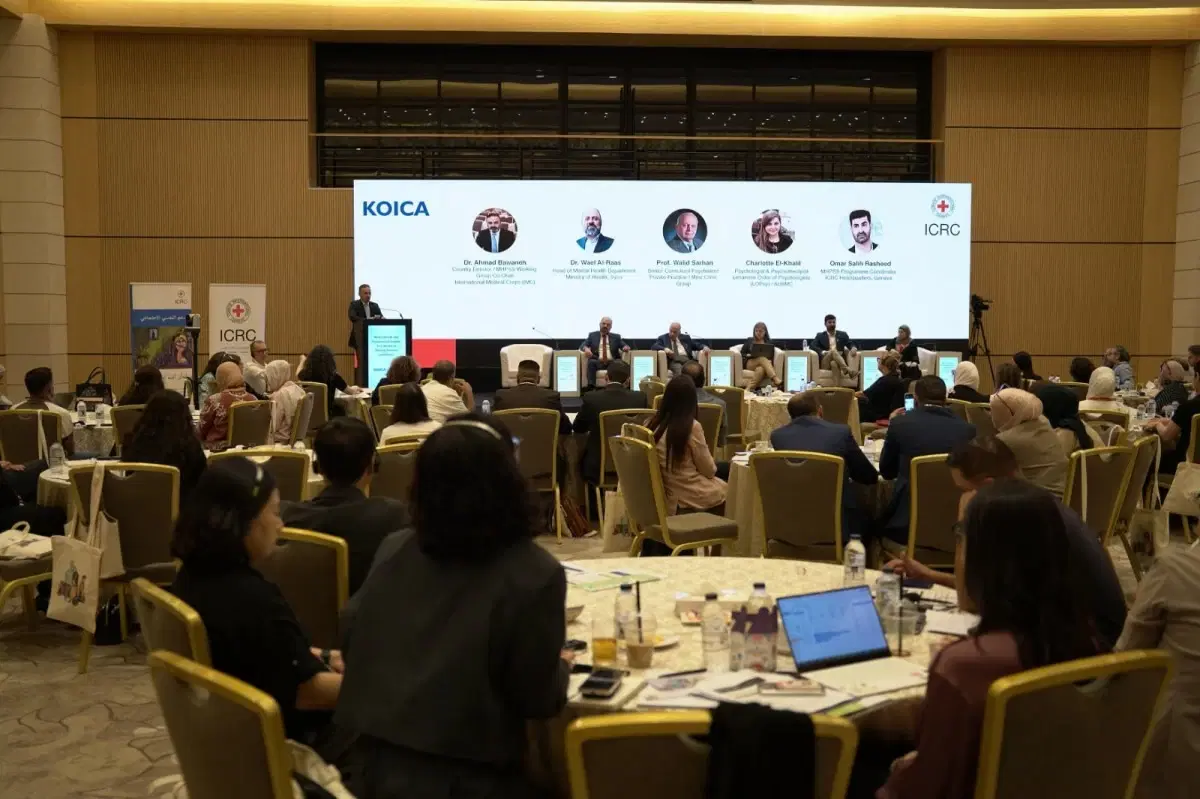
International Partnership to Enhance Mental Health and Psychosocial Support for Families of the Missing
With the participation of government agencies, experts, and academics
Ammar Al-Saquor3 min read
Share
The International Committee of the Red Cross (ICRC) mission in Amman held a two-day conference titled "Mental Health and Psychosocial Support for Families of the Missing: Bridging the Gap Between Theory, Research, and Practice", at the Landmark Hotel on September 15 and 16, 2026, supported by the Korea International Cooperation Agency (KOICA).
The conference brought together representatives from government agencies, mental health experts, academics and researchers, international and local organizations, as well as families of missing persons from various parts of the region and beyond.
Organized under the partnership within the ICRC and KOICA program on conflicts and vulnerability, the conference highlighted the shared commitment to providing mental health services and psychosocial support to families living in uncertainty about the fate and whereabouts of their relatives, and to alleviating their prolonged suffering.
The conference was opened with a keynote speech by Dr. Pauline Boss, a renowned family therapist and the originator of the concept of "ambiguous loss", followed by a series of presentations and panel discussions featuring experts, addressing the importance of mental health and psychosocial support for families, and its role in local policies, academic education, and research.
Dedicated sessions also covered the experiences of women and children affected by disappearances, as well as the experience of families during the search process, drawing on experiences from other countries. Several comparative studies were also presented, including studies on "ambiguous loss" among immigrant groups affected by disappearances and family separation.
The experiences lived by families were at the heart of many discussions, allowing for the voices of families to be heard and their realities and challenges to be expressed.
Over two days, the conference served as an integrated platform for learning and knowledge exchange, combining humanitarian responses with theoretical frameworks. An important part of the conference was dedicated to formulating recommendations on ways forward, based on the opinions and contributions of all participating experts.
Yann Freddy, Head of the ICRC Mission in Jordan, said:
"Without answers, without farewells, and without a place to mourn, millions of families in this region are suspended between loss and hope. International humanitarian law recognizes this profound pain, but we must ask ourselves how we prepare future generations of professionals to provide ongoing support that preserves dignity."
Jihyun Jun, Deputy Director of the KOICA Office in Jordan, emphasized: "This conference goes beyond merely reviewing project results; it constitutes a meaningful feedback mechanism, systematically linking field experiences with academic theory"
She added: "Through our strategic partnership with the ICRC, KOICA has supported families of missing persons at legal, administrative, psychological, social, and economic levels"
About the ICRC and KOICA Partnership
Within the framework of the Conflicts and Fragility Program (CFP), the ICRC and KOICA collaborate to provide comprehensive humanitarian aid, including the search for missing persons, and support for conflict-affected groups and vulnerable communities in Syria, Lebanon, and Jordan.