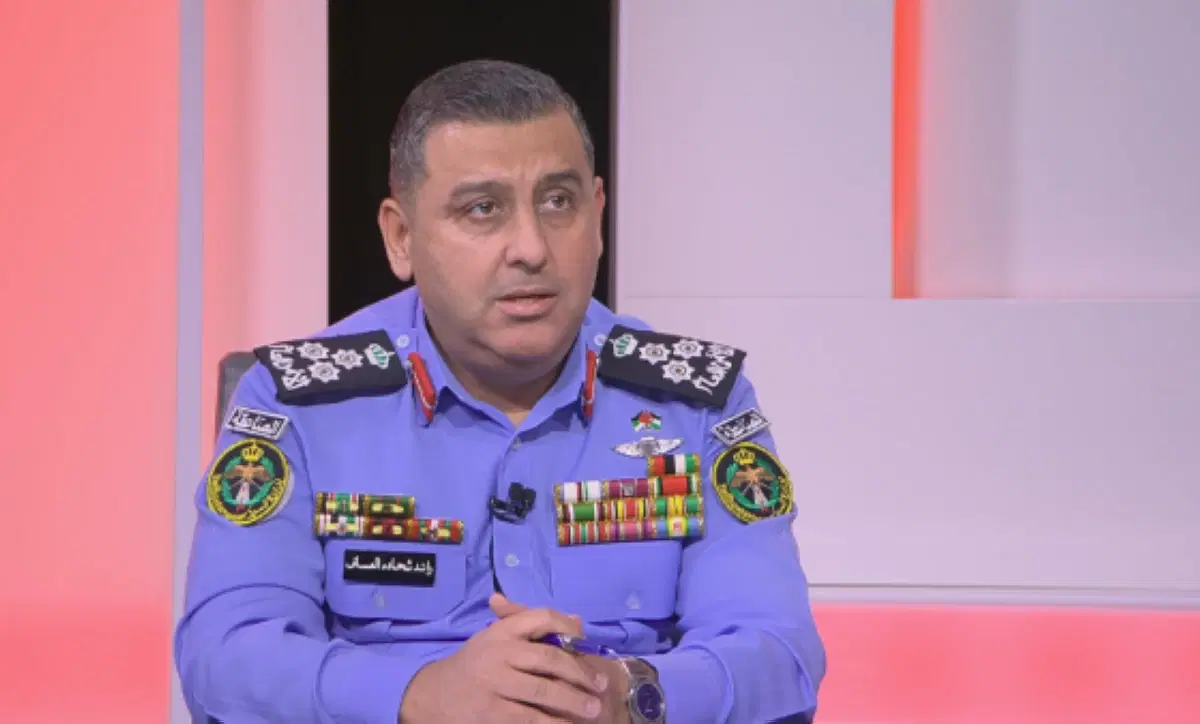
During his appearance on the "Sawt Al-Mamlaka" program, Al-Assaf explained that traffic congestion is linked to several reasons, confirming that it is a phenomenon witnessed by all countries of the world, especially during morning and evening peak periods.
Daily vehicle movement includes the movement of public transport vehicles, ride-hailing applications, and delivery vehicles, in addition to the movement of citizens to and from their workplaces, shopping, and running various errands, which leads to traffic density in the capital's streets.
In facing this density, the Public Security Directorate has worked to develop traffic management and provide the Traffic Department and operations rooms with modern systems and technologies, under the directives of His Royal Highness the Crown Prince and the close follow-up of the Director of Public Security, with the aim of assisting traffic officers and field commanders in making decisions, directing traffic, preventing and mitigating traffic obstructions, and maintaining the flow of movement, especially during peak periods.
2,500 cameras to monitor traffic movement
According to Al-Assaf, the main operations room has been developed with more than one traffic system, primarily "CCTV" cameras for television surveillance, which allow officers and personnel in the operations room to monitor main and secondary streets.
He indicated that the system includes about 2,500 cameras monitoring traffic movement, in addition to about 300 cameras belonging to the Greater Amman Municipality to monitor movement, emphasizing that these are television surveillance cameras and not traffic violation cameras.
"Modern "Video Wall" screens in the operations room provide a comprehensive view of traffic movement and obstructions, according to Al-Assaf, who explained that the screen helps in determining the impact of secondary roads on main ones and the end points of each, while feedback reaches traffic officers via wireless communication devices, allowing them to know what is happening in their traffic surroundings.
He pointed to the use of artificial intelligence cameras and a traffic management system that includes about 130 "ANPR" cameras belonging to the Public Security Directorate, which has allowed for the prediction of traffic movement and the provision of readings and results based on the inputs provided to it.
The monitoring system also includes "Heat Map" screens for accidents and others for violations, in addition to the use of "drones" in managing traffic movement and enforcing violations, due to the wider and more comprehensive view they provide of the movement.
4 smart traffic lights
In partnership with the Greater Amman Municipality, 4 smart traffic lights have recently been installed in locations previously occupied by traffic officers, especially where secondary streets merge with main ones.
These signals allow for giving preference and priority to the main arterial road when a secondary street merges into it, which maintains the flow of movement. This also allowed for the redistribution of the human force that was present in those locations to other sites to expand the range of vision and deployment.
The partnership between the Greater Amman Municipality and the Traffic Department includes controlling traffic lights, with sensors that allow for giving preference to traffic density at the expense of other lanes, which contributed to the transition to managing traffic movement with electronic tools that reduce human intervention.
Technology has succeeded in mitigating crises
Regarding the results of these measures, Al-Assaf confirmed that they have succeeded in mitigating traffic crises, noting that the past two months witnessed the presence of large numbers of expatriates, school holidays, in addition to several occasions including university graduations, social gatherings, and an increase in the number of weddings during the summer, which led to an increase in the movement of citizens.
With the start of the academic year, traffic density has returned to its morning and evening peak.
Electronic vouchers reduce service time from 10 minutes to two minutes
In another context, the Traffic Department has moved to using electronic vouchers, as traffic officers carry out their procedures in the field electronically, including electronic impoundment when necessary, in addition to checking on citizens through the "Sanad" application available on "PDA" devices, and checking for any existing violations they may have.
One of the most prominent benefits of electronic vouchers for the Traffic Department is reducing the service delivery time from 10 minutes to two minutes.
Winter campaign turns into a national campaign
Regarding preparations for the winter season, the directives of the Director of Public Security were to study the lessons learned from last year's winter campaign and to come up with a campaign this year that avoids negatives, if any, and has a different significance.
The Traffic Department is currently working on studying the campaign, with the intention that it will be, this year, a national campaign that includes all departments, government cars, and citizens' vehicles.
The campaign aims to deliver traffic awareness to everyone regarding vehicle maintenance, which contributes to reducing accidents caused by vehicles.