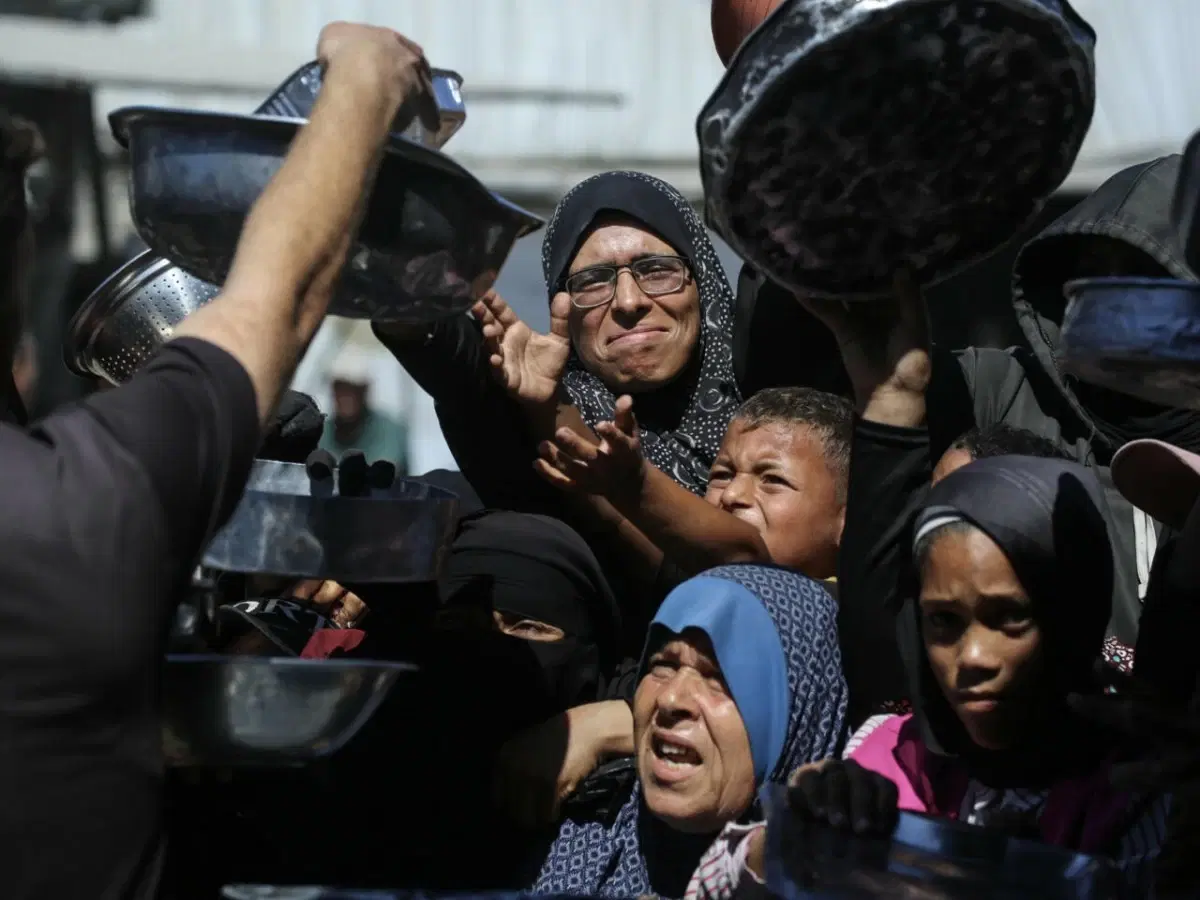
Nihaya al-Masri spends up to 6 exhausting hours daily amid crowding and pushing in front of a charity kitchen in the Gaza Strip, hoping to get some food for her family, as tragic humanitarian conditions persist despite a year passing since the ceasefire announcement.
Despite the agreement that was supposed to allow the flow of food aid into the devastated and besieged enclave, hunger remains widespread among Gaza's population.
The 35-year-old woman said that were it not for the kitchen run by humanitarian organizations, she and her eight children would have "absolutely nothing."
Hoping to secure a meal, al-Masri leaves her tent early every morning in the southern Gaza area of Khan Younis, returning only in the afternoon carrying 4 bowls of rice, lentils, and a little chicken—the only meal her family shares after long hours of waiting.
Among the ten family members is Nihaya's husband, who was injured in his legs by an airstrike, meaning "he cannot go and crowd with others" and wait to get food.
Al-Masri says the family must consume the small amount of flour they own with extreme care.
In August 2025, the Integrated Food Security Phase Classification (IPC), a UN-backed body, declared a state of famine in Gaza.
By December, the United Nations lifted this classification, explaining that the ceasefire allowed sufficient supplies to enter for two months to ease the crisis.
The Coordinator of Government Activities in the Territories (Cogat), the Israeli defense ministry agency responsible for civil affairs in the occupied Palestinian territories, said the humanitarian situation in Gaza is stable.
However, Sean Hughes from the UN World Food Programme warns that "the food security situation remains extremely serious."
He added that the latest available data, dating back to July, show that "1.4 million people out of about 2.1 million are experiencing acute food insecurity," including 200,000 people who "are just one step away from famine."
Despite some food items entering the enclave, the lack of sufficient dietary diversity continues to pose a health threat.
Hughes explains that "dietary diversity is one of the main problems related to food security in Gaza."
He added, "People cannot live on dry food items, wheat flour, and bread alone. Children, pregnant women, and breastfeeding mothers in particular need the micronutrients found in protein-rich foods, fresh vegetables, and fresh fruit."
Al-Masri says her children, aged between 3 and 14, "dream of eating fruit," but the family does not have enough money to buy it.
She adds that one of her sons suffered from malnutrition during the famine in 2025, "but his condition is gradually improving."
Malnutrition is caused not only by a lack of food, but also by a lack of essential nutrients, as it weakens children's immune systems, makes them more vulnerable to disease, and affects their development.
Hughes says, "Children suffering from repeated bouts of acute malnutrition is something a person never fully recovers from," adding that the mental and physical damage caused by it "persist into later stages of life."
At Nasser Hospital in Khan Younis, the head of the malnutrition unit, Israa al-Najjar, says she "has noticed an increase in syndromes and medical conditions" related to malnutrition affecting the immune system.
Doctors of the World reported that a study it conducted revealed that 93 percent of pregnant or breastfeeding women suffer from symptoms of anemia closely linked to malnutrition.
The study concluded that only 17 percent of women have a diet diverse enough to meet their nutritional needs.
Amidst all this, al-Masri continues to frequent the charity kitchen despite suffering from asthma that exhausts her severely.
However, her family is also working in an effort to improve their poor living conditions, as her children spend their days collecting "pieces of nylon, cardboard, and pieces of sponge" in an attempt to shore up their dilapidated tent.
She considers forcing her children to do this "a shameful matter," adding, "I swear to God, this is not normal."