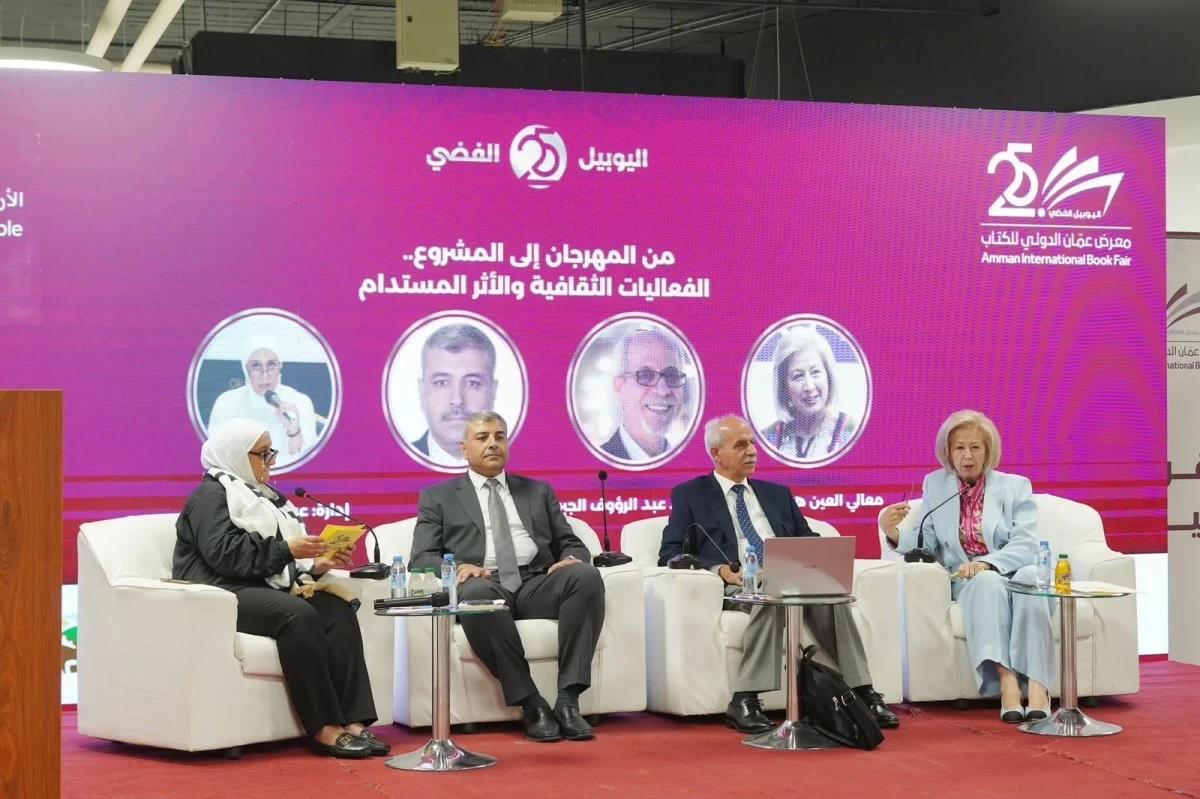
The seminar "From Festival to Project: Cultural Events and Sustainable Impact" held as part of the Amman International Book Fair on Thursday evening called for transforming festivals from transient events into sustainable projects with tangible impact, amid demands from attendees to translate the discussion into practical measures by clarifying the concept of the "surface structure" of culture, defending Arabic in schools and universities against the dominance of English, and establishing a "Supreme Council for Culture" to ensure vision, follow-up, and accountability.
The seminar, which was held as part of the cultural program of the fair organized by the Jordanian Publishers' Union, was attended by Eye Haifa Al-Najjar, Professor of Arabic Language, Literature, and Academic Critic Dr. Khaled Abdel Raouf Al-Jibr, and Cultural Affairs Researcher Samer Khair.
Eye Al-Najjar said: "The Amman International Book Fair reflects the cultural level and knowledge production of the nation, which requires moving beyond the superficial interest in buying books and publishing houses to a transparent discussion on whether it is just a market or an incubator for ideas, pointing out that sustainable work: "begins on the "next day" of the fair through launching school and university reading programs, translation grants, support for emerging publishers, and building knowledge alliances between participating houses"
Eye Al-Najjar called for: "Integrating cultural events into the creative and digital economy and artificial intelligence technologies and stopping their repetition without impact", stressing the: "importance of partnership between the ministries of culture, education, digital economy, and youth, involving young people, protecting Arabic, and increasing Arabic content on the Internet, which does not exceed 3%, to make culture the ethical compass of development"
Professor of Arabic Language, Literature, and Academic Critic Dr. Al-Jibr pointed to the: "intellectual and planning dimension of the cultural project", explaining that: "the shift towards neoliberalism has entrenched individualism, while cultural projects require temporal planning and network integration like development plans, and culture and arts as (surface structures) in the compositional sense do not bring about change with top-down decisions unless they go through a planned cultural act that affects deep structures, and the term (surface structure) was used in the structural linguistic sense opposite to deep and does not mean shallowness"
Dr. Al-Jibr warned of: "individual narcissism hindering collective work", calling for: "prevailing the conscious critical mentality instead of (criticism) and the self-initiative of institutions and universities to participate in cultural projects, including the fair, instead of waiting for invitations, and shifting from consumption and numerical abundance to (abundance) by generating sequential projects from one cultural event, such as turning stories into blogs and dramas, while adhering to (the culture of the phylum) based on cumulative planting over generations"
Writer Khair addressed: "the quality of cultural planning and its four roles: mobilization, support for intellectuals, entertainment, and development", criticizing: "random support policies that mix the wheat with the chaff and sometimes turn into favoritism, calling for turning the intellectual into a real partner according to quality criteria"
Khair emphasized that: "strategic cultural development targets the development of civil values as respect for others and the public space:", proposing to turn the (Ministry of Culture) into a (Ministry of Cultural Development) with the necessity of establishing statistical indicators to measure the impact of events before and after them"