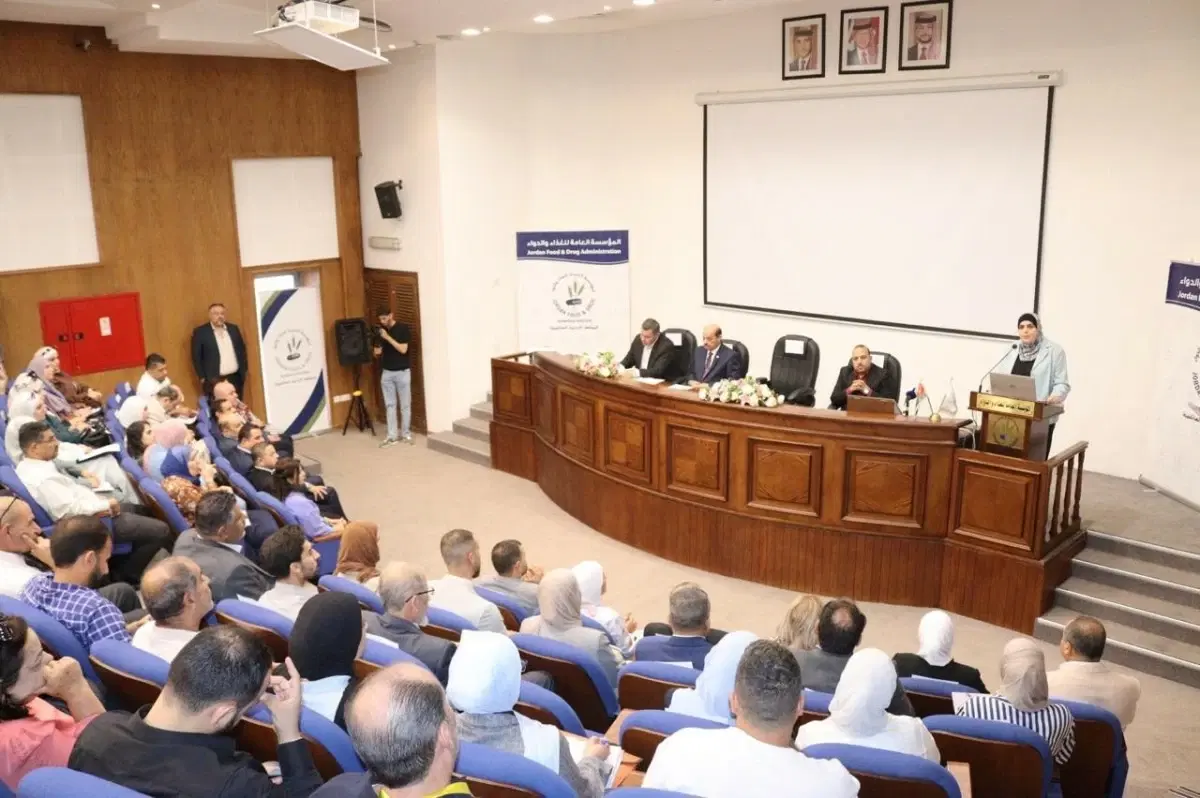
This came during the launch of a workshop on the requirements for school cafeterias and production kitchens, and the opening of the accompanying exhibition for the workshop, which includes a group of nationally produced healthy products, in support of the national product.
The workshop was attended by the Director of General Education in the Ministry of Education and Human Resource Development, Dr. Ahmed Al-Masaafah, the Director of Primary Health Care in the Ministry of Health, Dr. Muhammad Bani Nasr, the Chairman of the Higher Committee for the 'My Health in My School' initiative and the representative of the Health and Food Committee in the House of Representatives, Dr. Shaher Al-Shtawi, along with a number of school representatives.
Abeidat added that regulatory tours and field survey studies on school cafeterias are continuing intensively, due to the vital role of the school cafeteria in promoting healthy eating behaviors and habits, in addition to providing food that meets safety and quality requirements, emphasizing the importance of unifying efforts and integrating roles among various concerned parties to ensure the implementation of related health and technical requirements.
For his part, Dr. Al-Shtawi said that the school represents the environment in which healthy, behavioral, and dietary habits are formed, where the 'My Health in My School' initiative came from a national vision that believes in this, adding that the health requirements for school cafeterias are a unified and integrated national effort, as everyone has the responsibility to ensure that the food that reaches the hands of students in school is safe, sound, and healthy.
For his part, Dr. Bani Nasr said that the school cafeteria is a means of changing culture and encouraging healthy dietary behavior, pointing to the launch of the global school health survey in Jordan, which was conducted in 57 schools, which showed that 32.9% of students in this category suffer from overweight or obesity, where the percentage of students suffering from obesity reached 12.1%, and the results also showed that only 12% of students in this age group practice physical activity for more than 60 minutes a day during weekdays, where the Ministry is taking a set of tangible steps, aiming to improve the health and food environment in schools.
The workshop included a series of lectures supervised by the institution's delegate to the School Cafeterias Committee, Dr. Rawda Abdullah, including a lecture on production kitchens and the mechanisms for obtaining their licenses presented by Engineer Iman Khalifat, a lecture on the health requirements for school cafeterias presented by the Head of the School Health Department at the Capital Health Directorate, Dr. Muhammad Al-Mahases, and a lecture on 'Their Food, Their Safety: Celiac Disease and the School Cafeteria' presented by the President of the Celiac Disease Patients Care Charitable Association, Abeda Al-Qaisi.
It also included a lecture on the engineering of food choices in school cafeterias presented by the Head of the Factories Division at the Institution, Engineer Ola Hanoon, and a lecture on the prevention of food poisoning by the Head of the Food Safety Epidemiology Division, Dr. Hala Al-Khazali.
The workshop concluded with a discussion session and listening to the observations of school representatives and presenting the recommendations and future steps within the work to develop the food safety system in school cafeterias.