Extension of the state of emergency in occupation prisons exacerbates the suffering of prisoners
Amman5 min read
Share
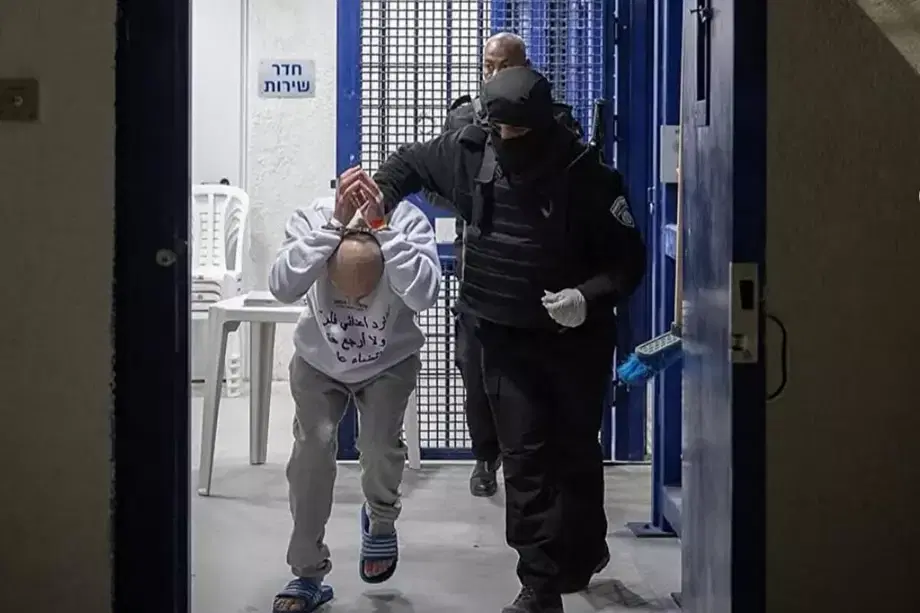
The Israeli government, via a telephone referendum, has extended the state of emergency in prisons and detention centers for an additional two months, until December 15, in a move that allows the Prison Service to continue holding detainees in exceptional conditions that exceed legal standards regarding minimum living space and detention conditions.
The decision, proposed by the extremist Israeli Minister of National Security Itamar Ben-Gvir, comes in light of unprecedented overcrowding in prisons and the increasing number of Palestinian detainees since the start of the war on October 7, 2023, amid human rights warnings about the continued deprivation of prisoners of basic life necessities, including sufficient food and drink, beds, blankets, bathing, and changing clothes for long periods.
According to data from the Israeli Prison Service attached to the draft resolution, 13,458 prisoners, constituting about 59% of the total number of prisoners, are held in living conditions that do not meet the requirements set by the Israeli Supreme Court.
The director of the Palestine Center for Prisoners' Studies, Dr. Riyad Al-Ashqar, believes that Ben-Gvir is escalating his measures against Palestinian prisoners as the Knesset elections approach, exploiting the state of emergency declared after the October 7 attack to implement punitive policies that go beyond previously established procedures.
Al-Ashqar warns that prisoners are living in the worst living and legal conditions since 1967, noting that the Israeli government seeks to turn the exceptional measures imposed on them after the war on Gaza into a permanent policy and a fixed legal framework, after they were initially presented as temporary measures imposed by the state of emergency.
In a related context, Professor Barak Medina, in the newspaper "Haaretz," quoted Judge Daphne Barak-Erez criticizing the lack of information regarding the conditions of prisoners and questioning the reasons for not providing the necessary data, even though disclosing it was previously standard practice.
Medina pointed out that the evidence presented to the Supreme Court, including cases of malnutrition, medical emergencies, and about a quarter of prisoners contracting scabies, did not lead to a tangible change in the course of dealing with the issue.
Testimonies regarding detention conditions include a lack of drinking and bathing water and cleaning supplies, insufficient food and clothing, as well as detainees being forced to sleep without beds or blankets, amid continued overcrowding and the approach of winter.
Official figures show the scale of the crisis inside Israeli prisons; as of October 5, the number of prisoners and detainees in Prison Service facilities reached 22,782 people, against an official capacity not exceeding 16,300 places, an increase of 6,482 prisoners over the approved ceiling.
This comes despite the recently announced increase in capacity from 14,500 to 16,300 places, in an attempt to align it with the actual numbers of detainees.
According to a document issued by the Planning Department of the Prison Service, the occupancy rate in the entire detention system exceeds 100%, while authorities are forced to provide between 4,200 and 4,300 portable beds and mattresses every night to deal with overcrowding inside the cells.
Conditions appear more acute among detainees classified as security prisoners; their number reached 9,309, of whom 8,420—or 90.5%—are held in conditions that do not meet the space requirements approved by the Israeli Supreme Court.
Since the outbreak of the war on October 7, 2023, the total number of prisoners and detainees has increased by 6,429, while the number of security detainees has increased from 5,238 to 9,309, an increase of 4,071 detainees.
Israeli authorities declared a state of emergency in prisons for the first time on October 22, 2023, following the wave of mass arrests that followed the outbreak of the war, before continuing to extend it successively.
The arrangements associated with this state allow for bypassing some requirements related to minimum living space, the provision of beds, and detention conditions for certain categories of prisoners, which raises questions about the limits of exceptional powers and the extent of their compliance with legal obligations.
The Israeli Prison Service acknowledges that the overcrowding crisis predated the war, but it has worsened significantly as a result of military operations in the Gaza Strip and the West Bank, and the accompanying large-scale arrests, which led to an increase in the number of security detainees by more than 77% compared to pre-war levels.
The crisis, according to the service's data, is not limited to a shortage of detention places, but extends to a shortage of human resources.
While the official staffing for prison guards is 13,084, the number of those actually appointed does not exceed 11,000, a difference of nearly 2,000 employees.
First Sergeant Moran Sharvit, from the Prison Service, stated that 1,224 individuals have been recruited so far, while 2,400 candidates are still in various stages of the recruitment process, noting that the length of the recruitment, training, and qualification period represents a challenge to filling the staff shortage.
Conversely, the government is facing continuous judicial criticism regarding detention conditions, while the Supreme Court itself faces criticism from human rights organizations that accuse it of being slow to rule on petitions related to prisoners, especially those related to the conditions of new Palestinian detainees and the disclosure of their identities.
The extension of the state of emergency raises concerns about entrenching a long-term exceptional situation that allows for bypassing legal guarantees related to detention conditions, which weakens the principle of the rule of law and limits the supposed judicial protection for prisoners.
On the humanitarian level, human rights organizations warn that the impact of overcrowding is not limited to reducing the space available for each detainee, but also leads to the deterioration of hygiene and sanitation, high temperatures and suffocation inside cells, a lack of privacy, as well as poor bathing conditions, in some cases to the point where prisoners are forced to use sanitary facilities in inhumane conditions.