The association added that the law was drafted in a way that practically targets Palestinians with the punishment, while Jews are exempted, noting that the petition it filed against the law is still under consideration by the Israeli Supreme Court since the night of its approval, and that it will continue to work for its abolition.
The director general of the association, Noa Sattath, said that the escalation of calls for the implementation of the death penalty reveals the extent of the danger warned by human rights organizations, considering that the desire for revenge should not be turned into a punitive policy, especially when it comes to a punishment that cannot be reversed. She added that the law grants the state a highly dangerous authority to take a human life, while at the same time perpetuating a discriminatory punitive system that affects fundamental rights.
Five human rights organizations, including Adalah, filed an urgent petition to the Israeli Supreme Court, detailing what they described as the discriminatory structure of the law, considering it to adopt an approach 'similar to apartheid' regarding the fundamental right to life.
According to the petition, the military track in the West Bank provides for the death penalty by hanging virtually on Palestinians convicted by Israeli military courts of committing 'terrorist acts' involving premeditated murder, while life imprisonment is imposed only in 'exceptional circumstances' not clearly defined. The ruling can be issued by a simple majority of judges, not unanimously, and without the need for a request from the prosecution, to be executed within 90 days, with the right to pardon abolished and the authority to reduce the sentence withdrawn from the military commander.
As for the civil track within Israel, premeditated murder crimes committed 'with the aim of denying the existence of the State of Israel' have been added to crimes that can result in the death penalty. Human rights organizations say this wording practically excludes Israeli Jews who commit similar crimes, making Palestinians the target group for the application of the law.
Adalah considers the law to be, according to its petition, a discriminatory and apartheid legislation, contrary to the rules of international humanitarian law and international human rights law, as well as entailing cruel and inhuman punishment and denial of the right to life.
The petition also raises the issue of legislative jurisdiction in the West Bank, arguing that the Israeli Knesset does not have the authority to legislate in the occupied territories, and that Article 43 of the Hague Convention grants legislative authority in the region to the military commander, so that the imposition of laws by the Knesset may constitute, according to the organizations, an illegal de facto annexation, while Palestinian residents are protected under international humanitarian law.
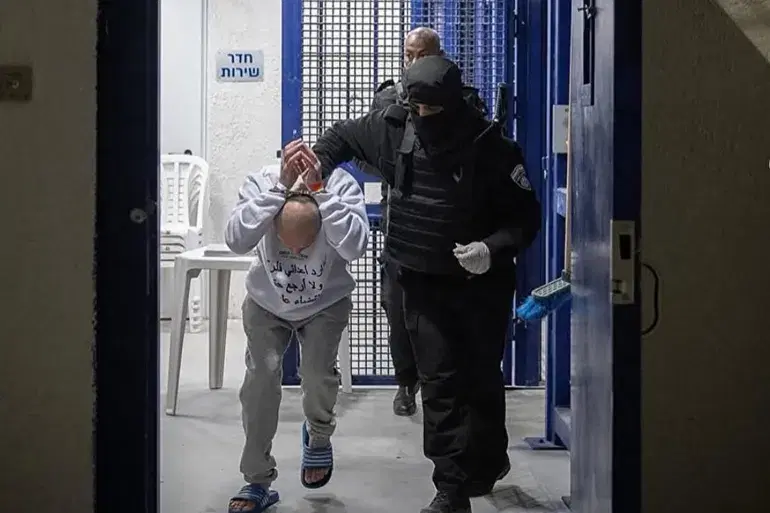
In parallel, the Israeli human rights information center B'Tselem published a report in January 2026 titled 'Hell on Earth: The Israeli Prison System as a Network of Torture Camps', which concluded that Israeli prisons and detention centers have turned into a network of facilities dedicated to harming detainees, and that what the organization described as torture is carried out as a systematic policy.
The organization's executive director, Yuli Novak, said that Israeli prisons have turned into a 'network of torture camps', noting that this policy, according to the organization, is supported politically, judicially, by prison authorities, and by Israeli media, which he said openly deal with the conditions of Palestinian prisoners' detention.
By the end of September 2025, the Israeli Prison Service was holding 10,863 Palestinians, including 3,521 administrative detainees without trial, 2,623 classified as 'illegal combatants' from Gaza, 3,227 classified as 'security suspects' without verdicts, and 1,492 security prisoners sentenced, including 350 children and 48 women.
According to the Palestinian Commission for Prisoners' Affairs, the number of prisoners in Israeli prisons and detention centers currently stands at about 9,400, including 88 women and more than 350 children.
The B'Tselem report documented a series of practices it said amounted to torture, including severe beatings, electric shocks, use of dogs, tear gas and sound bombs, forcing detainees to remain in painful positions, extinguishing cigarettes on their bodies, pouring boiling water, and firing rubber bullets from close range.
The report also spoke of practices of a sexual nature, ranging from threats of assault and forced nudity and actual assault, to beatings in sensitive areas and the use of dogs and forced insertion of objects into detainees' bodies.
The report also pointed to psychological torture methods, including humiliation, photographing naked, urinating and spitting on detainees, directing insults and threats to harm their family members, as well as deprivation of medical care, which the organization said led in some cases to permanent damage, including amputation of limbs, loss of hearing and vision, and death.
According to the report, 10 autopsies of Palestinians who died while in the custody of the Israeli Prison Service since October 7, 2023, showed deliberate medical neglect in six cases.
Data from Physicians for Human Rights indicate that 67% of the 349 detainees visited by the organization experienced at least one serious incident of violence, while the organization's branch in Israel reported that all 59 detainees it visited since February spoke of a lack of food and medical care.
The organization noted the spread of scabies in five facilities, while a 19-year-old detainee, who was held without charge, contracted a spinal infection following repeated scabies, resulting in paralysis of the legs and partial paralysis of one arm and loss of control over bowel movements, according to the data.
According to B'Tselem, family visits to prisoners have been completely halted since October 2023, and representatives of the International Committee of the Red Cross have been prevented from entering detention facilities. The organization pointed to obstacles to prisoners meeting their lawyers, including security charges against lawyers or preventing them from entering for long periods.
The report also focuses on the direct role of Ben-Gvir, as the Minister of National Security responsible for the prison system, accusing him of directly interfering in the conditions of Palestinian prisoners' detention.
Ben-Gvir previously posted a video on the 'X' platform showing him inside the cells of Palestinian female prisoners in an Israeli prison.
During the visit, one of the prisoners spoke of not showering for days, lack of medical treatment, and unsanitary clothes, while Ben-Gvir said that 'the days of good conditions in prisons are over', confirming that he is directly responsible for the current situation.
In August 2025, Ben-Gvir entered the cell of Fatah movement leader Marwan Barghouti and threatened him, saying that those who attack or kill Israelis 'will be eliminated'.
Media also reported that Ben-Gvir publicly displayed a gallows prepared to execute Palestinians, while in October 2025, he posted a video showing him in front of handcuffed and lying Palestinian detainees in a prison, describing them as Hamas elite forces and calling for their execution.
In other statements, Ben-Gvir called for 'liquidating 30 to 40 people every night' in the Gaza Strip, in remarks that drew widespread human rights criticism.