Experts: Promising export opportunities require market diversification and production development
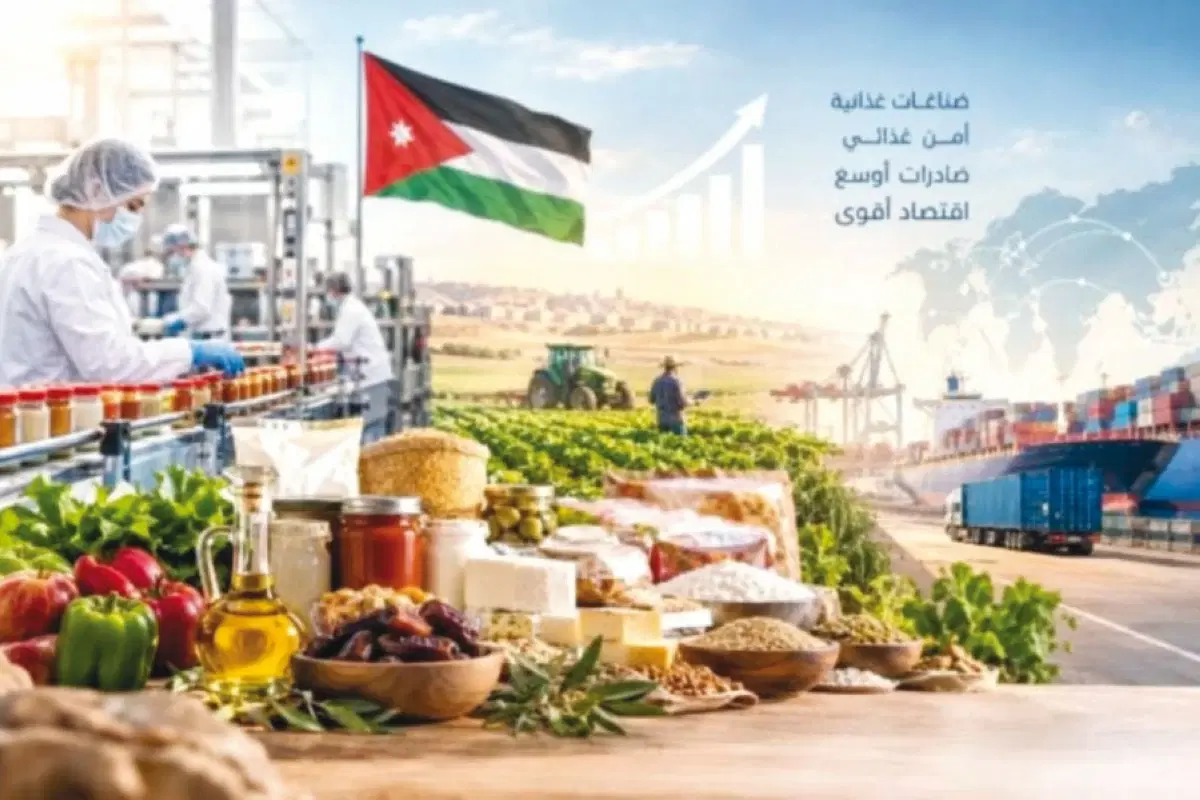
Jordanian food industries.. a pillar for food security and an engine for growth and employment
Amman6 min read
Share
With an annual production of 4.5 billion dinars, approximately 2,600 industrial establishments providing 66.5 thousand direct job opportunities, and a value-added reaching 1.8 billion dinars, the Jordanian food industries represent a fundamental pillar of the national economy and food security, as they cover more than 62% of local market needs, and their products reach more than 109 countries. With the launch of the National Strategy for the Food Industries Sector for the years 2027–2029, opportunities are shifting towards deepening value-added, enhancing integration between industry and agriculture, and expanding export markets.
Experts believe that enhancing the sector's competitiveness requires product development, increasing resource use efficiency, employing technology and innovation, and diversifying markets, in a way that achieves greater economic value and enhances the ability of establishments to compete locally and internationally.
The expert on agricultural policies and food security at the Geneva Centre for Studies and Research, Dr. Fadel Al-Zoubi, said that the strategy prepared by the Ministry of Industry, Trade and Supply in partnership with the Jordan Chamber of Industry, and with the support of the Economic Reform Program, goes beyond monitoring the sector's achievements to identifying the challenges of the next phase, foremost among which is that part of its growth is still based on an increase in quantitative demand, which makes deepening value-added a primary priority.
He explained that the value-added of the sector amounts to 1.8 billion dinars, equivalent to about 40% of total production, which calls for enhancing local manufacturing of inputs and linking food industries to Jordanian agricultural production, to increase the economic value achieved through production stages.
He pointed out that local products covering more than 62% of market needs does not mean achieving food self-sufficiency, in light of the reliance of industries on imported inputs, such as sugar, cocoa, milk derivatives, and packaging materials. This requires strengthening the relationship between agriculture and industry, developing products, and raising the percentage of local value-added.
Regarding exports, Al-Zoubi indicated that the sector achieved a cumulative growth of 102% over five years, with its exports reaching 823 million dinars in 2024. However, he pointed out the necessity of diversifying markets, in light of Saudi Arabia and Iraq accounting for a large share of exports to the top ten markets during the period 2022–2025, with cumulative values reaching 607 million dinars for Saudi Arabia and 482 million dinars for Iraq.
Al-Zoubi stressed the importance of expanding into European and American markets and the markets of Arab expatriates, and completing the food traceability system, especially for dairy and meat products, while addressing shipping and insurance costs that limit expansion into distant markets.
He called for focusing on higher-value products, such as date derivatives, olive oil packaged under Jordanian brands, ready-to-eat and healthy foods, and processed cheeses, in addition to developing support for research and development, and utilizing solar and thermal energy in factories to reduce production costs.
For his part, food security expert Imran Al-Khasawneh said that food industries enhance food security by converting raw materials into products that can be processed, preserved, and stored, ensuring the continuity of food supply to the consumer.
In this context, Al-Khasawneh pointed out that data from the Ministry of Industry, Trade and Supply on August 4, 2026, showed that the actual wheat stock reached about 610 thousand tons, sufficient for about 6.4 months, in addition to 302 thousand tons contracted, raising the total sufficiency period to nearly 9.6 months. He said that combining the strategic stock with the local food manufacturing base supports the Kingdom's ability to face shipping shocks, price hikes, and trade route disruptions.
He added that increasing productivity and improving transport, storage, and the efficiency of material and energy use contributes to containing costs and maintaining food prices within limits that are as consistent as possible with the citizen's purchasing power.
He stressed the necessity of making technology and innovation a focus for developing the sector, in light of limited natural resources, especially water, as the per capita share in Jordan is less than 61 cubic meters annually for all uses.
He indicated that food waste is not limited to the loss of products, but includes water, energy, labor, and financial resources used in production, transport, and storage, making the integration of technology with agriculture, industry, and marketing a necessity to produce greater nutritional value with fewer resources.
In turn, economic expert Iyas Al-Shuaibi said that food industries represent one of the pillars of the real economy, as they contribute about 5% of the GDP, provide more than 66 thousand direct job opportunities, and the number of direct and indirect job opportunities may reach about 100 thousand, in addition to covering more than 60% of local market needs.
On the export file, Al-Shuaibi considered that the 102% growth in exports over five years forms a base for expansion, but he stressed the importance of diversifying markets, in light of the concentration of exports in Saudi Arabia and Iraq. He also saw that the growth recorded in the US market, despite starting from a smaller base, highlights the ability of Jordanian products to reach markets with high competitive requirements.
Al-Shuaibi confirmed that deepening value-added requires moving from exporting products to building strong Jordanian brands, helping small and medium-sized enterprises obtain international quality certificates, and enhancing cooperation between factories and universities to develop innovative products, including organic and ready-to-eat foods.
He added that enhancing exports requires improving trade finance, developing refrigeration, storage, and logistics services, and providing a stable regulatory environment and clear and fast licensing and oversight procedures. He believed that Jordan possesses the elements that enhance its chances of becoming a regional hub for food manufacturing, noting that the next phase does not target increasing exports only, but raising the value achieved from every ton exported.
The experts agreed that developing food industries allows Jordan to enhance its food security and economic competitiveness at the same time, and that deepening value-added, raising production efficiency, and expanding markets represent practical paths to transform the sector's industrial base into broader opportunities for growth and investment, and to enhance the Kingdom's position as a regional hub for food manufacturing.