Egyptian Water Minister: Renaissance Dam is illegitimate and it is our right to take the necessary action
Anadolu5 min read
Share
Egyptian Minister of Water Resources and Irrigation Hani Swelam said on Sunday that the Ethiopian Renaissance Dam is "illegitimate", affirming that Cairo has the right to take the measures it deems appropriate to protect its water security.
This came during a briefing session in the capital Cairo, with representatives of foreign media in Egypt, organized by the General Authority for Inquiry (governmental), and attended by Anadolu Agency correspondent.
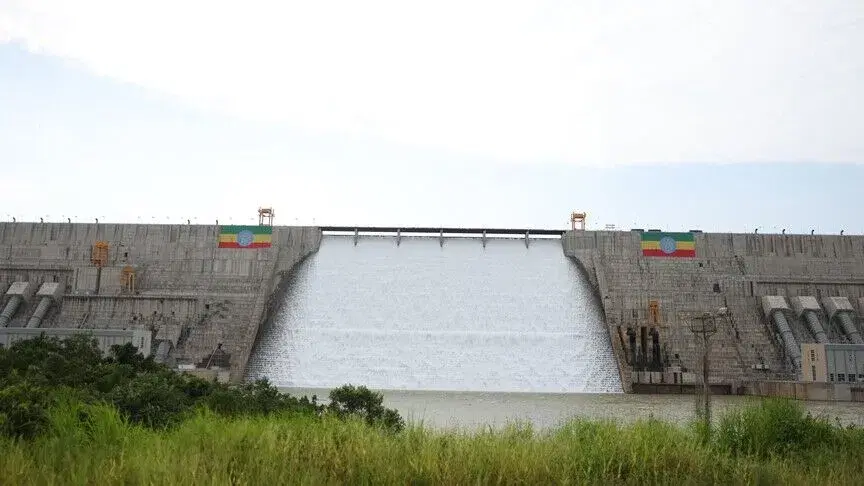
Egypt and Ethiopia have differed for years over the Renaissance Dam, which Addis Ababa began constructing on the Blue Nile in 2011, amid Cairo's demand to reach a binding agreement on its operation to ensure its water security.
Sweilam explained that the completion of the dam's construction and the passage of time do not mean Egypt's acceptance of the status quo or relinquishment of its rights, stressing that Cairo retains all measures permitted by international law to protect its interests.
He pointed out that the 2015 Declaration of Principles document was a roadmap that established commitments related to cooperation, reaching an agreement on the first filling and annual operation, as well as coordination and data exchange.
He confirmed that the Declaration of Principles does not grant Ethiopia the right to take unilateral actions regarding the dam, and Egypt considers the continuation of filling and operation without an agreement to be a breach of these commitments.
He continued: "The dam is illegitimate and will remain so. And it is Egypt's right to take appropriate action to lift the harm from it".
He added: "We have given Ethiopia more than one opportunity, and we have tried in every way to reach understandings, but it did not respond, and it also violated the Declaration of Principles."
Sweilam warned that uncoordinated operation could lead to sudden increases in water flows or sharp decreases, affecting dams in Egypt and Sudan.
He stressed that the core issue for Egypt is the timing of water arrival, its quantities, and management rules, not just the nature of the dam's use for electricity generation.
He continued: "Ethiopia's actions and statements by officials there indicate that the purpose of building the dam is not primarily to produce electricity."
He also emphasized the need for a binding legal agreement on the procedures to be followed in the event of an extended drought for several years or repeated floods.
Regarding the distribution of water resources, Sweilam rejected what he described as the Ethiopian proposal that Egypt receives the "lion's share" of the Nile's water.
He explained that Egypt's share of 55.5 billion cubic meters annually represents only about 2.7 percent of the total rainfall over the Nile Basin, estimated at about 2,000 billion cubic meters.
He pointed out that Ethiopia received more than 1,000 billion cubic meters of rainfall during 2023, including about 467 billion cubic meters over the Ethiopian part of the Nile Basin, while its renewable water resources are estimated at about 122 billion cubic meters annually.
He added that estimates of groundwater recharge in Ethiopia range between 51 and 81 billion cubic meters annually, linked to rainfall, unlike the deep groundwater in Egypt, which he described as non-renewable.
The Egyptian minister said that agricultural land in Ethiopia exceeds 18 million hectares (a hectare equals 10,000 square meters), compared to about 4.03 million hectares in Egypt.
He noted that rainfed agriculture in Ethiopia uses about 148 billion cubic meters annually of "green water", along with about 9.68 billion cubic meters of "blue water".
Green water refers to rainwater, while blue water refers to the amounts of water flowing from rivers and groundwater sources.
Sweilam said that total agricultural use amounts to about 158 billion cubic meters, while the water footprint of Ethiopia's livestock is about 85.5 billion cubic meters annually, most of it green water.
He also called for enhancing cooperation on green water, rainwater harvesting, groundwater, and improving water use efficiency in agriculture.
He pointed out that Ethiopia has great potential in solar and wind energy, considering that diversifying the energy mix can help alleviate water-related pressures.
Regarding his country's stance, Sweilam said that Egypt calls for peace, but it is "strong and knows when and how to act."
He stressed that Egypt reserves the right to take measures permitted by international law to protect its water security, and that all legal options remain open to it.
He added that sovereignty over land does not mean absolute sovereignty over an international river, and that upstream countries cannot treat the river's resources as a purely national resource.
He affirmed that the Nile's water is not a "grant or favor", but is subject to mutual rights and obligations and the rules of international law.
He pointed out that Egypt supports development projects in Nile Basin countries, provided they adhere to international law and do not impose a fait accompli or take unilateral actions regarding the river.
Cairo and Khartoum demand the conclusion of a first tripartite legal and binding agreement on the rules for filling and operating the dam, to ensure that it does not harm their water rights and interests.
In contrast, Ethiopia believes that operating the dam does not require a binding agreement and asserts that it does not intend to harm the interests of any other country.
The dispute led to the freezing of negotiations between the three countries for 3 years, before resuming in 2023, and then freezing again in 2024.