Netanyahu's party leads Eizenkot by 8 seats after 60% of votes counted
Amman3 min read
Share
Preliminary results of the Israeli elections on Wednesday showed the Likud party, led by Israeli Prime Minister Benjamin Netanyahu, leading its rival Gadi Eizenkot by 8 seats after 60% of the votes were counted, with neither securing the parliamentary majority necessary to form the next government.
Israel's Channel 12 reported that estimates of Knesset seat distribution, based on partial counting results, showed Netanyahu's bloc winning 56 seats, compared to 48 seats for Eizenkot's bloc, while Arab lists received 14 seats.
The Israeli newspaper "Yedioth Ahronoth" had reported, after about a third of the votes were counted, that Netanyahu's bloc had secured 59 seats, compared to 46 seats for Eizenkot's bloc, and 15 seats for the Arab lists.
The Israeli newspaper "Maariv" stated that about 3 million votes had been counted, noting that one out of every 5 votes went to Netanyahu.
In a development regarding the completion of the counting process, "Yedioth Ahronoth" reported, citing an official from the Election Committee, that the counting of double envelopes would begin at midnight on Wednesday and conclude on Thursday.
Exit polls had shown a very close race between the Netanyahu and Eizenkot blocs, as updated samples from Channel 13 and the Israeli Broadcasting Authority indicated a tie between the two blocs, with each receiving 51 seats, compared to 18 seats for the Arab lists.
Seat distribution estimates remain non-final, pending the completion of the vote count and the announcement of official results, while any bloc needs at least 61 seats out of 120 to form a government.
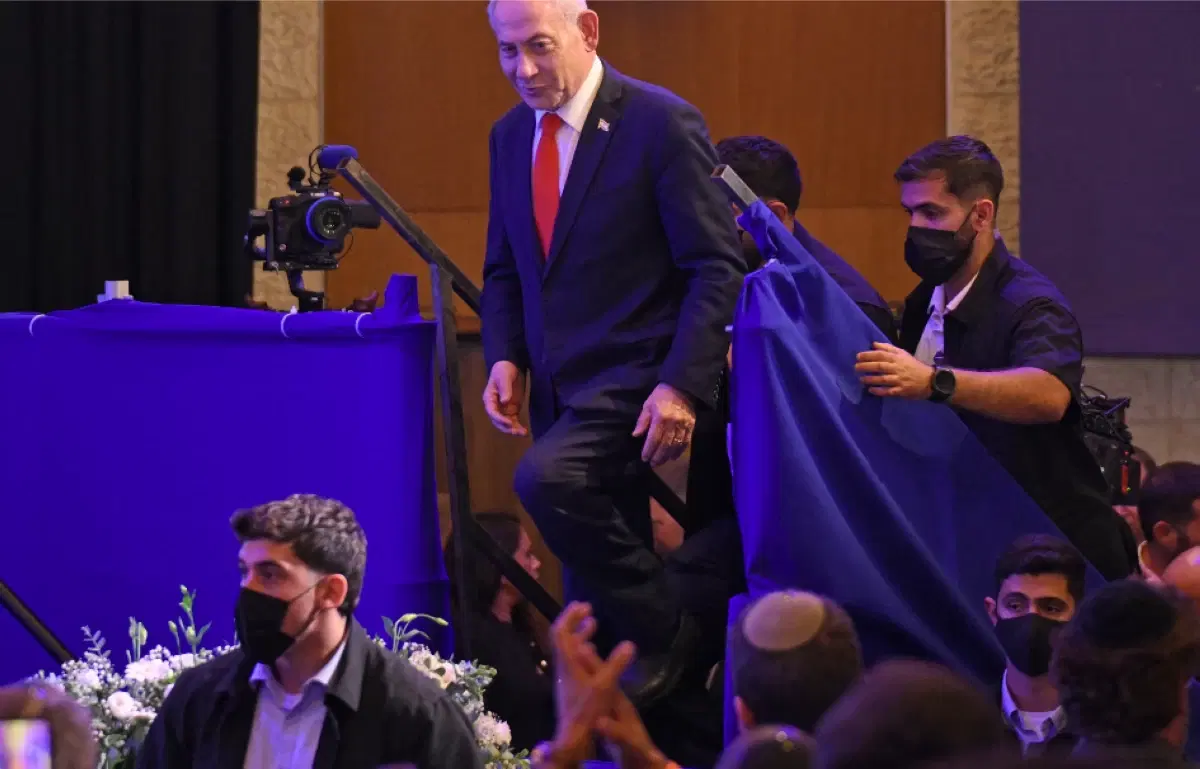
In a speech to his supporters in Jerusalem at dawn on Wednesday, Netanyahu vowed to form a strong right-wing government, emphasizing his refusal to form a government that relies on the support of Arab parties.
Netanyahu said that the right-wing bloc possesses a majority that necessitates the formation of a strong and cohesive government, considering that the final counting results will prove that Likud remains the largest political party in Israel.
For his part, Eizenkot vowed to work quickly to form a new government, despite announcing his refusal to form an alliance with Arab parties, which complicates the chances of forming a government coalition in light of the close results between the two blocs and the lack of a decisive majority.
The Israeli legislative elections on Tuesday saw a turnout of 77.7%, the highest since 1999, in the first elections since the war of October 7, 2023.