Hungary refuses to join a Kyiv-led regional bloc
Moscow demands Europe lift sanctions on its businessmen
Follow Al Rai

Zelenskyy: Security proposals could bring the end of the war closer
Hungary refuses to join a Kyiv-led regional bloc
Moscow demands Europe lift sanctions on its businessmen
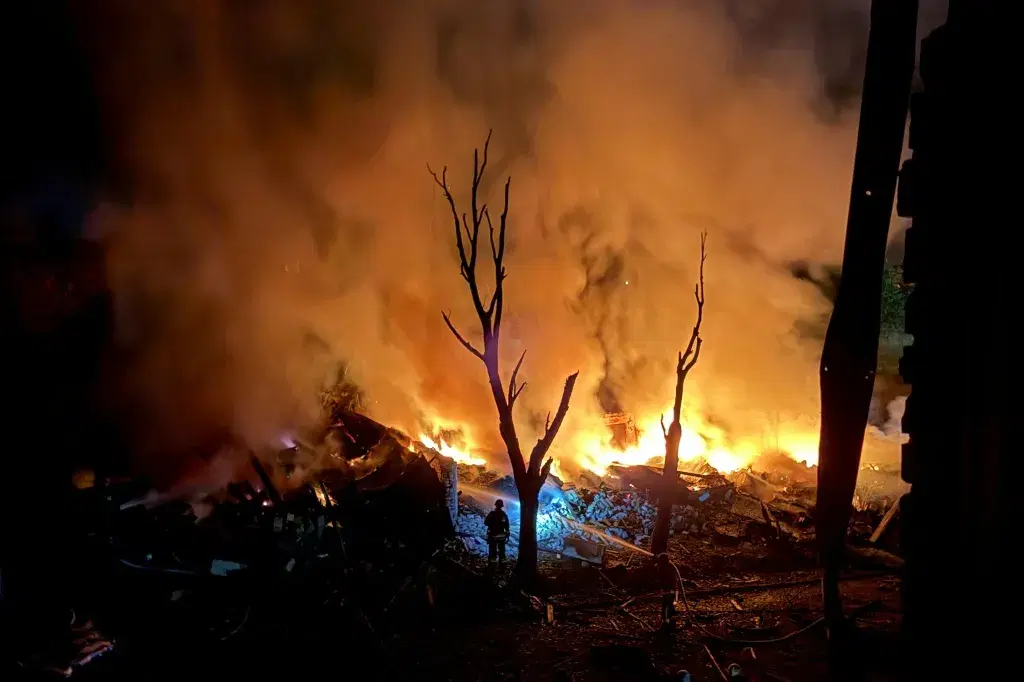
At least four people were killed in overnight Russian raids on the city of Dnipro in eastern Ukraine, while a drone attack killed a child in the south, authorities reported on Tuesday, coinciding with Ukrainian President Volodymyr Zelenskyy's arrival in New York to rally support for his country during the UN General Assembly meetings.
For months, Russia and Ukraine have been exchanging long-range strikes that are escalating in intensity, targeting an increasing number of civilian sites, including factories, warehouses, energy facilities, ports, and ships in the Black Sea.
Dnipropetrovsk regional governor Serhiy Lysak wrote on social media, "The Russian attack targeting the city resulted in the death of four people."
Lysak had previously reported that four districts in the city were targeted by "missiles, drones, and artillery," adding that the shelling hit warehouses and a company, causing severe damage.
Industrial sites in the cities of Kryvyi Rih and Pavlohrad in the same region were also targeted, according to the same official.
In the Mykolaiv region in the south of the country, a long-range Russian drone attack killed a three-year-old child, according to local authorities. Four other people were injured in a neighboring town, one of them seriously.
Ukrainian President Volodymyr Zelenskyy is scheduled to meet with his American counterpart Donald Trump on the sidelines of the UN General Assembly meetings.
Zelenskyy wrote on the X platform, "There are concrete security proposals and de-escalation measures that could bring the end of the war closer... We are working to strengthen air defense and ensure sufficient funding for Ukraine."
Washington recently revived diplomatic mediation efforts aimed at ending the war that has been ongoing in Ukraine for more than four years.
For its part, Hungary said on Tuesday that it had refused to join a regional cooperation initiative launched by its neighbor Ukraine, a sign of continued tension between the two countries despite the departure of Viktor Orbán's pro-Russian government.
The Ukrainian president opened the first summit of the Carpathian region countries in western Ukraine on Friday, announcing that representatives from seven countries in the region participated, including Hungary.
However, the Hungarian Foreign Ministry denied joining the bloc, which Zelenskyy said focuses on economic cooperation and security.
The ministry said in a statement: "Hungary is not a member of the 'Carpathian Initiative' regional cooperation initiative launched by President Zelenskyy, but it is closely following the establishment and development of the initiative."
Kyiv and Budapest have been trying for months to improve their relations after pro-EU Hungarian Prime Minister Péter Magyar took office in May.
Magyar succeeded the nationalist Viktor Orbán, who was close to the Kremlin and whose government repeatedly entered into disputes with neighboring Ukraine.
Kyiv and Budapest have long disagreed over the rights of the Hungarian minority in Ukraine.
The two countries reached an agreement on this issue in June, which prompted Budapest to stop blocking Ukraine's EU accession negotiations.
However, Hungary has since returned to blocking progress in the accession talks, accusing Ukraine of failing to implement the agreement.
Commenting on the Carpathian group meeting, Magyar told parliament, "We were invited, but we did not go, and for a good reason."
Ukrainian Foreign Minister Andrii Sybiha said on the X platform that Kyiv was "surprised by the unnecessary confrontational statements of the Hungarian Prime Minister towards Ukraine."
He added, "The reasons for this categorical refusal by Hungary remain unknown."
On another note, Russia demanded that the European Union lift all sanctions on all Russians included on its lists, at a time when Brussels is considering ending the measures imposed on Russian businessmen Alisher Usmanov and Mikhail Fridman.
Kremlin spokesman Dmitry Peskov said in his daily remarks to reporters, "We believe that these sanctions should be lifted from Usmanov and Fridman, and from all Russian businessmen, as well as from all Russian citizens."
Peskov reiterated the Kremlin's position that the asset freezes and travel bans imposed by the European Union are illegal.
The 27-nation bloc was moving toward lifting the asset freezes and visa bans on Usmanov and Fridman, following demands from France, Luxembourg, and Slovakia.
However, Latvia objected to the move, casting doubt on the entire process of renewing sanctions on Russians as the deadline for the decision approaches.
Know more about this story?Send us a tip
Ask about this report — answers stay grounded in its text.