Continued Incursions and Fortifications: What Do We Know About the 'Sofa 53' Project in Quneitra Countryside?
Anadolu4 min read
Share
Concerns are resurfacing in the Syrian street as the Israeli army continues its digging and fortification works in southern Syria, along the line separating it from the occupied Golan Heights, as part of the project known as 'Sofa 53'.
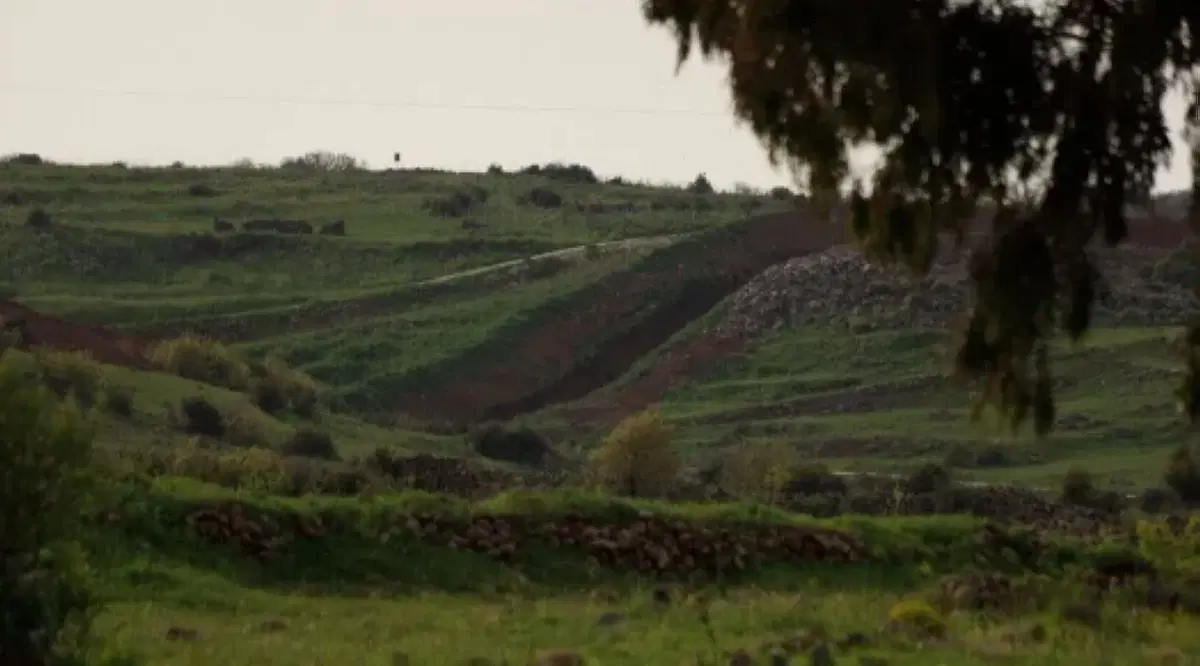
These concerns have come back into the spotlight as Israeli forces resumed digging west of the village of Al-Usha in southern Quneitra, as part of their project to build a military road along the separation line within the buffer zone covered by the 1974 Disengagement Agreement, according to the official 'Syrian News' channel.
The danger of expanding this project is evident in its direct consequences on the natural structure of the region; it turns thousands of dunams of agricultural land in Quneitra countryside into land unsuitable for farming or grazing. It also negatively affects water flow, harming the region's residents who depend mainly on agriculture and livestock as a primary source of income.
In addition, residents complain about escalating Israeli incursions, including raids and arrests, setting up checkpoints, and the resulting panic among school students and shepherds.
It is an engineering and military project launched by Israel in mid-2022 within the disengagement area in Quneitra countryside. The project started from the outskirts of Hadar town in the north, passing through the villages of Jibata al-Khashab, al-Hamidiyah, al-Qahtaniyah, Rawhinah, Bir Ajam, and Barika, reaching the village of Al-Usha in the far south.
The project was named 'Sofa 53' (meaning 'Great Storm' in Hebrew), and Tel Aviv claims its purpose is to prevent potential attacks by armed groups supported by Iran. However, this narrative loses its justification as work on the project continues despite the fall of Bashar al-Assad's regime in December 2024 and the subsequent exit of those groups.
The Israeli newspaper 'Yedioth Ahronoth' previously described the project as a 'massive engineering fortification of the borders,' including deep trenches and defensive barriers. Israeli forces took advantage of the security vacuum following the regime's fall to intensify work on it, advancing into the buffer zone by a distance ranging between 300 and 1000 meters, and seizing large areas; they cut off 7,000 dunams of land in Jibata al-Khashab, and 6,000 dunams in the villages of al-Hamidiyah and al-Hurriyah, almost completely destroying vegetation, pastures, and wild trees.
In this context, the Israeli army built a military road about 8 meters wide, reinforced with two sides of earthen barriers about 5 meters high, in addition to setting up observation points and military positions along the line parallel to the ceasefire in the Golan.
Quneitra's media director, Muhammad al-Saeed, noted that the damage assessment in the northern and central countryside amounted to about 12,000 dunams affected, pointing out that they had contacted the United Nations Disengagement Observer Force (UNDOF), but information flow remained limited due to the restriction of media access to the area.
For his part, the mayor of Jibata al-Khashab, Muhammad Mazen Mariud, confirmed that the project caused the loss of 7,000 dunams of the town's land, stressing that the trenches contribute to soil erosion and negatively affect rainwater and agricultural and livestock movement, in addition to extending the damage to the entire province through the destruction of forests and restricting the movement of residents.
Officially, the Syrian Foreign Ministry strongly condemned these measures, considering them a flagrant violation of the 1974 Disengagement Agreement and a blatant violation of international legitimacy resolutions.
The Foreign Ministry affirmed that the continuation of the Israeli aggressive policy and field incursions poses a direct threat to regional security and stability and undermines international law, emphasizing Syria's adherence to its legitimate right to exercise full sovereignty over all its territories and calling on the international community to assume its responsibilities in preserving the sovereignty of states and the sanctity of their borders.
It is worth noting that since the fall of the Assad regime, Israel has expanded the scope of its operations and advanced its forces towards the buffer zone in the Golan and adjacent sites, demanding its withdrawal and adherence to the 1974 Disengagement Agreement, while Israel insists that its movements are based on security considerations.