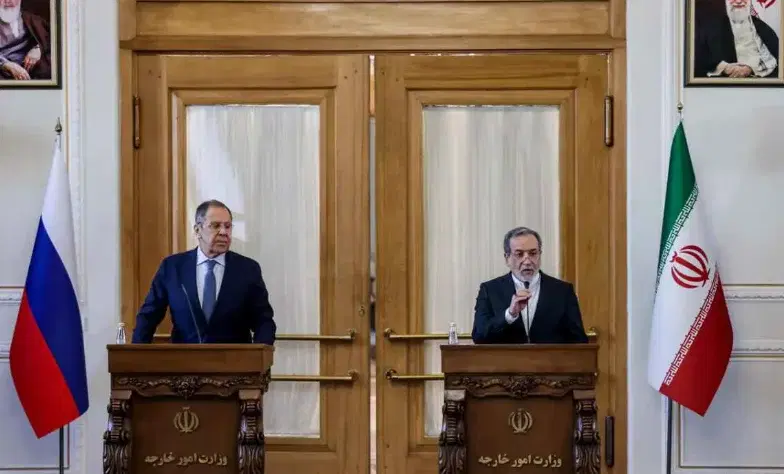
He added that the two sides exchanged views on regional security and emphasized the importance of enhancing security in Lebanon, pointing to the convergence of Moscow's and Tehran's positions regarding regional issues.
Lavrov welcomed Iran's orientation towards diplomatic solutions to achieve peace, affirming Russia's readiness to seek a way out of the current crisis, and stressing the importance of returning the situation in the Strait of Hormuz and the region to what it was before the war.
Regarding the nuclear issue, Lavrov stated that Russian workers will gradually return to the Bushehr nuclear power plant in Iran, calling for the establishment of a fairer global system based on the UN Charter.
For his part, Araghchi held the United States responsible for the tension and insecurity in the Strait of Hormuz, considering that what he described as "the US-Israeli aggression against Iran," along with the economic blockade imposed on his country, are among the main reasons for insecurity in the region.
Araghchi called on regional countries to continue working to reach a security agreement, welcoming any initiative that enhances regional security without the presence of foreign forces, and stressing that resolving regional issues is not achieved through military means, but rather through dialogue and diplomacy.
Araghchi accused European countries of complicity in the US-Israeli war against Iran, calling on them to adopt a rational and diplomatic approach.
He also pointed to discussing ways to enhance political, economic, and strategic relations between Tehran and Moscow, affirming that economic cooperation between the two countries is proceeding well and that consultation between them is ongoing regarding international and regional issues.
He stated that the talks addressed developments in Yemen, Lebanon, Palestine, and Afghanistan.