Al-Oran: A public safety regulation enhances Aqaba's readiness and mitigates risks
Amman4 min read
Share
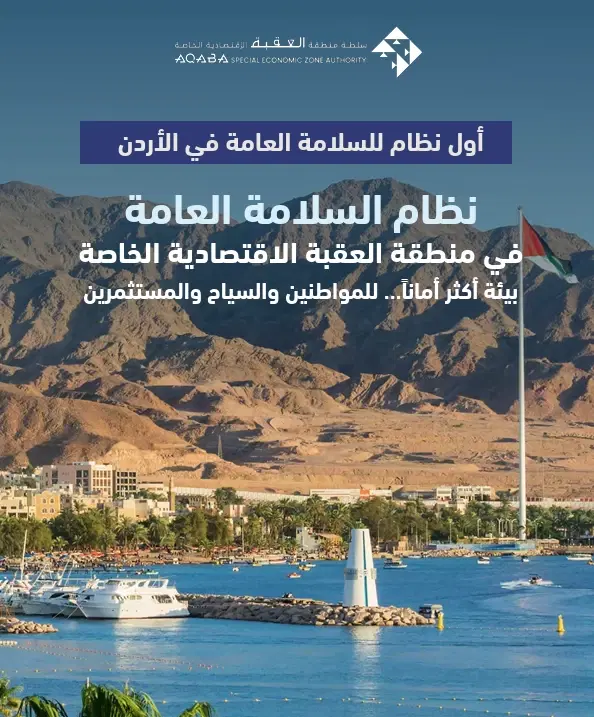
The Aqaba Special Economic Zone (ASEZ) is moving towards establishing an integrated system for public safety and risk mitigation through a draft regulation that sets unified standards for prevention and response in economic facilities, ports, beaches, public utilities, and tourist and residential sites. This shifts the approach to risk management from reacting to incidents after they occur to proactive prevention, keeping pace with the economic, urban, and tourism growth in Aqaba, and establishing a safer and more sustainable environment for citizens, visitors, and investors, following the Cabinet's approval of the legislative reasons for the Public Safety Regulation in the Aqaba Special Economic Zone for the year 2026.
The Commissioner for Environment and Public Safety at the Aqaba Special Economic Zone Authority (ASEZA), Dr. Nidal Al-Oran, stated in an exclusive interview with "Al-Rai" that the project comes in response to the expansion witnessed by Aqaba in terms of population, investments, and industrial, tourism, and service activities, as well as the need for a unified framework that enhances public safety requirements and risk prevention, protects citizens, visitors, investors, and their investment assets, and supports business continuity across various sectors.
He explained that the project covers economic facilities and activities, ports, entertainment venues, public events, beaches, swimming pools, residential complexes, and tourist camps, in addition to public facilities, parks, schools, and buildings, through requirements tailored to the nature of each site and the risks associated with it.
Al-Oran emphasized that the draft regulation integrates with and supports the regulations and instructions of the Civil Defense and Public Security without conflicting with them, and enhances coordination between the Authority, the Aqaba Governorate, and the relevant authorities to ensure the integration of roles and responsibilities in risk and emergency management, and the development and evaluation of safety procedures.
He indicated that the project is based on four integrated phases: awareness and education, preventive measures, remediation and rehabilitation, and documenting lessons learned after incidents occur, with the aim of fostering a culture of prevention rather than merely dealing with the aftermath of incidents, and utilizing evaluation and documentation results to improve procedures and reduce the recurrence of risks.
He added that the requirements for facilities include risk assessment and documentation, the preparation of emergency and evacuation plans, the implementation of periodic drills, staff training, the provision of safety and protection equipment, conducting and documenting necessary maintenance and inspections, and providing specialized public safety personnel, all of which contribute to increasing staff efficiency, reducing accidents, and enhancing the sustainability of facilities.
He pointed out that the project includes special requirements for the storage and handling of hazardous materials, including adherence to approved sites, the provision of warning labels and protective equipment for workers, the preparation of emergency plans, the qualification of relevant teams, and the submission of periodic reports to the Authority, which enhances oversight and prevention measures against potential risks.
Al-Oran noted that safety requirements for beaches, swimming pools, and public places include crowd control and entry/exit management, adherence to capacity limits, the provision of lifeguards and first aid in locations that require them, the separation of swimming areas from marine sports, the placement of guidance and warning signs in both Arabic and English, and the application of safety requirements for children's pools.
He explained that the project includes an early warning system—both audible and visual—that reaches various groups, including people with disabilities, while taking into account the needs of the elderly and children in public places, thereby enhancing the ability of those in facilities and utilities to receive and respond to warnings.
He indicated that the project's media package includes four levels of readiness, starting with the normal level (green), followed by increased readiness and monitoring (yellow), partial emergency activation (orange), and finally full activation of the emergency plan (red), commensurate with the level of risk and the nature of the situation, and in coordination with the relevant authorities.
He added that procedures for dealing with violations are based on a graduated approach, starting with a notice, then a warning, and reaching the suspension of work and closure when necessary until conditions are rectified, in accordance with approved procedures and powers, to ensure compliance with safety requirements and the protection of individuals and property.
Al-Oran stressed that the success of the system's implementation depends on the cooperation of citizens, institutions, and investors, the commitment of facilities to safety requirements, and the integration of roles between the relevant authorities, emphasizing the importance of reporting incidents via the unified emergency number 911.
He affirmed that the project constitutes a framework for coordinating efforts, developing public safety procedures, mitigating and assessing risks, protecting people and the environment, supporting the sustainability of economic and tourism activities, and consolidating Aqaba's position as a safe and attractive destination for investment.