Al-Fayez: Crises and challenges require strong parliaments to confront them
Amman6 min read
Share
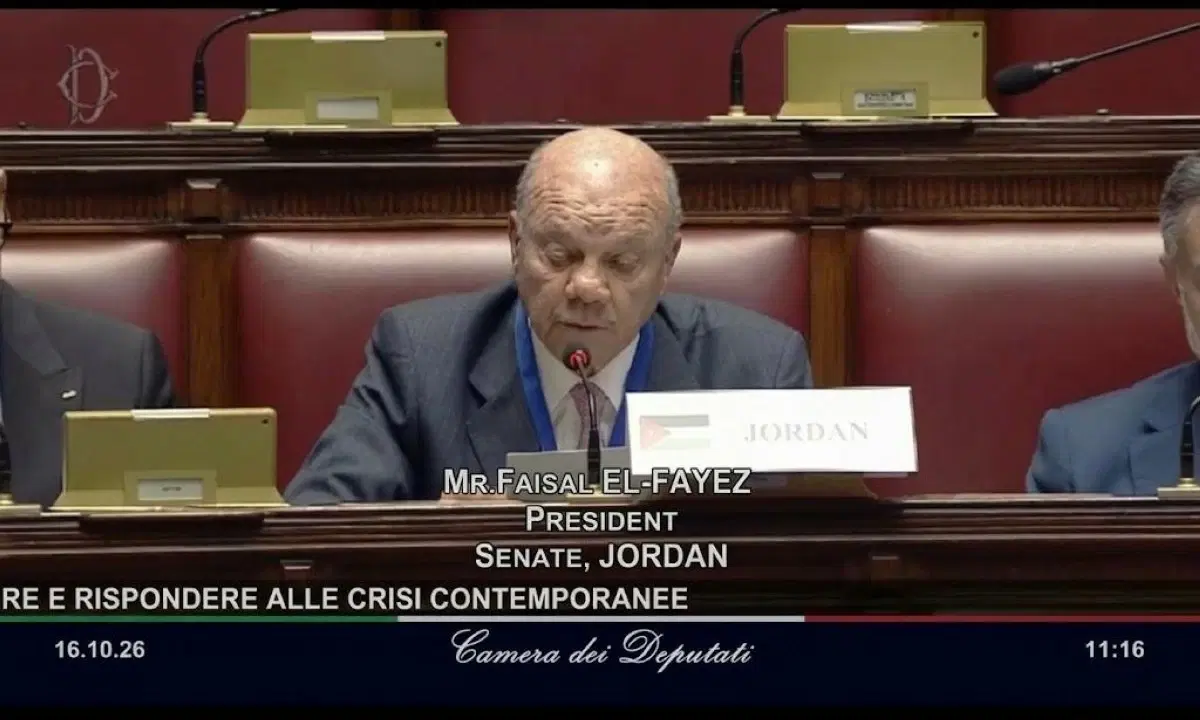
President of the Senate, Faisal Al-Fayez, called on various international parliaments to play a role in responding to the contemporary crises facing the world and working to confront them, noting that various challenges require strong parliaments capable of protecting their peoples and building a more stable future for them.
He said that the conflicts and challenges facing the world today are becoming increasingly complex, but what is more important is how to deal with these challenges; responding to and confronting them is not limited to governments alone, but requires building a real partnership between civil society institutions and various international bodies, in which parliaments have a pivotal and effective role.
This came during the speech he delivered today at the International Conference of Parliament Speakers, which began its proceedings in the Italian capital, Rome, under the title "The Role of Parliaments in Addressing and Responding to Contemporary Crises," with broad participation from international parliament speakers and representatives of various global parliamentary organizations and bodies, and in the presence of the Jordanian Ambassador to Rome, Qais Abu Dayeh.
Al-Fayez pointed out that at a time when crises are multiplying, none of them is exclusive to one country over another; there are worsening climate crises and challenges, economic and financial crises, and conflicts and disputes that threaten international security and stability, in addition to digital challenges and cybersecurity.
Al-Fayez briefed the parliament speakers and representatives of parliamentary bodies and organizations on the most prominent contents of the speech delivered by His Majesty King Abdullah II before the United Nations General Assembly.
He said that His Majesty the King, in his speech, presented the international community with the reality of the conflicts, crises, and challenges facing the world, their political, security, and economic repercussions, and their impact on international peace, as well as on human dignity and their right to a free and safe life.
Al-Fayez added, "His Majesty the King demanded that the international community must assume its responsibilities towards protecting international security and stability, stopping violations, and respecting the rules of international law, emphasizing the necessity of moving from managing crises to addressing their causes, and from merely taking positions to taking practical steps that protect the human being and their right to life, asking: What is the value of international law if it can be ignored for decades? And what is the value of international institutions if the rules are not the same, the rights are not the same, and human dignity is not the same?"
Al-Fayez added, "Today, before the eyes of the international community, and as stated in His Majesty the King's speech before the General Assembly, for eight decades the Israeli government has continued to commit war crimes against the Palestinian people in the Gaza Strip and the occupied West Bank. It also continues violations against Islamic and Christian holy sites in Jerusalem, and the Israeli occupation government's attempts to Judaize the Jordan Valley and infringe upon the freedoms and dignity of individuals. So why, when it comes to Israel, do all the tools of punishment and accountability possessed by the international community remain ink on paper? And why is accountability for the Israeli government absent, and it escapes punishment, continuing to disregard the resolutions of international legitimacy and international humanitarian law?"
The Senate President indicated that His Majesty the King emphasized in his speech that the demolition of Palestinian homes to expand settlements in the West Bank is not the implementation of the law, but rather forced displacement, and that the seizure of occupied lands is not land registration, but rather de facto annexation. Furthermore, the checkpoints established by the Israeli government in the occupied West Bank are not security infrastructure, but a system of oppression, and the systematic attacks on Palestinian population centers are not "settler riots," but a continuous Israeli policy.
Al-Fayez said that parliaments today face rapid transformations that impose unprecedented challenges on them, affecting the essence of their legislative and oversight work. Challenges are no longer limited to traditional political crises, but have extended to include complex technological, societal, and environmental dimensions. Among the most prominent contemporary challenges facing parliaments are those related to the digital divide and the rapid development of technology; therefore, parliaments find themselves facing a technological flood that requires a quick response to keep pace with this development.
He pointed out that parliaments also suffer from a trust gap between them and the street, which requires more transparency to confront fake news and attempts to distort parliamentary work, in addition to facing many cross-border crises, such as climate change, pandemics, and economic crises, which force parliamentarians to think from an international perspective, not just a local one.
Al-Fayez emphasized that addressing and responding to crises requires parliaments to have more flexibility to deal with them and limit their repercussions. Parliaments are not just legislative institutions that enact laws, but are the voice and conscience of the people. He noted that in times of crisis, the role of parliaments doubles by working to stop conflicts and disputes, promote social justice, advance education and healthcare, achieve digital justice between the North and South, address cybersecurity challenges, and ensure the optimal and ethical use of modern technology tools to protect individual privacy, through enacting legal legislation and activating parliamentary oversight.
He said that through joint cooperation, exchange of expertise, and coordination of positions among themselves and with executive authorities, they can build early warning networks and exercise collective pressure to find peaceful and just solutions to conflicts through peaceful means and responsible dialogue, confront the challenges of asylum and displacement, climate change, support sustainable development in conflict zones, address the challenges of poverty and hunger, and consolidate the values and principles of human rights, integrity, and transparency.
He pointed out that strengthening effective partnership between various parliamentary bodies by building bridges of friendship and cooperation among them would advance their role, enhance their presence, and accumulate their expertise to achieve the desired development and consolidate the principles of peace and security. Furthermore, the effectiveness of parliaments in facing crises requires strengthening their institutional capabilities, developing mechanisms for rapid consultation with experts, civil society, and the private sector, and enhancing cooperation between parliaments at the international level. Many crises cannot be solved in isolation from others; the role of parliaments in crises is not that of a spectator, but an active and responsible partner. Therefore, they must work to take proactive measures and seek to turn crises into opportunities to strengthen preventive legislation, build more flexible and just systems, and strengthen trust between the citizen and the state.
At the conclusion of his speech, Al-Fayez pointed to the data issued by the Stockholm International Peace Research Institute (SIPRI), which indicates that the volume of global military spending reached approximately 2.88 trillion US dollars in 2025, and estimates for 2026 indicate that it will range between 3.1 and 3.3 trillion dollars.
He asked, can we say that we live in a safe and stable world?