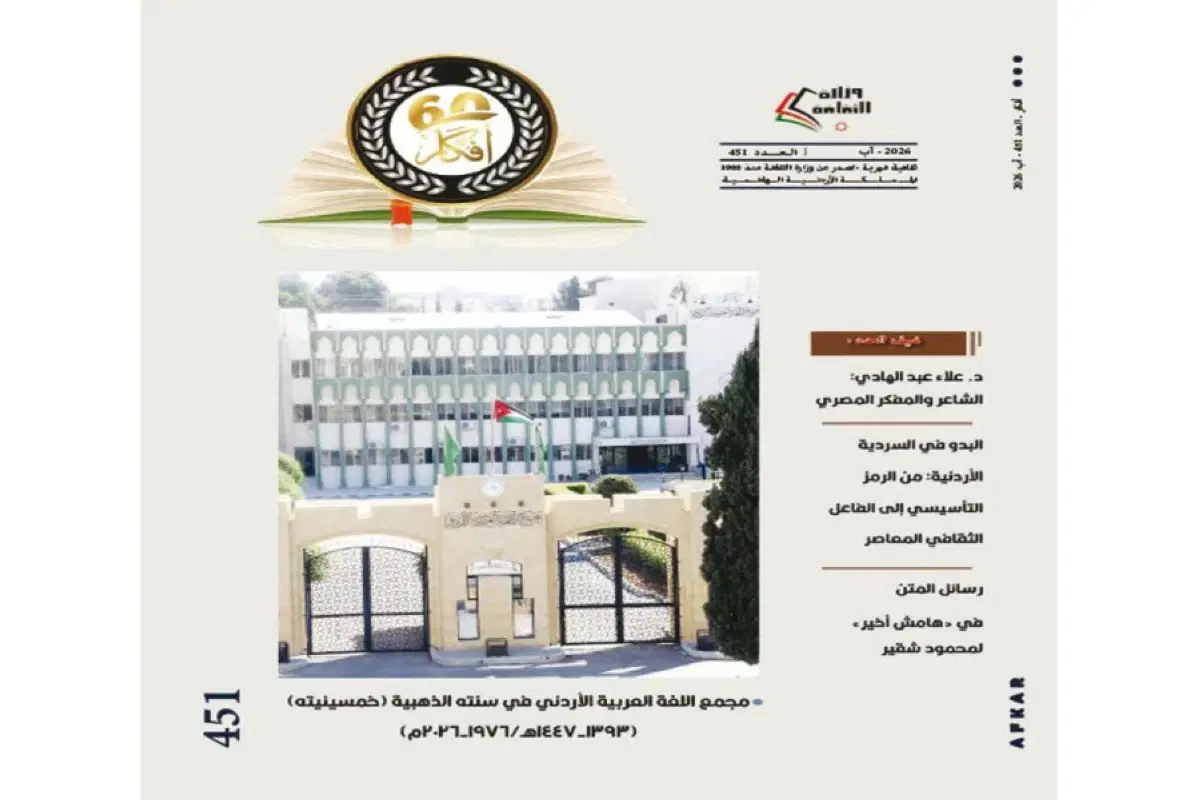
"Afkar" documents 50 years of the Jordan Academy of Arabic's journey
Amman4 min read
Share
On the occasion of the Jordan Academy of Arabic's golden jubilee, the cultural magazine "Afkar," published by the Ministry of Culture, has dedicated an extensive file in its issue No. (451) that reviews five decades of the Academy's journey, from the early stages of its establishment and development phases, through its projects in Arabization, protecting the Arabic language, and publishing heritage, to its presence in society and its relations with other Arabic language academies.
The file was prepared and its interviews were conducted by Professor Dr. Samir Al-Darubi, an active member of the Academy, who traced the path of linguistic and scientific work in Jordan and highlighted the most prominent milestones that paved the way for the establishment of the Academy in 1976.
In the file, Al-Darubi returns to the early roots of institutional linguistic work in Jordan, pointing to the "Arab Scientific Academy in the East," which was established in 1923 under the presidency of Sheikh Saeed Al-Karmi, and the roles it undertook in education, antiquities, journalism, printing, and administrative language before its activities ceased at the end of 1925.
He also pauses at the "Jordanian Committee for Arabization, Translation, and Publishing," which was established in the Ministry of Education in 1961, and what it achieved over 15 years in the fields of Arabization, translation, terminology development, and heritage editing, leading up to the efforts that resulted in the establishment of the Jordan Academy of Arabic.
The file reviews the establishment of the Academy in 1976, the election of Dr. Abdul Karim Khalifa as its first president, as well as the journey of its founding members and the legislation that regulated its work and defined its goals in preserving the integrity of the Arabic language, keeping it abreast of sciences and literature, developing terminology and dictionaries, and reviving Arab and Islamic heritage.
Arabization and Protecting Arabic
The file covers the Academy's most prominent projects over the past five decades, foremost among them the Law for the Protection of the Arabic Language No. (35) of 2015 and the project for the Arabization of scientific university education, which included the translation of 23 volumes of university curricula in a number of scientific and medical disciplines.
It also monitors the Academy's efforts in Arabizing scientific symbols and issuing the "Academy's Project for Arabic Scientific Symbols," in addition to publishing the "Journal of the Jordan Academy of Arabic" as a peer-reviewed scientific periodical since 1978.
The file also sheds light on cultural seasons, linguistic conferences, modern Arabic lexicography projects, and heritage publishing, including the "Dictionary of General Life Terms in Jordan" and the "Lisan Al-Arab Economic Dictionary," alongside a number of heritage investigations and publications.
In the context of keeping pace with technological transformations, Al-Darubi discusses the Academy's transition to using computers and databases, the issuance of guides for Arabic computer terminology, and the organization of specialized events and workshops on artificial intelligence and search engines.
Arab and Societal Presence
The file highlights the scientific relations the Academy has forged with a number of Arabic language academies, primarily those in Damascus, Cairo, Iraq, and Sharjah, in addition to its joining the Union of Arabic Scientific Language Academies in 1977.
In this context, it pauses at the cooperation with the Sharjah Academy for Arabic Language on the "Historical Dictionary of the Arabic Language" project with the participation of Jordanian researchers, as well as the exchange of publications and expertise and participation in Arabic linguistic conferences and seminars.
The file devotes a portion of its pages to figures who contributed to the Academy's journey through interviews with its president, Professor Dr. Mohammad Adnan Al-Bakhit, Dr. Abdul Majeed Nuseir, Dr. Hammam Ghassib, Dr. Ibrahim Badran, and Dr. Jaafar Ababneh, which addressed issues of Arabization, teaching sciences in Arabic, dictionary development, and linking language with technology and development.
The file concludes by monitoring the Academy's presence in Jordanian society through its cooperation with educational and media institutions and universities, organizing seminars and competitions aimed at children and youth, training media professionals, and contributing to the proofreading of public signs and titles.
On this occasion, the "Afkar" file provides documentation of a journey that spanned five decades, along with the accompanying efforts in safeguarding and developing the Arabic language, Arabizing sciences and terminology, publishing heritage, and strengthening the presence of Arabic in Jordanian scientific, cultural, and societal life.