Wea'a Center issues a guide to empower female lawyers in digital security and safety
Amman5 min read
Share
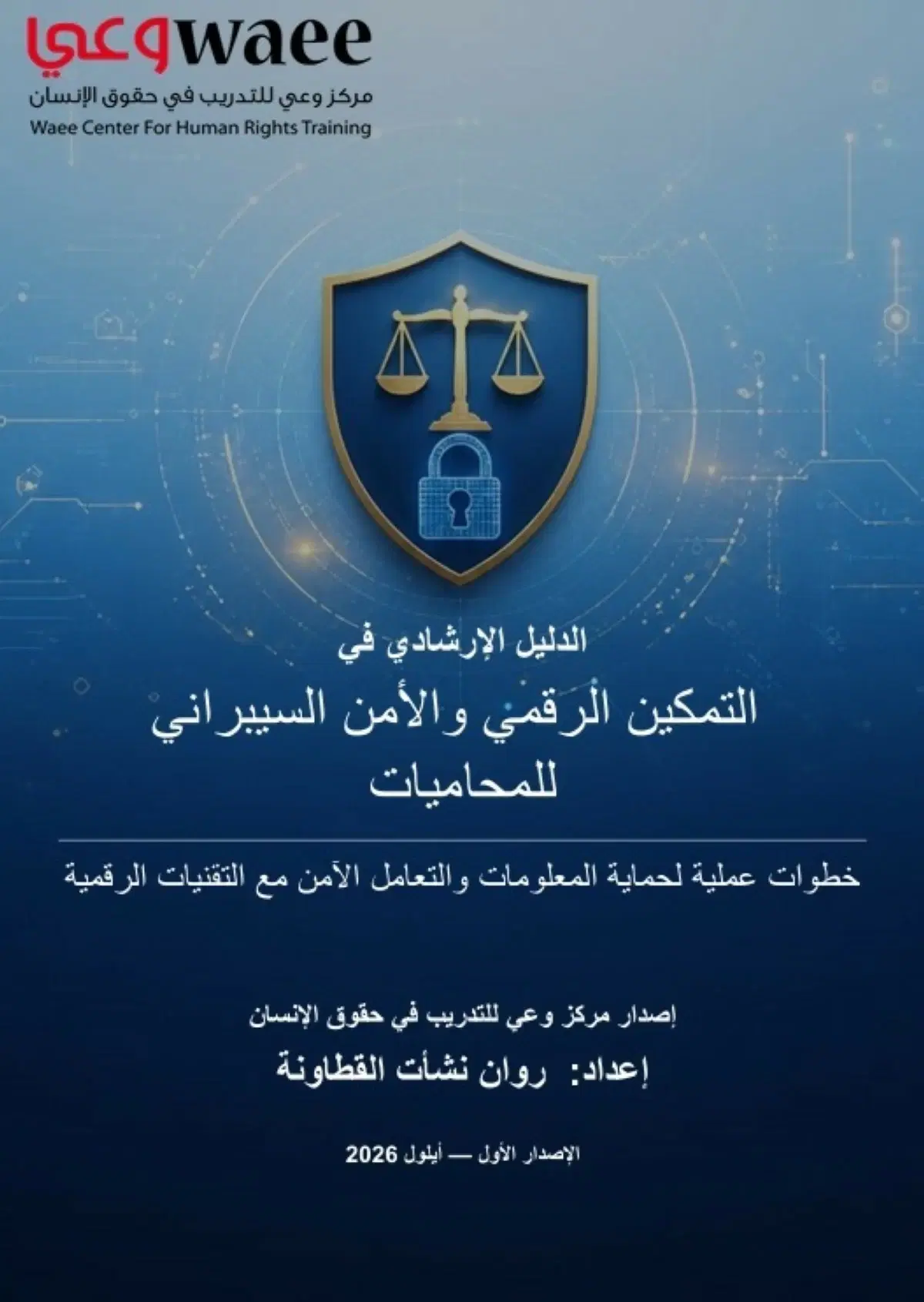
Wea'a Center for Human Rights Training has issued a specialized guide titled "Digital Empowerment and Cyber Security for Female Lawyers: Practical Steps to Protect Information and Safely Handle Digital Technologies" prepared by Ms. Rawan Al-Qatawneh, a specialist in the field of cyber security and digital crimes, with the aim of enhancing the knowledge and skills of female lawyers in digital security and safety and enabling them to protect their accounts, devices, case files, and client data amid escalating digital risks.
The issuance of the guide comes amid the rapid transformation in the nature of legal work, which increasingly relies on computers, smartphones, the internet, and cloud services for communication with clients, document preparation, correspondence, case file management, and the use of electronic services. With this transformation, the need to enhance information protection and maintain its confidentiality and integrity has emerged as a fundamental part of a lawyer's professional responsibility.
Lawyer Taghreed Al-Daghmi, founder of the Lawyers' Network to Combat Digital Violence Against Women, said that the issuance of the guide comes in response to a practical need imposed by the digital transformation in legal work. It provides essentials that help a lawyer understand the digital environment and associated risks, take appropriate preventive measures, and act correctly in the event of any security incident. She emphasized that cyber security is no longer a technical matter limited to specialists but has become part of a lawyer's daily practice, confirming that the guide does not require advanced technical knowledge and presents information in a practical, easy, and simplified manner.
She added that dealing with digital violence cases requires, in addition to legal knowledge, an understanding of the nature of digital attacks, the tools used by attackers, and methods of protecting accounts, information, and digital evidence, noting that targeting a lawyer digitally may affect her professional safety and the security of her clients' information.
The guide comes alongside the "Legal Defense Skills and Advocacy in Digital Violence Cases" guide previously issued by Wea'a Center as part of an integrated system for building the capabilities of female lawyers in combating digital violence, combining legal knowledge, specialized defense and advocacy skills in digital violence cases, and technical, digital security, and safety skills.
For her part, the author of the guide, Rawan Al-Qatawneh, explained that the preparation of the guide was in response to the transformation that has occurred in legal work, where case files have moved from physical cabinets to digital devices, and with them, the responsibility of protecting the client's confidentiality has shifted from physical to digital protection.
Al-Qatawneh emphasized that the guide was designed to be a practical, applicable tool rather than just general guidelines. Therefore, each section begins with a realistic situation a lawyer might face, then moves to clear steps that can be implemented while reading, starting from understanding the risks, protecting accounts and devices, passwords, and activating two-factor authentication, through to communication security, phishing, social engineering, and digital footprint, up to what should be done in the event of a breach, blackmail, or loss of devices, emphasizing the importance of preserving and documenting digital evidence in a safe and systematic manner and avoiding actions that may lead to their loss or damage.
The guide also addresses the safe and responsible use of artificial intelligence in legal work, stating the risks associated with its use, such as exposing confidential data, relying on inaccurate information or incorrect references, and introduces the basics of digital evidence and the importance of its safety, collection, and documentation.
Al-Qatawneh emphasized that digital security protection is not limited to protecting devices and accounts but extends to protecting the information that clients entrust to the lawyer, considering digital security and safety as a natural extension of the professional confidentiality duty. Therefore, the guide provides the lawyer with what enables her to protect her client's secret in their digital tools as she does in the courtroom.
Al-Qatawneh affirmed that the guide is an empowerment tool that helps the lawyer transition from a concerned user to a conscious and controlled user of their digital tools. When a lawyer's devices are hacked, the damage is not only to her but to everyone who entrusted her with their secret. Therefore, digital protection today is not an additional skill but a natural extension of the confidentiality duty that the lawyer commits to at the core of her profession.
Wea'a Center confirmed that the guide, although primarily prepared for female lawyers, can also benefit male lawyers, especially in protecting accounts, devices, legal files, preventing phishing and social engineering, safe handling of digital evidence and information, and the responsible use of artificial intelligence.
Wea'a Center hopes that the guide will form a practical reference for female and male lawyers, contribute to establishing a culture of digital security and safety in the legal work environment, and enhance the integration between legal knowledge and technical understanding to support the protection of information and client confidentiality and contribute to building a safer and more just digital space.
The issuance of the guide is part of the activities of the "Lawyers to Combat Digital Violence Against Women Using Technology" initiative implemented by Wea'a Center for Human Rights Training, which aims to build the capabilities of female lawyers in the fields of digital empowerment, cyber security, and legal defense skills in digital violence cases, and enhance their role in preventing, responding to, and supporting the access of survivors to protection and justice.
The initiative comes in response to the recommendations of the Universal Periodic Review of Human Rights in its fourth session on Jordan, particularly those related to combating violence against women, enhancing community awareness, building the capabilities of female lawyers, and developing their skills in defending women and enabling them to access justice.