In this context, the President of the Engineers Syndicate, Mr. Abdullah Asem Ghosheh, said that His Majesty's emphasis on the link between water and national security places engineering before a national responsibility, as it is a partner in protecting Jordan's water future, explaining that the water issue is no longer just a service or environmental file, but has become part of the national security system. He added that the royal reference came in the context of regional developments and what the northern borders are witnessing, which confirms that water cannot be separated from politics and security, especially in a region where basins and sources are linked to factors beyond national borders.
Ghosheh pointed out that the protection of water resources is not limited to politics and diplomacy, stressing that “what politics protects, engineering must secure,” which expands the responsibility of the engineer from designing facilities and networks to building a water system capable of withstanding risks, crises, and climate change. He explained that this requires diversifying water sources, enhancing desalination, transportation, and storage capabilities, increasing the reliability of distribution networks, and managing facilities according to the life cycle concept, including preventive maintenance, risk management, digitalization, and efficiency improvement.
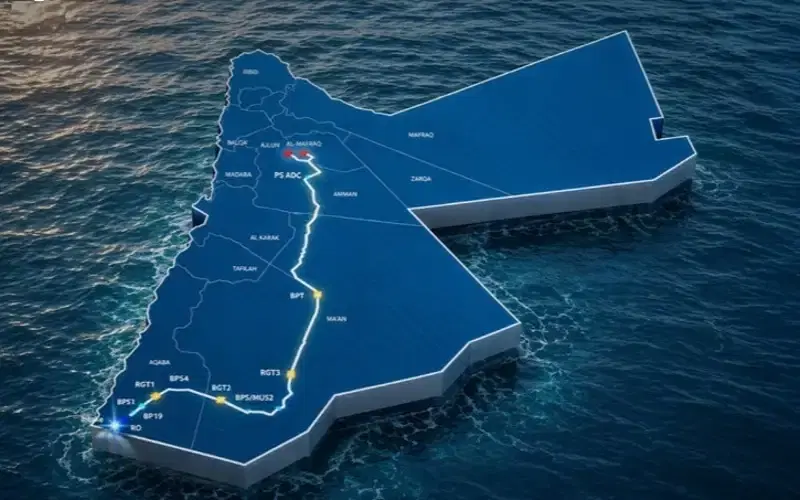
He addressed the importance of the National Water Conveyance Project as part of the strategic infrastructure in the Kingdom, stressing the need to look at it as a long-term national asset that requires sustainable management, not a project whose mission ends as soon as it is completed and put into operation. He pointed out that securing additional sources must be accompanied by protecting available resources, through reducing losses, managing pressure, detecting leaks, improving pumping efficiency, expanding the use of smart meters and treated water, explaining that artificial intelligence, the Internet of Things, and remote sensing allow for the transition from dealing with failures after they occur to predicting them, as “what we do not measure accurately, it is difficult to manage efficiently.”
Ghosheh explained that water and energy are interconnected, as desalination, pumping, transportation, and treatment consume large amounts of energy, making energy efficiency and the expansion of renewables part of the national capacity to secure water. He concluded that the stage requires the transition “from facility engineering to system engineering, from project management to asset management, and from problem solving to risk anticipation,” considering that water in a country facing accumulated challenges is a national asset whose security is linked to the security and future of the state.
For his part, the President of the Contractors Syndicate, Fuad Al-Duwairi, confirmed that the Syndicate is aware of the sensitivity of the water file, and that the water situation in the Kingdom imposes a serious approach to this file, which affects the lives of citizens and the stability of the country. He explained that this is in line with the royal directives that raised water to the level of national security, and require all technical sectors to be ready to participate in major water projects.
Al-Duwairi revealed that the Syndicate held several sessions with specialists in the water sector and the parties concerned with the National Conveyance Project, in order to identify the requirements of the project and its technical and executive needs. He added that the Syndicate has started arrangements with contractors to be ready, ensuring the readiness of the national construction sector to contribute to the implementation of a project that is one of the most important infrastructure projects in the Kingdom.