The Technical College at the University of Jordan: Towards a Progressive Technical Education that Builds Skills and Responds to Labor Market Shifts
Amman9 min read
Share
Rapid shifts in the labor market and the requirements of sustainable economic and social development have necessitated a reconsideration of university education patterns, moving from a model focused on theoretical knowledge to one where knowledge is integrated with skills, application, and practical experience.
This direction comes in line with royal directives aiming to develop a modern educational system based on innovation and productivity, enhancing applied education, and linking educational outputs to the needs of the economy and the labor market.
From this starting point, the Technical College at the University of Jordan was established to offer a new model for university education based on preparing the student for a profession alongside academic qualification, placing practical experience in the labor market at the core of the educational experience, ensuring that training is not a brief phase on the sidelines of study, but an essential part of the academic path.
The college offers four-year technical bachelor's programs, through which students progressively build their technical and professional knowledge and skills, obtaining internationally recognized professional qualifications during their course of study, leading to a technical bachelor's degree from the University of Jordan.
A Full Year in the Labor Market
One of the most prominent features of the Technical College experience is that students do not just undergo traditional field training; rather, they spend a full academic year in the work environment as part of their academic path. This allows them to transition from classrooms and laboratories to a real work environment, deal with actual professional problems and challenges, work within teams and institutions, and apply what they have learned in their specialization.
This experience gives students the opportunity to acquire skills that cannot be developed through theoretical knowledge alone, such as professional communication, teamwork, time management, problem-solving, using professional techniques and tools, and understanding the requirements and culture of the work environment.
Thus, upon reaching graduation, students have combined academic knowledge, technical skills, and actual practical experience, rather than merely being trainees undergoing a short experience before graduation.
An Educational Pathway that Grants Students Progressive Qualifications
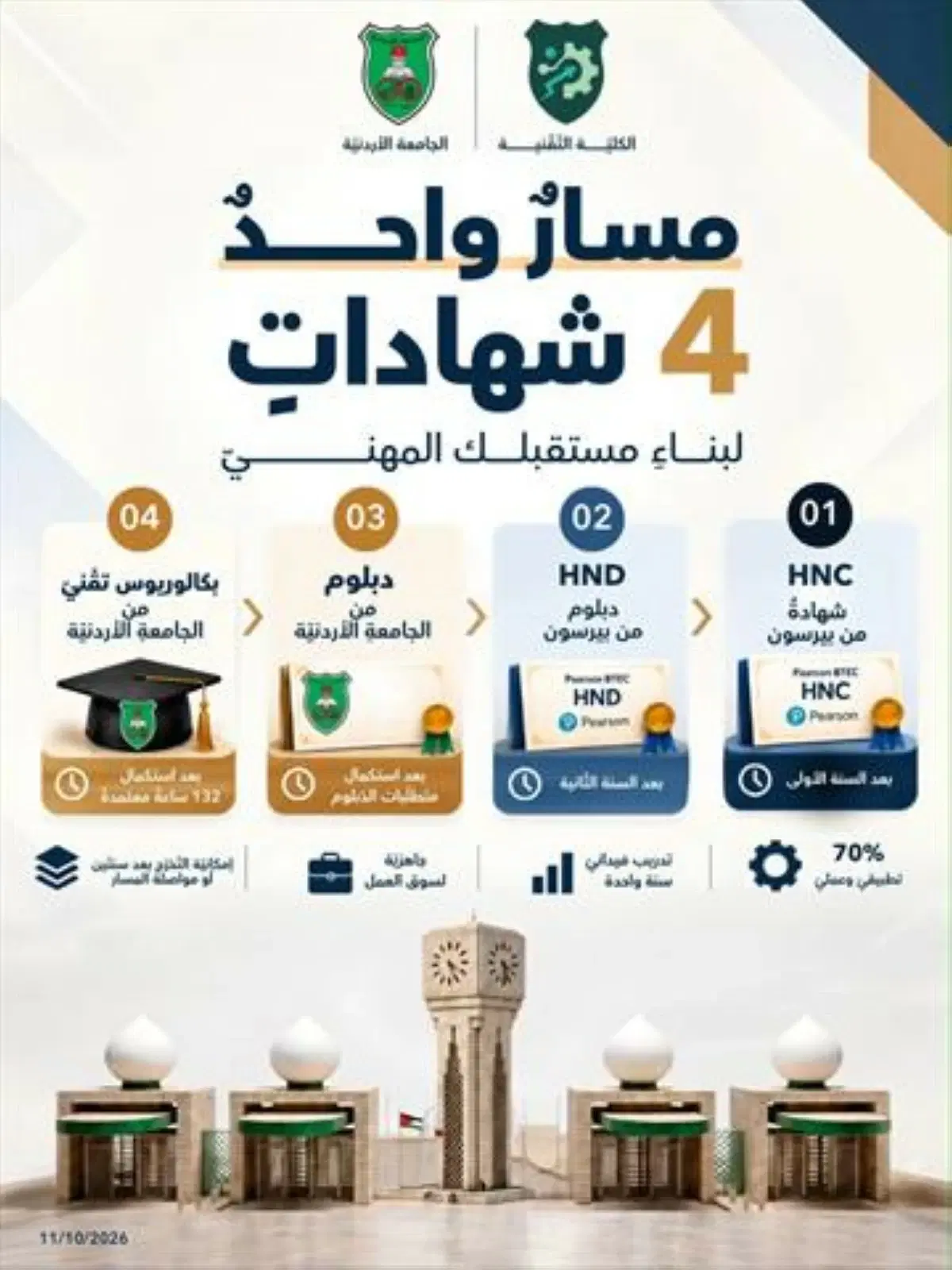
The educational pathway at the college is characterized by its flexibility and multiple outputs. From the early years, students begin building their professional qualifications alongside their university studies. After completing the requirements of the first academic year, they can obtain a professional certificate from Pearson, and then continue the pathway to obtain a technical diploma from Pearson after completing the requirements of the next level.
Afterwards, students continue their studies at the University of Jordan to complete the requirements of the third and fourth years, including academic study, practical application, and field experience, leading to a technical bachelor's degree from the University of Jordan.
Thus, students do not wait until the end of the four years to obtain their first professional qualification, but rather build their qualifications progressively throughout their university journey, enabling them to possess qualifications usable in the labor market at various stages of their study.
From University to the Labor Market
University President Dr. Nathir Obeيدات emphasizes the importance of this direction in expanding the scope of applied education at the university, and linking university knowledge with the practical skills students need before entering the labor market, based on a philosophy that acquiring professional experience must begin from the early academic years, and that students need real opportunities to apply what they learn in environments simulating professional reality.
Obeidat explains that the college relies in its educational approach on equipping students with practical experience, which is achieved through practical training, projects, case studies, laboratories, and working in professional environments, alongside short skill and professional certificates students obtain during their study years, helping them document and highlight their skills before graduation, and granting them a deeper understanding of the nature of the profession and the challenges they may face in the labor market.
He notes that involving expertise from the labor market and certain international educational institutions in building the college's programs and developing its content enhances the alignment of curricula and educational outputs with the actual needs of various sectors, and opens up opportunities for students to learn about practical applications in their fields of specialization, thereby boosting their readiness to transition from studies to professional life.
In the same context, Dean of the College Dr. Hadeel Yaseen points out that the college welcomed 650 male and female students in its first cohort, distributed across seven technical specializations, who enrolled through the unified admission program within programs developed in response to rapid shifts in the labor market and in support of the economic modernization path.
Yaseen explains that the college's programs focus on growing technical and professional fields associated with digital transformation, energy, services, and supply chains, including: data analysis and business intelligence, digital marketing and e-commerce, sustainable supply chains and logistics, renewable energy engineering and green technologies, smart systems engineering, hospitality management and customer service, and digital games development.
She adds that the college's philosophy is not only based on teaching new specializations, but on changing the way of learning itself, so that students progressively transition from acquiring knowledge to applying it, from training to practice, and from practice to acquiring actual professional experience.
Student Bashar, who enrolled in the smart systems specialization within the first cohort, believes that his choice of specialization stems from what it combines of advanced technical and engineering fields, including artificial intelligence, mechatronics engineering, data automation, and the Internet of Things.
He adds that his background in the information technology specialization within the BTEC program contributed to enhancing his interest in this field, and granted him a cognitive foundation that helped him realize the importance of the specialization and its future applications.
He continued that the smart systems specialization is considered one of the modern specializations offered this year at the bachelor's degree level, after previously being offered within postgraduate programs, and he emphasizes that the expansion of its applications and the growing reliance on artificial intelligence techniques and smart systems make it a promising field linked to many future technological development paths.
As for Jana Al-Nsour, a student in the digital games development specialization, she explained that her inclination towards the practical side was among the main reasons for choosing the specialization. She added that the establishment of the Technical College at the University of Jordan, which she described as her preferred university choice, encouraged her to enroll in it due to the technical specializations it offers that combine academic knowledge and practical application, stressing that the nature of study at the college suits her interests and ambitions.
Technical Programs Responding to Labor Market Shifts
The technical bachelor's program in data analysis and business intelligence provides students with knowledge and skills enabling them to deal with data and transform it into information and indicators that can be utilized in decision-making. Students progress in learning data collection, organization, analysis, presentation, and interpretation, alongside databases, statistical analysis, and business intelligence.
As for the digital marketing and e-commerce program, it combines marketing, business administration, e-commerce, and modern technologies, qualifying students to understand market and customer behavior, manage campaigns and digital content, analyze data, develop user experience, and deal with e-commerce channels and digital payment methods.
In the field of sustainable supply chains and logistics, the program focuses on managing the movement of materials, products, and information from supplier to customer, with attention to operational efficiency, modern technologies, and sustainability, including procurement, supplier management, inventory, warehouses, transportation, distribution, risk management, and digital supply chains.
The digital games development program comes in response to the growing growth in the gaming, interactive applications, and simulation industry, combining programming, design, computing, and interactive technologies. It progresses through fields of software development, game design, artificial intelligence, 3D design, modeling, animation, and virtual and augmented reality.
In the energy field, the renewable energy engineering and green technologies program offers education combining engineering foundations and practical application in renewable energy systems, energy efficiency, and green technologies, with a focus on laboratories, projects, and applications related to energy, utilities, and industry.
The smart systems engineering program also focuses on systems that combine hardware, software, sensors, communication, control, and artificial intelligence, combining programming, electronics, embedded systems, automation, the Internet of Things, and machine learning.
In the hospitality and services sector, the Technical Bachelor’s program in Hospitality Management and Customer Service aims to prepare graduates who possess the managerial knowledge and operational and professional skills necessary to work in the hospitality sector, with a focus on customer experience, food and beverage management, lodging, reception, events, digital marketing, and service quality.
The University and the Labor Market in a Continuous Partnership
The Technical College does not view the labor market as a final destination for the student after graduation, but rather as a partner in the educational process; the student's presence in the work environment for a full year allows for building a direct relationship between the university and economic and productive institutions, and helps in continuously developing programs in accordance with professional and technological changes.
This partnership also allows the student to become familiar early on with the nature of the profession they have chosen, to test their ability to apply what they have learned, and to build practical experience that can form their professional starting point after graduation.
Through the Technical College, the university seeks to establish an educational model that makes skill, experience, and application an integral part of the university bachelor’s degree, alongside academic knowledge, and enhances cooperation with productive sectors and labor market institutions.
Its mission is based on providing an applied educational environment that stimulates creativity, innovation, and entrepreneurship, offering competency-based technical programs, linking education to the needs of various sectors, and preparing competencies capable of dealing with rapid technological and professional transformations.
Thus, the Technical College at the University of Jordan offers a different path for university education: it begins with knowledge, transforms into skill, then into practice and experience in the labor market, and ends with a Technical Bachelor’s degree.
The core idea is not for the student to graduate holding only a university degree, but to graduate possessing a professional certificate, technical qualifications, academic knowledge, and a full year of experience in the labor market; it is an integrated system aimed at making the transition from university to professional life more connected and prepared for the reality of work.