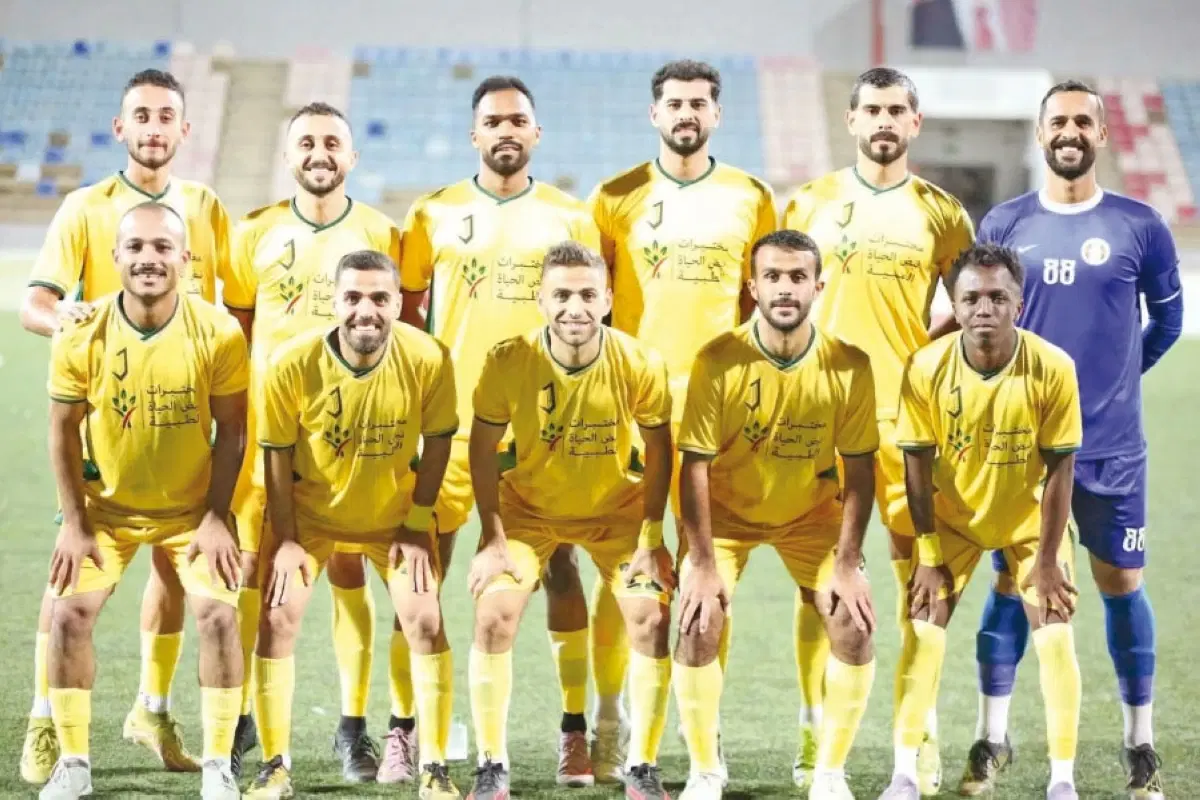
The struggle for points intensifies between the "Professional" teams
Al-Faisaly and Al-Hussein in the summit of the seventh round
Amman12 min read
Share
The professional football league competitions enter their seventh week, starting today, amidst varying calculations among the ten championship teams, which are looking to achieve their goals according to their position on the ranking ladder, in a phase where the features of the competition have begun to become clear gradually, without reaching a point that allows any team to feel secure in its position or lose hope of improving it.
Al-Faisaly continues to lead the standings with 14 points, ahead of Al-Baqa'a and Al-Wehdat, who are tied with 11 points, while Al-Jazeera and Al-Ramtha occupy fourth and fifth places with 9 points each. Al-Hussein Irbid comes sixth with 8 points, then Al-Salt seventh with 6 points, and Doqra and Al-Arabi in eighth and ninth places with 4 points each, while Shabab Al-Ordon occupies tenth place with three points. The new round comes after results that carried more than one implication; Al-Faisaly drew with Al-Jazeera 2-2, Al-Baqa'a won against Al-Arabi by two unanswered goals, Al-Wehdat defeated Shabab Al-Ordon by a clean goal, while Al-Hussein overcame the obstacle of Doqra with a goal to nil, and the Al-Salt and Al-Ramtha confrontation ended in a goalless draw. While Al-Faisaly seeks to establish its footing at the top, the chasers are anticipating any new stumble to pounce on the first place, at a time when the middle teams are looking to get closer to the lead, and the bottom teams are looking for victories to restore balance to their path. With the league continuing in its three-stage system, the importance of points is not limited to the current ranking, but extends to building a competitive balance that can be relied upon in the coming stages, especially since the differences are still subject to change, and one loss or a precious victory may redraw the calculations clearly.
Round Summit
Eyes turn next Saturday evening to the Amman International Stadium, where Al-Faisaly and Al-Hussein meet in a confrontation that is considered the most prominent in the seventh round, given the value of the two teams and their ambitions to compete for the title. Al-Faisaly enters the meeting while at the top of the standings, but realizes that its recent draw against Al-Jazeera, after a match that witnessed four goals, stopped its progress with full points, which makes regaining the winning tone a necessity to maintain a comfortable gap from its closest chasers.
On the other hand, Al-Hussein looks to build on its recent victory against Doqra, and strengthen its balance, which reached 8 points, in an effort to get closer to the leading teams and not allow the gap to widen. The match represents a test of Al-Faisaly's ability to deal with pressure and maintain its offensive effectiveness, in the face of a team that in turn has great motives to confirm its presence in the competition race. Between the leader's desire to strengthen its position and Al-Hussein's ambition to reduce the gap, small details, investing opportunities, and defensive discipline seem to be factors likely to influence the result of the summit.
Below is a highlight of the round's confrontations, according to chronological order:
Al-Salt and Al-Jazeera
Competitions open at six this evening, when Al-Salt hosts its counterpart Al-Jazeera at the Petra Stadium, in a meeting that carries varying importance for both teams, even if the common goal is to collect the three points.
Al-Salt, the seventh-placed team with 6 points, is looking to invest in the land and audience factors to return to victories, after coming out with a goalless draw against Al-Ramtha in the last round. Although the team succeeded in avoiding loss, its need to improve its ability to create opportunities and convert them into goals seems clear, especially since its scoring outcome does not exceed three goals in six matches.
As for Al-Jazeera, which occupies fourth place with 9 points, it enters the meeting with morale based on the draw against Al-Faisaly, in a match during which it showed an ability to keep pace with the leader and reach its goal twice. Al-Jazeera has 13 goals in its balance, which makes it one of the most effective teams at the offensive level, but it is required to address defensive aspects that appeared on more than one occasion, after its net received five goals.
The match gives Al-Jazeera a chance to advance towards the top three, while a win for Al-Salt constitutes an important step towards getting closer to the middle teams, and therefore the nature of the confrontation may force both parties to seek a balance between offensive initiative and defensive caution.
Al-Ramtha and Al-Baqa'a
The round's matches continue tomorrow, Friday, when Al-Ramtha receives its counterpart Al-Baqa'a at five in the evening at the King Abdullah II Stadium, in a confrontation that brings together two teams equal in ambition towards strengthening their position in the advanced area of the table.
Al-Ramtha occupies fifth place with 9 points, after coming out with a goalless draw against Al-Salt in the last round, a result that did not give it the addition it was looking for in the progress race. The team needs to regain offensive effectiveness, after scoring only four goals in six matches, a outcome that forces the technical staff to look for more diverse solutions in building attacks and reaching the opponents' goal.
On the other hand, Al-Baqa'a enters the meeting from second place with 11 points, after achieving an important victory over Al-Arabi by two unanswered goals, confirming its ability to invest in opportunities and come out with positive results that strengthen its position among the chasers. Al-Baqa'a scored six goals against four that its net received, which are numbers that reflect a team that relies on discipline and realism, but it aspires to raise its scoring rate as the competition progresses.
The confrontation carries double importance for Al-Ramtha, which seeks to invest the opportunity to play on its land to reduce the gap with its competitor, while Al-Baqa'a aspires to continue its positive results and maintain its pressure on Al-Faisaly. The ability to impose rhythm in the middle of the field, and reduce errors in defensive areas, may be among the most prominent keys to the meeting.
Al-Wehdat and Al-Arabi
And at seven-thirty tomorrow evening, the Amman International Stadium hosts the confrontation between Al-Wehdat and Al-Arabi, which the hosts enter with an advantage in terms of ranking and recent results, while Al-Arabi is looking for a result that restores its confidence and helps it move away from the danger zone.
Al-Wehdat occupies third place with 11 points, after its victory over Shabab Al-Ordon by a goal to nil, in a result that strengthened its position within the chasing group. Although the team scored only three goals in six matches, it received only one goal, to have the strongest defense among the championship teams until the end of the sixth round. This number reflects the team's ability to organize its lines and limit the danger of opponents, but at the same time it puts offensive effectiveness to a renewed test, as Al-Wehdat needs to invest its defensive superiority in achieving more clear victories.
As for Al-Arabi, it comes in ninth place with 4 points, after its loss to Al-Baqa'a by two unanswered goals. The team needs to improve its performance in both offensive and defensive aspects, after scoring three goals and receiving ten, a outcome that reveals difficulties in dealing with the pressure of opponents and maintaining balance during the match.
The match seems to be an important opportunity for Al-Wehdat to continue pressure on the leader, while Al-Arabi realizes that coming out with a positive result against a competitor of Al-Wehdat's size could constitute a turning point in its path. Hence, Al-Arabi's ability to close spaces and limit the danger of Al-Wehdat's players, in exchange for investing available opportunities, will be a fundamental factor in determining the path of the confrontation.
Al-Faisaly and Al-Hussein
The week continues turning its pages the day after tomorrow, Saturday, at seven-thirty in the evening, at the Amman Stadium, with the meeting of Al-Faisaly and Al-Hussein, in the summit of the round whose importance exceeds the limits of the three points, given the position of the two teams and their ambitions in the competition.
Al-Faisaly possesses a clear advantage in terms of results, after collecting 14 points from four victories and two draws, without being exposed to loss, scoring 13 goals against only three goals in its net. These numbers highlight the team's ability to combine offensive power and defensive solidity, but the recent draw against Al-Jazeera showed that maintaining progress requires constant focus, especially in matches where the pace of pressure rises.
As for Al-Hussein, it seeks to invest its victory over Doqra by a goal to nil, and return with a result that strengthens its position in the competition race. The team has 8 points, but it received ten goals against scoring eight, which forces it to deal cautiously with Al-Faisaly's offensive power, with the need to look for real opportunities to threaten its goal.
The match gains additional importance for Al-Faisaly, which realizes that any new stumble may give the chasers a chance to reduce the gap, while Al-Hussein sees in it an opportunity to confirm its ability to compete with the advanced teams. Between the leader's ambition and the title holder's desire to strengthen its presence, performance details and the ability to invest opportunities will be decisive in drawing the result of the summit.
Doqra and Shabab Al-Ordon
In the final scene of the round's days, Doqra and Shabab Al-Ordon meet at six in the evening at the Petra Stadium, in a match that gains special importance for both teams, given their presence in the latter half of the ranking table and their need to improve their point balance.
Doqra occupies eighth place with 4 points, after its loss to Al-Hussein by a goal to nil, a result that showed its ability to remain close to the competitor, but it did not give it what it needs to strengthen its position. The team scored three goals and received nine, which puts offensive effectiveness and defensive solidity among the most prominent files it must deal with.
As for Shabab Al-Ordon, it languishes in tenth place with 3 points, after losing to Al-Wehdat by a goal to nil. Although the team has not achieved any victory yet, it scored five goals, against ten goals its net received, and it also came out with three draws, which means that it managed to avoid loss in half of its six matches, but it did not succeed in converting that into victories.
The confrontation seems like a direct opportunity for both teams to improve their standing, especially since the difference between them is only one point. A win would be worth more than just adding three points, given the morale boost and confidence it could provide in overcoming this difficult phase. Conversely, a draw might keep the calculations open, but it would not necessarily be the result that meets the ambitions of either side.
Al-Ersan leads the top scorers
On the scoring front, Al-Faisaly star Ahmed Al-Ersan continues to lead the top scorers list with six goals, after scoring twice against Al-Jazeera during the sixth round, confirming his importance in his team's attacking system. Al-Jazeera player Yazan Al-Bakhit comes in second place with four goals, while a number of players are tied with three goals each, namely Ahmed Al-Harahsheh and Yahya Al-Bakhit from Al-Jazeera, Saul Castor from Shabab Al-Ordon, and Abdul Rahman Jarwan from Al-Baqa'a.
These figures reveal a remarkable attacking presence for Al-Jazeera, which has scored 13 goals, the same number scored by Al-Faisaly, with a clear difference in the number of goals conceded; Al-Faisaly's net has received only three goals, compared to five for Al-Jazeera. League teams have collectively scored 61 goals in 30 matches until the end of the sixth round, at an average of nearly 2.03 goals per match, a rate that reflects varied attacking competition between teams, with a need for a number of them to increase their efficiency in front of the goal.
As for goal creation, evaluating this aspect requires a complete statistical breakdown of assists, for which no reliable and updated data has been published as of the end of the sixth round. However, following the attacking roles of players who contribute to building opportunities, alongside the scorers, remains essential to understanding the technical picture more comprehensively, as attacking effectiveness does not stop at scoring alone, but is also linked to the quality of chance creation, off-the-ball movements, and exploiting spaces.
No room for waste
The seventh round comes at an important time in the championship, with Al-Faisaly continuing to lead and multiple competitors capable of closing in on it, against the backdrop of close points between a number of mid-table and bottom teams. No confrontation seems decided in advance, in light of the varying results and the disparity in attacking and defensive capabilities, which forces technical staffs to treat every match as a station that requires a precise reading of the opponent, appropriate selection of personnel, and flexibility in dealing with the flow of the game.
Between teams looking to establish their footing at the top, others seeking to improve their position, and a third group trying to move away from the danger zone, the seventh round seems poised to offer confrontations open to more than one possibility. Winning alone may not be the deciding factor in some matches, but rather how it is achieved, the ability to manage a lead, handle pressure, and maintain focus until the final whistle.
Ultimately, what the ten teams need at this stage is consistency, and not settling for a fleeting positive result, because the league race is long, and the points that seem simple at the beginning may have a significant impact on the competition calculations as the stages progress.
Hence, this round is not just a new stop on the match schedule, but an opportunity for every team to confirm its ambition, correct its path, and send a clear message to its competitors regarding its ability to continue the journey until the end.