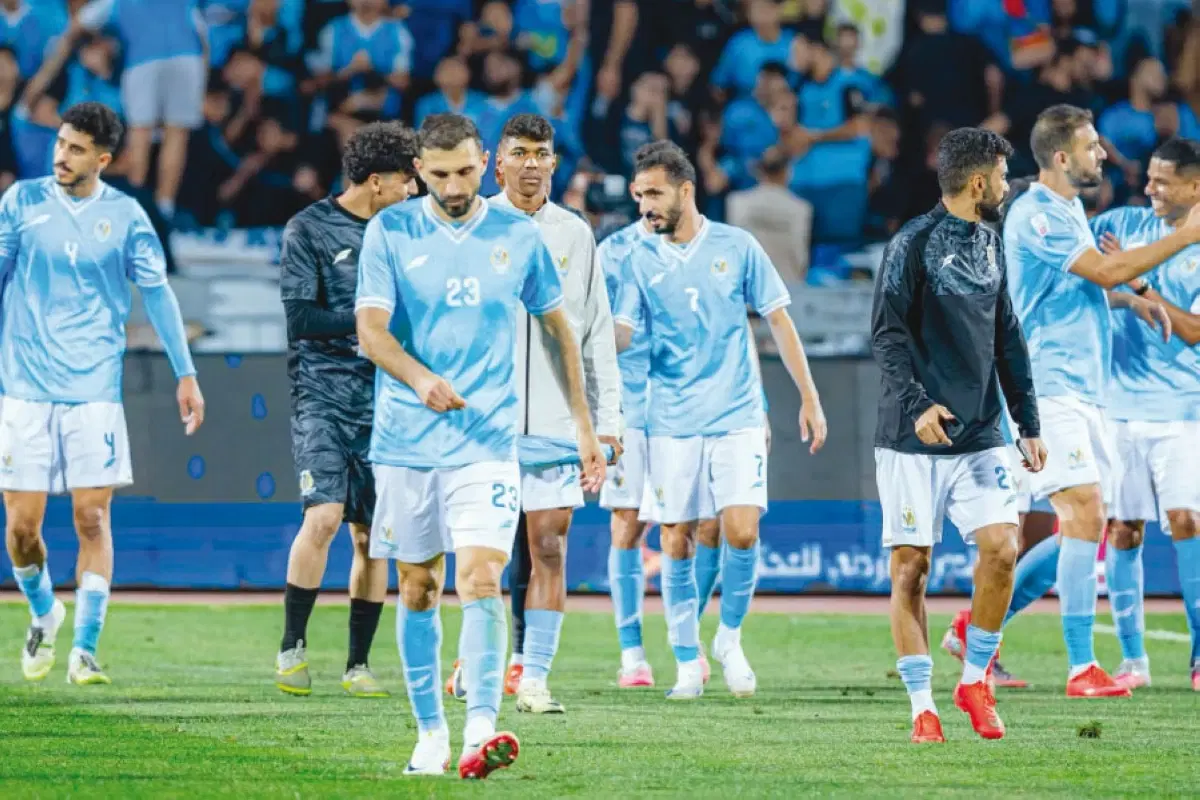
The fifth round was not ordinary in its results and technical performance; Al-Faisaly emerged from it with a broad victory over Al-Ramtha by four goals to one, confirming its ability to combine offensive effectiveness with defensive discipline, while Al-Jazeera presented one of its most prominent performances by winning against Dogara 5-1, confirming that it possesses offensive solutions capable of confusing opponents, despite its need to maintain stability and avoid the fluctuation that could cost it precious points in the coming rounds.
On the other hand, the round's results carried mixed signals for the rest of the teams; Al-Wehdat regained the winning tone by defeating Al-Hussein by a single goal, a result that gives it an important morale boost, while Al-Baqa'a and Al-Salt came out with a goalless draw that did not achieve full benefit for either of them.
On the other side, Al-Ramtha received a heavy loss against Al-Faisaly, after failing to keep up with its opponent's offensive effectiveness, while Dogara paid the price for defensive errors against Al-Jazeera, despite its success in opening the scoring. Al-Arabi also achieved an important victory over Shabab Al-Ordon, with a goal that came late, giving its team three precious points, while Shabab Al-Ordon remained required to find more effective solutions in front of the goal, after the continued difficulty of converting opportunities into positive results.
These data make the sixth week a new station to test the teams' ability to build on what has been achieved and correct the errors that appeared, especially since the point differences between most of the mid-table teams are still limited, which opens the door to tangible changes in the standings table with each round.
Leadership and anticipation
Al-Faisaly imposed itself at the top of the scene after five rounds, raising its tally to 13 points from four victories and a draw, without suffering any loss, and with a goal difference of ten positive goals, after scoring 11 goals and conceding only one goal.
These numbers reflect a remarkable balance between the team's lines and its ability to decide matches, but at the same time, they place it before the responsibility of maintaining the same rhythm, especially since the Al-Jazeera test represents a direct confrontation against one of its most prominent pursuers, which comes in second place with eight points, tied with Al-Wehdat, Al-Baqa'a, and Al-Ramtha, with a difference in goal difference between these teams.
This point cluster represents an indicator that the competition behind the leader is still open, and that one victory could give its owner an important advantage, while a new setback could rearrange the papers and put some teams under the pressure of pursuit.
Al-Jazeera possesses a clear offensive boost after its big win over Dogara, while Al-Wehdat relies on its victory over Al-Hussein, but it needs to show greater effectiveness in the final third of the pitch. As for Al-Baqa'a, it seeks to turn its relative stability into consecutive victories, while Al-Ramtha needs a quick reaction after its loss to Al-Faisaly, so as not to drift away from the competition circle.
In the next zone, Al-Salt and Al-Hussein stand with five points each, and they realize that restoring balance has become a necessity to avoid widening the gap with the leading teams. Al-Arabi and Dogara have four points each, while Shabab Al-Ordon stands in last place with three points, which makes the matches of these teams of double importance, whether in improving their positions or in avoiding entering into complex calculations early.
This distribution means that the sixth round does not carry the importance of the leader alone, but its effects extend to the entire table; a win could bring a team closer to the top, just as another loss could increase the pressure on a team that has not yet succeeded in reaching the level it aspires to.
Al-Bakhit in the spotlight
In terms of scorers, the name of Yaseen Al-Bakhit, the Al-Jazeera player, stands out at the top of the scene after scoring four goals, tied with Arafat Al-Haj, the Al-Wehdat player, and Ahmed Al-Ersan, the Al-Faisaly player, and Ahmed Al-Harahsheh, the Al-Jazeera player, are among the most prominent pursuers, with three goals each.
The competition for the top scorer title is not separate from the collective struggle for points; the team that has more than one source of scoring is usually more capable of dealing with the marking imposed on its top star, which is what teams aspiring to continue at the top need, away from relying on one player or a limited offensive solution.
Professionals.. a value that exceeds names
The importance of the role played by foreign professionals with their teams is renewed in this round, after the last round showed that the real impact is not linked to names alone, but to the player's ability to integrate into the collective system and raise the quality of performance in decisive moments.
These numbers reflect an influential presence for players capable of making a difference, and also give the upcoming confrontations an additional dimension, in light of the scorers' quest to continue scoring, and their teams' reliance on investing their capabilities in matches that may be decided by small details.
The responsibility of professionals increases at this stage, because teams do not need a player who only performs his individual duties, but elements that give the group balance, experience, and the ability to deal with the pressure of matches.
Hence, this round seems like another opportunity for professionals to prove their technical value, whether through scoring and creating opportunities, or through tactical discipline and the ability to control the rhythm of play, which is directly reflected in their teams' results and their positions in the standings table.
Refereeing under the microscope
The repercussions of the fifth round were not limited to results and technical levels, but extended to the controversy that accompanied some refereeing decisions, in light of the sensitivity of the competition and the high value of points as the rounds progress.
Dealing with refereeing cases remains a natural subject of discussion in football, but the most important thing is that this discussion is based on a clear technical review, and that influential decisions receive the appropriate explanation, which enhances confidence and limits the expansion of the space for interpretation and protests.
With the continued use of Video Assistant Referee (VAR) technology in the competition, the importance of accuracy in applying the protocol and clear communication regarding cases that require review doubles. Also, maintaining the calm of players, technical staff, and fans remains a shared responsibility, because if controversy exceeds its limits, it may obscure the technical aspects that deserve attention.
Today.. Al-Hussein + Dogara
The Al-Hussein and Dogara confrontation opens the week's matches today at 6:00 PM at King Abdullah Stadium, in a meeting that both teams enter under the pressure of the need to improve their position in the standings table. Al-Hussein, which has five points, looks to invest its technical capabilities and return to the path of victories after its loss to Al-Wehdat, while Dogara is looking to overcome the effects of the heavy loss against Al-Jazeera and restore the discipline it lacked on the defensive side.
The nature of the match forces Al-Hussein to look for more effective offensive solutions, with the need to avoid the spaces that the opponent might exploit in counterattacks. As for Dogara, it needs to show a different personality and move away from individual errors, while taking advantage of any opportunity that comes its way in front of the goal.
A win gives one of the two teams a precious opportunity to advance towards the middle zone, while a loss will increase the pressure on the side that fails to correct its path. Therefore, defensive details and investing in opportunities seem to be among the most prominent keys to deciding the outcome.
Tomorrow.. Al-Salt + Al-Ramtha
Eyes turn tomorrow at 5:00 PM at Amman Stadium to the Al-Salt and Al-Ramtha confrontation, due to its clear importance for both teams, even if their motives differ; Al-Salt, which has five points, wants to build on its relative solidity, but it needs to improve its offensive performance after the goalless draw with Al-Baqa'a. As for Al-Ramtha, which has eight points, it enters the match looking to compensate for its loss against Al-Faisaly and restore the confidence that was affected by the heavy result.
Al-Salt will have to deal realistically with its opponent's capabilities, while trying to exploit spaces and set pieces, and avoid excessive retreat that might give Al-Ramtha the opportunity to impose continuous pressure.
In contrast, Al-Ramtha needs to restore balance between its lines, improve defensive coverage, and not leave the spaces that cost it goals in the last round.
The three points seem important for both sides; Al-Salt wants to get closer to the leading teams, and Al-Ramtha does not want to lose more ground to its competitors, which makes the confrontation open to multiple possibilities.
Friday.. Al-Jazeera + Al-Faisaly
The Al-Jazeera and Al-Faisaly confrontation, at 7:30 PM in Al-Quweismeh, advances to the forefront of the sixth week's matches, given the position of the two teams in the standings table and the ambition of each of them to achieve a result that strengthens its position in the competition race.
Al-Faisaly enters the match leading with 13 points, after its big win over Al-Ramtha, and it realizes that continuing the victories will give it an additional advantage and put its competitors before a more difficult task in reducing the gap. But the Al-Jazeera confrontation differs in its nature from the previous meeting, because the opposing team also possesses offensive solutions that appeared clearly in the 5-goal victory over Dogara.
Al-Jazeera relies on investing in the morale state it is experiencing and trying to exploit the factors of speed and movement in the spaces.
The match gains double importance for Al-Jazeera, because a win will give it a big boost in the race for the top, while a victory for Al-Faisaly constitutes a new step towards consolidating the lead.
As for a draw, it may serve the calculations of other teams awaiting the summit's results, making the management of the match's minutes and handling its crucial moments a key factor in determining the outcome.
Saturday.. Al-Arabi + Baqaa
Al-Arabi seeks to continue its recovery after defeating Shabab Al-Ordon, when it meets Baqaa at Petra Stadium at 5:00 PM on Saturday, following a goalless draw with Al-Salt. Al-Arabi enters the match with four points, setting its sights on achieving a new victory that moves it away from the bottom places, while Baqaa, holding eight points, looks forward to returning with a positive result that strengthens its presence among the front-running teams.
A victory gives Al-Arabi an important opportunity to approach the mid-table teams, but it needs to capitalize on the morale it has gained and avoid relying on waiting until the final minutes to decide the match.
As for Baqaa, it seeks to turn its defensive balance into a more effective attacking output, after failing to score in the previous round.
The match requires both parties to handle its course clearly; Al-Arabi is required to take the initiative without sacrificing balance, and Baqaa needs to impose its rhythm and benefit from the experience of its players in managing matches that carry clear points pressure.
Saturday.. Shabab Al-Ordon + Al-Wehdat
The week's matches conclude with the meeting between Shabab Al-Ordon and Al-Wehdat at 7:30 PM in Al-Quwaisama, in a matchup bringing together a team looking to escape the bottom of the standings and another aspiring to get closer to the top.
Shabab Al-Ordon enters the match in last place with three points after losing to Al-Arabi, putting it under a real necessity to seize this opportunity and restore confidence, especially since continued setbacks could increase pressures as the competition progresses. The team needs to improve its ability to create chances and not settle for limited attempts, while maintaining defensive focus against an opponent that possesses elements capable of exploiting mistakes.
As for Al-Wehdat, holding eight points, it enters the match with high morale after defeating Al-Hussain, but realizes that the previous victory will not have full value unless it succeeds in building upon it. It will be required to enhance attacking effectiveness, control the match tempo, and avoid giving its opponent a chance to get back into the game.
A victory carries different importance for each team; Shabab Al-Ordon needs the points to correct its course, while Al-Wehdat aims to capitalize on any stumble by rival teams and advance in the standings. Hence, the matchup appears to be a test of the ability to handle pressure, rather than technical capabilities alone.
Points and Stability
With the arrival of the sixth week, the value of points begins to rise, not because the season is approaching its decisive stages, but because the features of the competition have begun to clear up, and each team has become more aware of what it needs to achieve its goals. Al-Faisaly seeks to protect the top spot, while Al-Jazeera, Al-Wehdat, Baqaa, and Al-Ramtha look forward to narrowing the gap, as the rest of the teams try to improve their positions and avoid widening the margin.
In a tournament held in three stages, it is not enough to achieve a standout victory or put on a good performance; rather, the competition requires the ability to sustain momentum, deal with different opponents, and overcome setbacks as quickly as possible. Moreover, maintaining technical stability, raising the efficiency of capitalizing on chances, and minimizing defensive errors will remain crucial factors in determining the teams' paths.