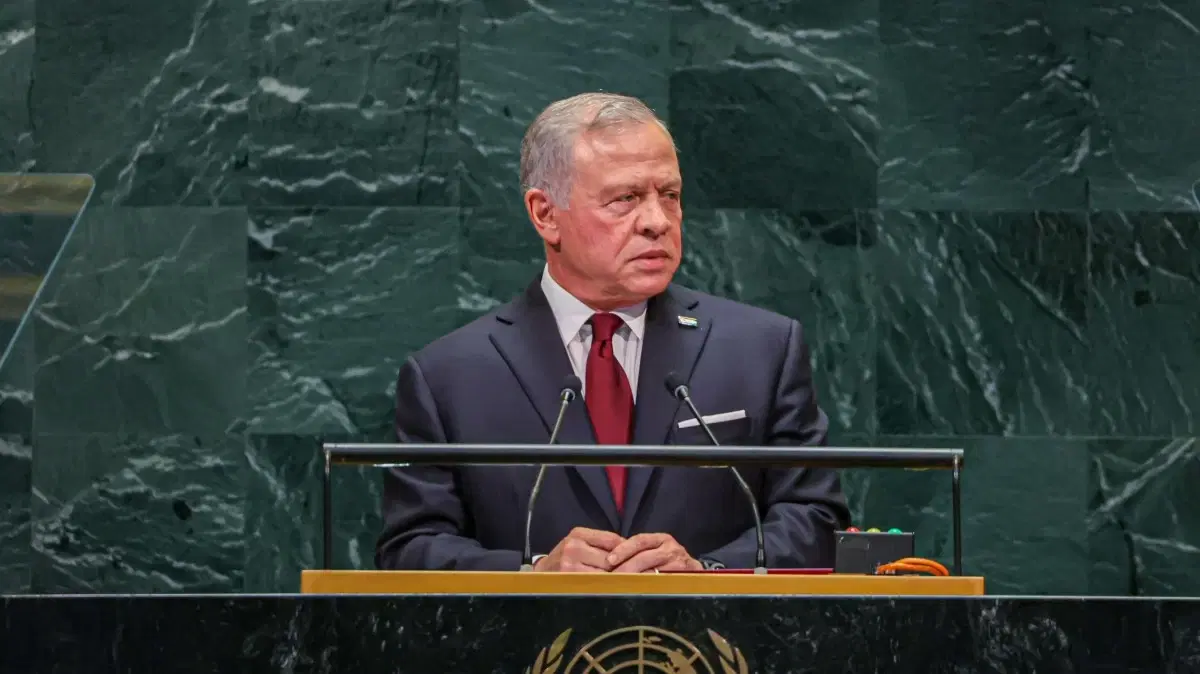
From the analytical perspective of the extensive royal diplomatic movement in the corridors of the United Nations General Assembly during its '81st' session, led by His Majesty King Abdullah II, through his contacts and meetings with leaders of countries, heads of governments, and international officials, the Jordanian proposal sought to strengthen support for the Palestinian cause and emphasize the necessity of protecting the security and sovereignty of Arab countries and to push towards a political path that restores stability to the region.
Reading the Jordanian diplomatic scene through the international platform in New York clarifies the extent of the multiplicity of diplomatic pathways, as Jordanian diplomacy moves through parallel pathways, including the bilateral relations pathway through meetings of His Majesty the King with leaders and heads of governments, in addition to the multilateral pathway through the United Nations and its Secretary-General and international organizations, and then the political pathway directly linked to the crises of the region, primarily the Palestinian issue, the situation in Gaza and the West Bank, and Jerusalem, alongside the security of Arab countries.
The meeting of His Majesty the King with the Secretary-General of the United Nations, Antonio Guterres, as one of the most important meetings, carried with it a Jordanian message to the international institution that sustainable regional stability is linked to guaranteeing the legitimate rights of the Palestinian people and the establishment of an independent Palestinian state based on the two-state solution, as His Majesty warned of the risks of settlement expansion, annexation of territories, and violations in Jerusalem.
The public indicator in the meeting of His Majesty the King with the Secretary-General of the United Nations was clearly the recognition of the strength of the Jordanian role and its political discourse, which was followed by the leadership of the international organization, in addition to praising the efforts of Jordan, under the leadership of the King, in supporting peace and regional and international stability, and cooperation with United Nations agencies.
According to observers, the Jordanian diplomatic movement in New York reaffirmed that the Palestinian issue still occupies a central position in Jordanian, Arab, and international foreign policy, considering it an Arab and international issue and its direct link to the security and stability of the region.
Here, one of the features of the Jordanian diplomatic discourse at this stage appears through linking security, politics, and the economy, as well as linking the Palestinian issue to regional stability, so that the files do not appear separate from each other.
Political analyst and legal expert, Professor of Public Law, Dr. Mu'ath Abu Dlu, said that the Jordanian diplomatic movement was not just protocol meetings but aimed to strengthen Jordan's position according to the regional equation, especially in light of highly sensitive events and times, in addition to linking Jordan's national and strategic security to regional and international security.
Abu Dlu pointed to His Majesty the King's emphasis in his speech on the necessity of stopping the escalation in the region and preserving the security of Arab countries, which means working to bring aid into the Gaza Strip and ending the escalation in the West Bank and Jerusalem, referring to Israeli movements and repercussions in Syria and Lebanon and attempts to expand in the region.
He added that the Jordanian diplomatic movement can be looked at from several angles, meaning that Jordan wants to be present in shaping the situation and not just a recipient of results, noting the King's meeting and presence with Arab and Muslim leaders in an important political meeting that discussed regional escalation in the presence of President Donald Trump, which could be a turning point for the Palestinian issue, meaning turning it from a political file related only to the Palestinians into a regional security and stability issue, which the King emphasized the necessity of the world acting to protect the Palestinians, protect Jerusalem, and preserve the two-state solution.
Abu Dlu said that Jordanian diplomacy has proven that national and strategic security is not isolated, separate, or distant from its regional environment, pointing to the King's talk about Syria and Lebanon and that Jordan will preserve its national security, borders, and water resources.
He added, I believe that Jordanian diplomacy always tries to move to protect the state, protect the holy sites, the Palestinian issue, and protect Christian and Islamic holy sites, and also try to keep Jordan always stable, indicating that the royal diplomatic movement was not enough for Jordanian diplomacy to be active in the region and active in international influence pathways and in defending its national and national issues.
Professor of Political Science, Dr. Rasha Al-Mubaideen, said that the meetings of His Majesty King Abdullah II in New York revealed the movement of Jordanian diplomacy in a wide space that brings together the United Nations, bilateral relations, international organizations, Arab coordination, economic and political partnerships, pointing out that in the 81st session of the General Assembly, Jordan worked through a series of meetings with leaders of countries, international officials, and the Secretary-General of the United Nations to keep the Palestinian issue at the heart of international discussion and link it to the security and stability of the region, while highlighting Jordanian interests and emphasizing that regional peace and peace require addressing the roots of the conflict, respecting international law, the rights of peoples, and the sovereignty of states.
She added that, from this perspective, the New York meetings, for Jordanian diplomacy, are more than an annual station, but they have formed a space for gathering political pathways, coordinating messages, and opening channels with international powers, in addition to turning the Jordanian position into a direct dialogue with the influential parties in the future of the region.
She continued that from this angle, the royal movement in New York formed an extension of a broader Jordanian diplomatic path that is based on employing international relations to serve interconnected goals, supporting the Palestinian cause and the right of Palestinians to establish their state, as well as pushing towards reducing escalation and finding a path to peace, with an emphasis on protecting Jordanian interests and national security.