The Council of Ministers approves the strategy for localizing the drone industry and a package of service and regulatory decisions
Amman14 min read
Share
Approval of the adoption of the National Strategy for Localizing the Drone Industry in the Kingdom for the years 2026 – 2036.
Approval of the regulation on the conditions for granting, renewing, or amending electricity licenses for the year 2026, which applies to emerging activities in the sector.
Approval of the draft regulation for licensing companies providing households with cleaning female workers for the year 2026.
Approval of the Ministry of Health's strategy for the years 2026 – 2030, for the ministry to begin completing the procedures for its launch and starting its implementation.
Approval of the reasons underlying the draft amending regulation for the federations regulation for the year 2026.
Approval of the reasons underlying the draft regulation for organizing the affairs of university colleges and intermediate community colleges for the year 2026.
Approval of the reasons underlying the draft amending regulation for the administrative organization regulation of the General Iftaa Department for the year 2026.
Approval of including the Baptism Site (Al-Maghtas) within the national network of protected areas, and declaring it a nature reserve with an area of 10 square kilometers, coinciding with the beginning of preparations to celebrate the second millennium of the baptism of Jesus Christ in 2030.
Approval of the draft law ratifying the agreement on the extradition of persons between the government and the government of the Kingdom of Morocco for the year 2026; in preparation for referring it to the House of Representatives to proceed with its enactment according to constitutional procedures.
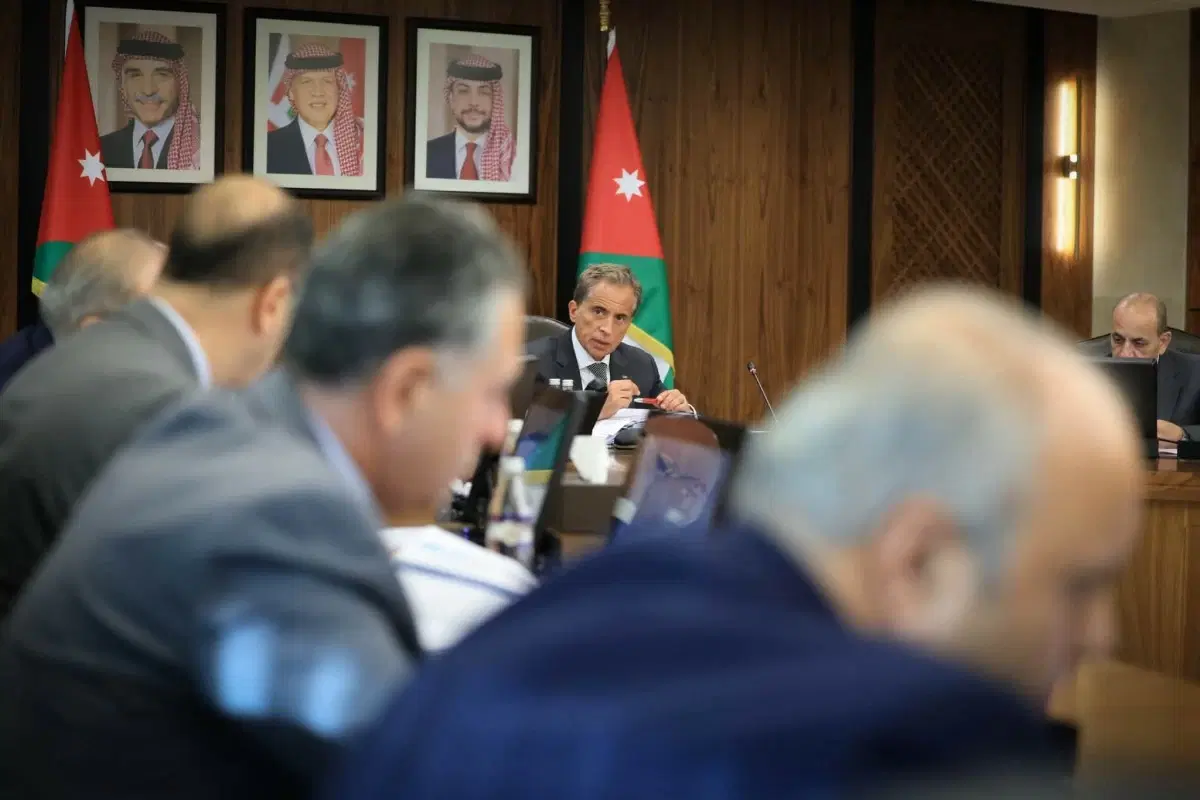
The Council of Ministers decided in its session held today, Tuesday, chaired by Prime Minister Dr. Jafar Hassan, to approve the adoption of the National Strategy for Localizing the Drone Industry in the Kingdom for the years 2026 – 2036; in preparation for proceeding with its implementation according to the timeframes and programs specified therein.
The strategy aims to build an integrated national industry in this field, gradually moving the Kingdom from importing this technology to developing, manufacturing, assembling, integrating its systems, and testing them locally; thus enhancing the added value to the national economy and expanding opportunities for Jordanian competencies and companies.
The strategy proceeds from the premise that the drone industry is not limited to manufacturing or assembling the aircraft, but is based on an integrated ecosystem that includes software, electronics, communications, navigation, control systems, energy, structures, integration, and testing; building knowledge and engineering and technical capabilities within the Kingdom, raising local added value, and not being satisfied with merely assembling imported components, thereby allowing the development of advanced national expertise that can extend its impacts to other industrial and technological sectors.
This industry is linked to wide-ranging service applications that directly affect the citizen's life, including agriculture and resource management, infrastructure and power line inspection, mining, municipal and logistics services, surveying, monitoring, and emergency response, enabling the use of technology to raise the efficiency of services provided to citizens, accelerate their completion, and reduce their cost in the future. The strategy was based on an assessment of national capabilities in this field, which included dozens of Jordanian companies, showing an industrial and engineering base capable of development, as 15 universities participated in assessing the research capabilities associated with this industry, to link these capabilities during the next stage within a more integrated national system capable of production and development.
The strategy targets five main axes including: building a national industrial base for developing and manufacturing drone products; consolidating Jordan's position as a regional hub for systems integration, testing, and verification; deepening local capabilities in high value-added technologies and systems, linking scientific research to the drone industry, and stimulating local demand to support innovation and industrial development.
The strategy attaches great importance to the development of education and training in line with industry needs, by updating engineering programs and curricula, expanding practical training, linking student and graduation projects to real industrial challenges, and strengthening partnerships between universities, companies, and research and development centers; so that academic knowledge transforms into solutions and products applicable to industry. The strategy adopts a realistic approach to localizing this industry; focusing on areas where Jordan can build added value, knowledge, and competitive capabilities, such as software, communications, testing, and engineering development, while benefiting from standard imported components when local manufacturing is unfeasible, thus directing investment toward the highest value areas for the national economy.
The Council of Ministers also approved the regulation on the conditions for granting, renewing, or amending electricity licenses for the year 2026.
The regulation comes for the purposes of supporting and facilitating investment in the energy sector, based on the provisions of the effective General Electricity Law, and in a manner that takes into account the legislative necessities and requirements for specified activities.
The approval of the regulation is considered a step aimed at developing the regulatory framework for the electric energy sector, enhancing its operational efficiency, and stimulating investment through simplifying and unifying licensing procedures, and establishing fair and clear principles for fees, thereby achieving a balance between sector regulation requirements and empowering economic activities.
The regulation also includes setting incentive fees for practicing energy storage activity, which contributes to enhancing the stability of the electrical system and raising its capacity to absorb the expansion in the use of renewable energy systems, in line with the objectives of the energy sector strategy.
The regulation includes a package of strategic incentives supporting the transition in the energy sector, most notably exempting the independent transmission activity and its associated generation dedicated to green hydrogen production projects from licensing fees, which contributes to keeping pace with modern green hydrogen production technologies and encouraging investment in this promising field.
The regulation aims to unify, organize, and facilitate the procedures for granting and renewing licenses for electricity sector activities, and update the legislative framework to keep pace with technical and digital developments and newly introduced activities in the energy market.
The draft regulation comes within the framework of simplifying service procedures provided to investors and operators, by merging licensing conditions into a single legislative text that is easy to apply and ensures the stability of procedural paths.
The draft regulation adopts incentive mechanisms, including zero-value fees for newly introduced activities with a positive impact on the electricity system, such as renewable energy storage and independent transmission activities, in support of investment, innovation, and keeping pace with energy transition requirements.
It also aims to ensure the integration of electrical networks with renewable energy resources, enhance technical governance, and create a balanced legislative environment that supports sector growth.
The approval of the regulation comes in the context of developing the legislative and regulatory environment for the electricity sector, which enhances its investment attractiveness, supports the sustainability of the energy system, and establishes a balance between regulatory efficiency and the requirements of economic growth and transition toward clean energy.
The Council of Ministers also approved the licensing regulation for companies providing households with cleaning female workers for the year 2026.
The regulation comes for the purposes of regulating affairs related to companies providing households with cleaning female workers, by setting special provisions for their licensing, procedures for granting and renewing these licenses, and cases of their cancellation and suspension by the Ministry of Labor.
The regulation also determines the obligations incumbent upon companies providing households with cleaning female workers, the procedures and penalties taken against violating companies, and limiting violations resulting from the spread of the phenomenon of advertisements on social media and media outlets for the purpose of providing house cleaning services, and preserving the rights of beneficiaries of the services they provide.
The regulation allows for the establishment of companies for house cleaning services and supplying the service requester with female workers for house cleaning according to a service contract concluded between them on a daily, weekly, or monthly basis through Jordanian and non-Jordanian female workers.
Companies licensed under the regulation provide the service of supplying households with one or more cleaning female workers under a service contract without this including the overnight stay of the female worker in the house. The company licensed for this purpose is required to provide special housing for the female workers, a specific uniform for them, and submit a bank guarantee to ensure good performance, which is renewed annually before its expiry date.
Companies licensed under the regulation for licensing companies providing households with cleaning female workers are prohibited from recruiting any female worker except through a licensed entity in the country with which an agreement or memorandum of understanding has been signed between it and the government.
Companies licensed under the regulation are obligated to qualify and train female workers in cleaning work, and to keep copies of employment contracts concluded with female workers and proof of their inclusion in social security.
The regulation does not allow non-Jordanian female workers who are employed or recruited in the profession of house cleaning worker to transfer to any other sector.
Within the framework of legislation related to administrative modernization and institutional development, the Council decided to approve the Ministry of Health strategy for the years 2026 – 2030, for the ministry to begin completing the procedures for its launch and starting its implementation.
The Council assigned the ministry to review the plan annually to ensure the link between allocations, program priorities, outputs, and performance indicators; to ensure directing spending toward programs with the highest impact and achieving the best possible efficiency in the use of available resources / contributing to narrowing the funding gap, which is reflected in improving the services provided to citizens.
The Ministry of Health's strategy represents the national and institutional framework to guide the ministry's efforts towards developing a more efficient, high-quality, equitable, and sustainable health system, in line with lofty royal directives, the Economic Modernization Vision, the Public Sector Modernization Roadmap, and the Sustainable Development Goals.
The strategy comes in response to health, financial, demographic, and technological challenges, with a focus on enhancing prevention, improving service quality, raising spending efficiency, developing infrastructure, digital transformation, and boosting national and international partnerships.
It aims to provide an advanced and integrated health system that promotes the health of the individual and society, and delivers safe and comprehensive preventive, therapeutic, rehabilitative, and palliative health services with equity, quality, and efficiency, while carrying out the regulatory and supervisory role over services related to population health and safety in active partnership with relevant entities to achieve universal health coverage.
The strategy constitutes a roadmap for developing the Ministry of Health and enhancing its leadership, regulatory, and service roles, contributing to improving population health, quality of life, and achieving universal health coverage.
The strategy includes six main pillars: 1- Primary and preventive health care, aiming to enhance prevention and early detection, develop family health services, combat communicable and non-communicable diseases, and establish primary care as a main gateway to the health system.
2- Health care: developing therapeutic and specialized services, raising clinical quality and patient safety, and improving referral and treatment pathways as well as emergency and ambulance services.
3- Human resources: developing health and administrative competencies, closing job gaps, enhancing continuous training and medical specialties, and raising productivity and institutional efficiency.
4- Infrastructure, electronic transformation, and supply: modernizing and expanding health facilities and equipment, accelerating digital transformation, developing health information systems, and enhancing the efficiency of supply chains.
5- Insurance coverage and financial sustainability: expanding universal health coverage, improving the efficiency of spending and health financing, reducing duplication, and enhancing the financial sustainability of services.
6- Governance: enhancing good governance, quality, oversight, and accountability, developing health risk and crisis management, supporting medical tourism, and boosting institutional performance.
The Council also decided to approve the reasons underlying the draft amending regulation for the Federations Regulation for the year 2026, in preparation for referring it to the Legislation and Opinion Bureau to proceed with its enactment according to due process.
The draft regulation aims to institutionalize the governance of federations of various types, composed of a number of associations, raise performance efficiency, enshrine administrative decentralization, and digitalize procedures, in implementation of the objectives of the Economic Modernization Vision related to accelerating the pace of digital transformation and ensuring institutional assessment and accountability based on key performance indicators.
The Council also decided to approve the reasons underlying the draft regulation for organizing the affairs of university colleges and intermediate community colleges for the year 2026, in preparation for referring it to the Legislation and Opinion Bureau to proceed with its enactment according to due process.
The draft regulation aims to provide a detailed, integrated legislative framework that regulates the affairs of official and private university colleges and intermediate community colleges, defines their governance and management structures, and regulates the formation of their councils, competencies, and mechanisms for selecting their academic leaderships, including deans and academic department heads.
The draft regulation also defines the powers, responsibilities, and institutional relationships among university colleges in a manner that suits their nature and role in the higher education system.
The Council of Ministers decided to approve the reasons underlying the draft amending regulation for the administrative organization regulation of the General Ifta Department for the year 2026, in preparation for referring it to the Legislation and Opinion Bureau to proceed with its enactment according to due process.
The draft regulation comes in view of the need to develop the department's organizational structure and reorganize the departments, units, and their administrative affiliations in a manner that suits the nature of the tasks and competencies undertaken by the department and work requirements, contributing to addressing any overlap or duplication in tasks and ensuring roles and competencies.
Under the amendments, specialized organizational units will be established with the aim of enhancing the department's capabilities in the fields of digital transformation and religious media, keeping pace with technical developments, raising the efficiency of institutional performance, and improving the level of services.
Concurrently with the start of preparations to celebrate the second millennium of the Baptism of Jesus Christ in 2030, the Council of Ministers decided to approve the inclusion of the Baptism Site (Al-Maghtas) within the National Network of Protected Areas, and to declare it a nature reserve with an area of 10 square kilometers, and to complete the necessary procedures in accordance with governing laws and legislations.
The decision comes based on the exceptional environmental value enjoyed by the Baptism Site, alongside its global religious, cultural, and historical importance.
According to studies and field surveys, the area includes an integrated ecosystem representing one of the most important natural habitats on the eastern bank of the Jordan River, where riverine and wetland environments intertwine with valleys and plains to form an interconnected network providing food, shelter, and breeding and resting sites for a large number of living organisms.
The Baptism Site is inscribed on the UNESCO World Heritage List, giving it exceptional importance that combines natural heritage and cultural heritage simultaneously.
The proposed nature reserve covers an area including the Baptism Site, its natural areas, valleys, and associated habitats, including Wadi Kharrar, Wadi Gharaba, and the areas connected to the Jordan River.
The impact of declaring the Baptism Site a nature reserve will not be limited to protecting plants and animals, but will also contribute to enhancing the protection of the nature surrounding the world heritage site, supporting scientific research and long-term environmental monitoring programs, establishing a biodiversity database, in addition to developing eco-tourism, cultural tourism, and religious tourism sustainably, and providing economic opportunities for local communities through tourism and research services, without causing conflict with current land uses.
Within the framework of international cooperation, the Council of Ministers approved the draft law ratifying the extradition treaty between the government and the government of the Kingdom of Morocco for the year 2026, in preparation for referring it to the House of Representatives to proceed with its enactment according to constitutional procedures.
The draft law comes in line with the close relations between the two brotherly countries, and the frameworks for strengthening them in all fields, and in accordance with the provisions of the law.
On another front, the Council of Ministers decided to appoint Yasser Mukhaimer Faris Hantouli as Director General of the Jordan Hejaz Railway, after obtaining the highest marks in the competition conducted under the government leaderships regulation.