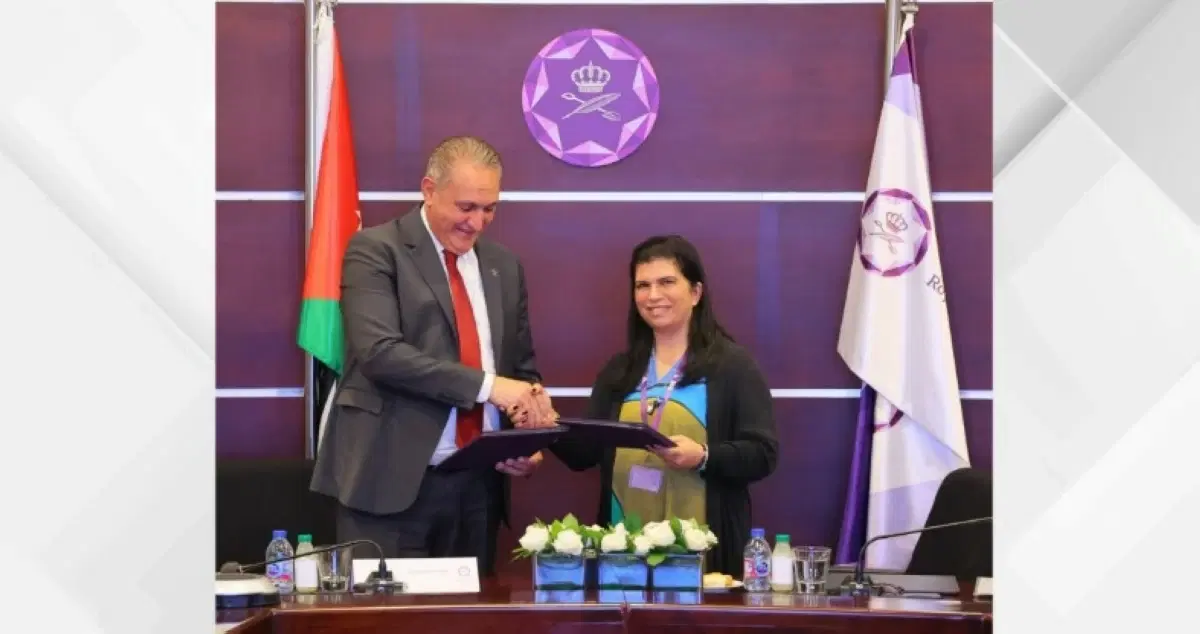
Princess Sumaya and the Minister of Environment Sign a Technical and Research Cooperation Agreement
Amman4 min read
Share
Her Royal Highness Princess Sumaya Bint Al-Hassan, President of the Royal Scientific Society, and Dr. Ayman Suleiman, Minister of Environment, signed a framework agreement for technical and research cooperation on Thursday.
The agreement aims to enhance institutional partnership between the Royal Scientific Society and the Ministry of Environment to expand areas of cooperation in environmental studies, monitoring, measurements and environmental analysis, and support decision-making based on scientific data and evidence.
The agreement provides for the use of the scientific, technical and laboratory capabilities available at the Society in the implementation of studies, programs and projects that serve the priorities of the Ministry and the adoption of the Society as a technical arm to support decision-making.
The areas of cooperation in the agreement include monitoring the quality of surface and groundwater, dam and river water, and treated water, air quality and emissions monitoring, soil monitoring, as well as climate change studies, green economy, circular economy, integrated natural resource management and waste management, in addition to environmental studies and specialized technical assessments.
The agreement includes the implementation of technical and scientific research and studies, conducting environmental and laboratory measurements and analyses, and implementing capacity-building and training programs and knowledge transfer.
Her Royal Highness affirmed that the agreement reflects the importance of employing science and technology in the service of national priorities, stressing that the Royal Scientific Society believes that environmental protection and efficient management of natural resources require that decisions and policies be based on reliable scientific data and advanced national capabilities.
Her Royal Highness said that this agreement represents an important step to deepen the partnership with the Ministry of Environment, and to put the scientific, technical and laboratory capabilities of the Society at the service of national efforts to face environmental and climate challenges and support the sustainable development path.
Her Royal Highness added that cooperation between national institutions should go beyond the implementation of studies and measurements to convert scientific research and environmental monitoring results into applicable knowledge that contributes to the development of policies, improvement of practices and building national capacities.
Dr. Suleiman emphasized the importance of the agreement in enhancing the technical and scientific capabilities of the Ministry, pointing out that this agreement represents an important framework for enhancing cooperation with the Royal Scientific Society and benefiting from its specialized expertise and technical and laboratory capabilities, which supports the Ministry's efforts in environmental monitoring and evaluation and the preparation of specialized studies, and helps to improve the efficiency of response to environmental challenges and decision-making based on scientific data and evidence.
He said that the Ministry wishes to expand work with the Society on a number of major projects in the environmental field, such as the Yarmouk Basin water, the national water carrier, reserves, waste, recycling and reuse.
He added that the Ministry looks forward to working with the Society to expand the scope of work from the local to the regional level in various environmental fields through the submission of joint proposals, including proposals for the Union for the Mediterranean.
He said that Jordan, as one of the countries most affected by the repercussions of climate change, attaches great importance to benefiting from climate financing and directing it towards supporting environmental and climate projects and programs, and benefiting from the presence of the regional office of the Green Climate Fund in Jordan, which enhances the Kingdom's ability to attract financing and implement projects with sustainable impact.
He explained that the Ministry is working to promote the green economy and the blue economy, and to expand the scope of projects linked to them, which contributes to supporting sustainable development, enhancing the efficiency of resource use, and creating new economic opportunities that take into account environmental and climate requirements.
Following the signing of the agreement, it was agreed to hold working meetings between those concerned in the Ministry and the Society to determine priorities and develop implementation plans for the framework agreement, which contributes to expanding and deepening areas of cooperation, and serves the public interest.
It was agreed to implement the projects, studies, monitoring programs and activities specified through independent implementation agreements or contracts, which determine the scope of work, outputs, time schedule, responsibilities and implementation mechanisms for each project.