"Parliamentary Administrative Committee" discusses commercial zoning and administrative value of Jordan Valley lands
Amman5 min read
Share
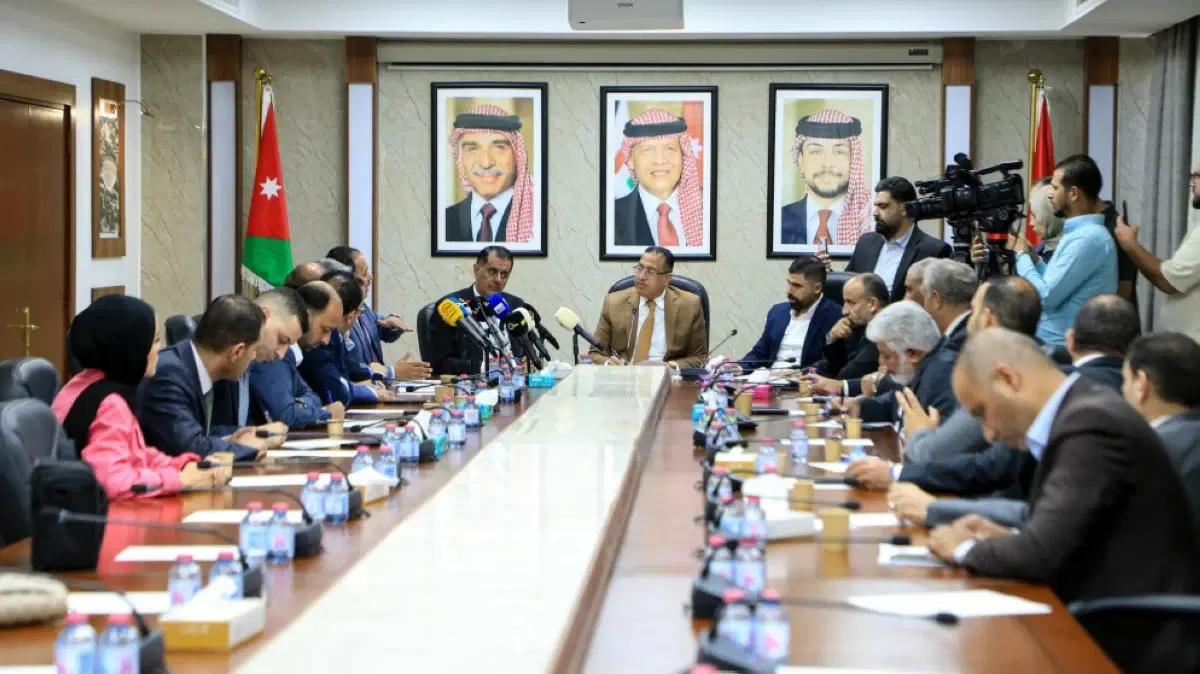
The Parliamentary Administrative Committee, chaired by MP Khalifa Al-Diyat, discussed on Wednesday a number of files and issues related to the Jordan Valley regions, primarily the commercial zoning of frontages located on the public road, the estimated value of residential units, the criteria for their allocation, the dues owed to retirees of the Greater Irbid Municipality, as well as the file of daily-wage workers and the permanent appointment of those among them who hold academic qualifications.
Al-Diyat said, in the presence of the Secretary-General of the Jordan Valley Authority Hisham Al-Haisa, the Secretary-General for Local Affairs at the Ministry of Local Administration Mohammed Al-Amoush, the Assistant Secretary-General of the Ministry of Water Omar Salameh, and a number of concerned parties, that the committee discussed the regulation of commercial frontages on the public road and the licensing of existing or proposed projects. He pointed to the consensus to present these projects to the Jordan Valley Authority, provided that the area of the agricultural unit on which the project is located is not less than 25 dunums, that there are no encroachments on the public road, and with the approval of all partners, in preparation for taking the appropriate decision in coordination with the Ministry of Local Administration.
Regarding the adoption of the registration value issued by the Jordan Valley Authority instead of the administrative value determined by the Department of Lands and Survey, Al-Diyat explained that the committee held a number of meetings with the relevant authorities, and a recommendation was made to the Ministerial Services Committee to re-adopt the registration value, in preparation for submitting it to the Council of Ministers to take the appropriate decision in this regard.
Regarding the criteria for allocating residential units, Al-Diyat confirmed that there is no change to the approved criteria, noting that the committee discussed the issue of areas allocated to beneficiaries, the estimated value of the units, and the outstanding dues, in addition to demands related to proving residency for the region's residents.
He added that the committee will discuss the cases of the region's residents who do not have school certificates, or their children within the second batch, after the completion of distributing units to applications that meet all conditions, noting that the subject will be subject to study and taking the appropriate and fair decision, in three batches.
Al-Diyat indicated that there is a committee including representatives from the Ministry of Local Administration, the Public Service and Administration Commission, and the Cities and Villages Development Bank, which is tasked with studying the cases individually and taking the appropriate decision regarding them, in a way that ensures the achievement of justice and benefit for the largest possible number of eligible persons.
For their part, MPs Mohammed Al-Ghuwairi, Wissam Rabeihat, Abdel Hadi Breizat, Tayseer Abu Orabi, Ahmed Al-Olimat, Raed Al-Dharaweh, Bakr Al-Haisa, Hamed Al-Rahamneh, Ibrahim Al-Mahameed, Mutaz Al-Harout, Suleiman Al-Zabin, and Malik Al-Taharweh called for the rehabilitation of the Ghor-Dead Sea road and the northern regions, given its importance and need for maintenance and rehabilitation works, stressing the necessity of preserving agricultural land, especially in the Jordan Valley regions.
For his part, Al-Haisa confirmed that one of the tasks of the Jordan Valley Authority is to preserve agricultural land, stressing the necessity of separating agricultural land from land allocated for housing, and not changing the status of agricultural land.
He pointed out that the administrative value of Jordan Valley lands is under study, explaining that any encroachment on residential land with an area exceeding 400 square meters is dealt with according to the prevailing price per square meter, stressing the importance of achieving a balance between residential and agricultural land.
Al-Haisa indicated that despite water scarcity and limited water sources, the agricultural index in the Jordan Valley remains high, noting that technical committees have worked on studying files related to the railway project and the expansion of the Arab Potash Company, pointing out that the expansion of the Arab Potash Company will reflect positively on the national economy, and that the expansion does not exceed 1 percent of the agricultural land area in the Jordan Valley.
Regarding the Ghor road, Al-Haisa explained that it is a through road, and that all observations and proposals related to it will be studied.
For his part, Al-Amoush said that the Ministry of Local Administration seeks to preserve agricultural land in various regions of the Kingdom, and to enhance food and water security, in line with national trends in this field.
Regarding the file of daily-wage workers in the Ministry of Local Administration, Al-Diyat called for finding a radical solution to the issue, while the MPs demanded the permanent appointment of daily-wage workers who hold university degrees and those who do not, and to accelerate the appointment procedures, stressing the importance of providing job stability for employees.
For his part, Al-Amoush said that the ministry is committed to appointing about 1,900 daily-wage workers, noting that the first batch was appointed about two weeks ago, and that the door for objections to the appointment decisions has been opened, provided that the objections are studied and the second batch is appointed next month, while the last batch will be appointed next February.
Regarding the appointment of daily-wage workers who hold university degrees, Al-Amoush explained that they fall into two categories; the first are those who were appointed before obtaining the degree, and the second are those who were appointed while holding the degree and did not disclose it, denying any intention to terminate the services of any of them, and indicating that a committee will be formed to study their files individually and take the appropriate decision regarding them.
Regarding the water sector, the MPs stressed the necessity of finding quick solutions to the problem of water distribution rotations in the governorates, in light of the many complaints received from citizens, calling for improving distribution mechanisms and addressing imbalances to ensure the fair delivery of water to citizens.