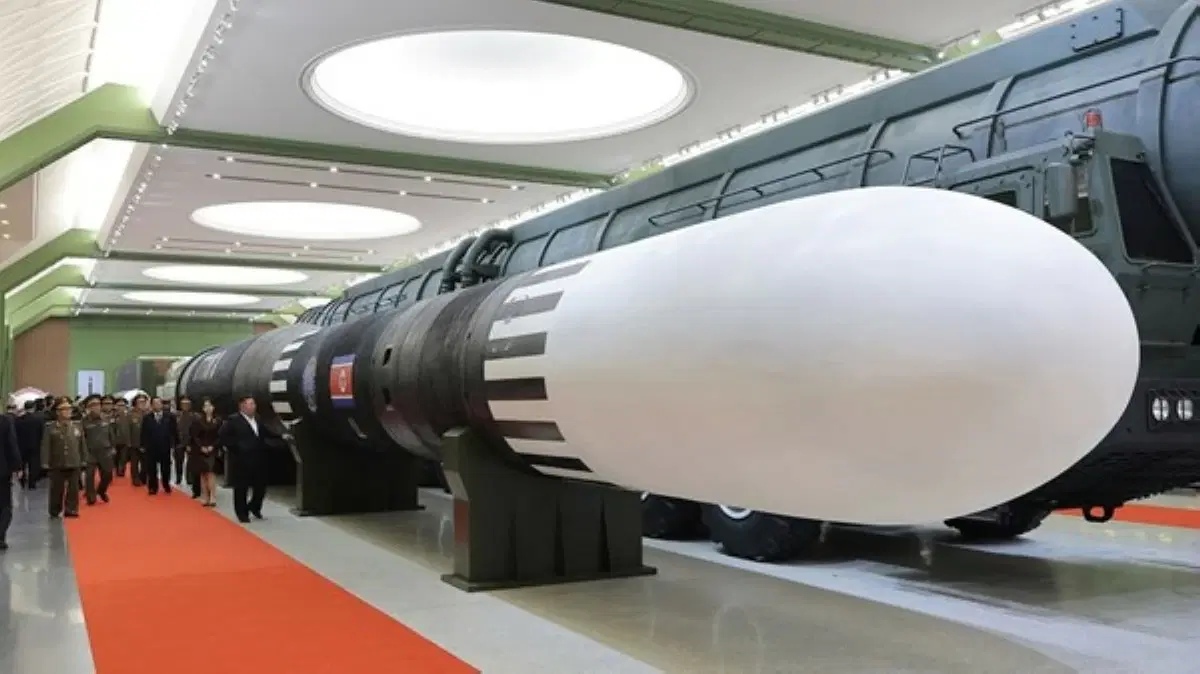
Pyongyang has conducted a test of a "new type" of guided torpedo system that uses artificial intelligence technologies for target detection and guidance, the official Korean Central News Agency reported on Saturday, as the nuclear-armed state intensifies its weapons testing.
This comes two days after North Korea announced the launch of two types of strategic cruise missiles from submarines, and weeks of tension with Seoul following the explosion of two landmines on the border between the two parts of the peninsula.
Analysts believe that Pyongyang may be accelerating the development of its missile capabilities with Russian military support, in exchange for sending troops to support Moscow in Ukraine.
The agency stated that an underwater launch test of the high-speed "Zam-2.0" system was conducted on Thursday with the aim of "verifying the success of the technical upgrade process" for this weapon.
It added that "artificial intelligence technologies were applied to the target detection and guidance functions of the new-generation high-speed guided torpedo."
It confirmed that the test proved the "core technology for increasing propulsion efficiency and the performance of the missile propulsion device," adding that it has completed "more than 180 rounds of various tests over the past five years."
North Korea had previously announced earlier this month the testing of a medium-range hypersonic missile powered by artificial intelligence technologies. At the time, it said there was "no way to avoid" the hypersonic missile, asserting that it is "capable of changing its flight path at low altitude."
Analysts say that torpedoes are designed to strike enemy targets underwater at high speed, but the introduction of artificial intelligence may also allow them to perform evasive maneuvers and make decisions that mislead the adversary.
Lim Eul-chul, a professor at Kyungnam University, told Agence France-Presse, "South Korea and the United States use decoys to divert torpedoes, but artificial intelligence could help distinguish between real targets and decoys."
"From torpedoes to submarine-launched weapons, Pyongyang is pouring its resources into showing that US strategic assets can be neutralized," he added.
In September, North Korean leader Kim Jong Un emphasized the need to "strengthen the use of artificial intelligence" in domestic weapons systems.
The announcement on Saturday came at a time when the two Koreas appear to be intensifying an arms race in the field of hypersonic missiles.
Hypersonic missiles fly at more than five times the speed of sound and can maneuver during flight, making them more difficult to track and intercept.
Days after North Korea announced it had tested an AI-powered medium-range hypersonic missile, Seoul conducted a test of its own weapon in this field, a hypersonic glide vehicle it described as a "key strategic asset capable of changing the course of the battlefield."
For its part, Pyongyang questioned the success of this test this week, suggesting that Seoul may have "failed to achieve supersonic flight," a claim denied by South Korea.
The weapons tests come amid growing speculation about a potential meeting between US President Donald Trump and North Korean leader Kim Jong Un, as world leaders prepare to participate in the APEC summit scheduled to be held in China in November.
After several attempts met with silence from Pyongyang, Trump said again this week that he "might" meet with North Korean leader Kim during his Asian tour next month.
Yang Moo-jin, former president of the University of North Korean Studies in Seoul, said that ahead of a potential summit between North Korea and the United States, Pyongyang appears to be "trying to downplay South Korea's hypersonic missile program to portray itself as being ahead of Seoul, Washington's ally, in the arms race."
However, he added that North Korea might need more time to develop its torpedo system, especially in reducing the noise it emits underwater.
Yang noted that "at high underwater speeds, the torpedo emits significant noise, making it easier to detect."
He considered that "reducing this noise represents a major technical challenge that requires advanced technology, and it seems that North Korea has not yet reached this level."