Morocco's Football Boom: Clubs, Academies, and Young Talents Shaping the Next Generation
Amman7 min read
Share
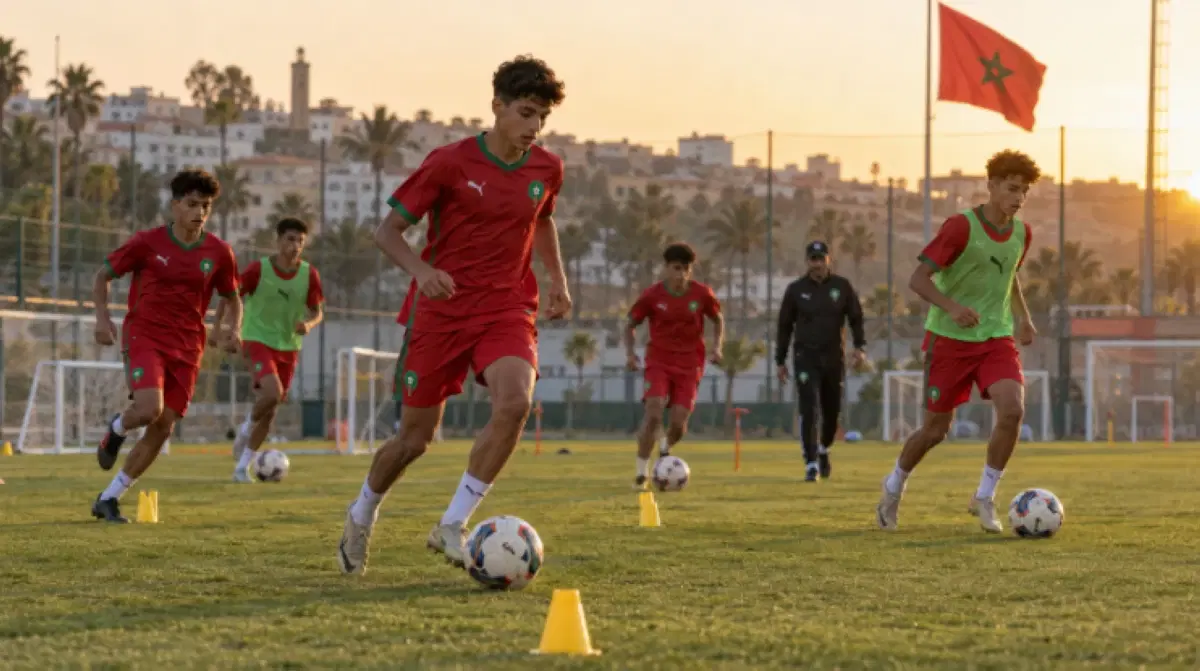
On the night of October 19, 2025, Moroccan café screens stayed lit until late. Phones were opened to live score apps, cheers rose with every ball approaching Argentina's goal, and whoever couldn't find a chair stood at the door watching from afar. Those who saw the match from the outside thought it was a surprise, but those who know Moroccan football closely realize that what happened in Santiago came from small pitches, academies, and clubs that spent years working away from the spotlight. And this is the story of that path.
In Morocco, football begins before a child even learns the players' names. A plastic ball in a neighborhood alley, a replica jersey of Wydad or Raja, and an endless debate over who deserves a spot in the lineup. This is where all official projects start, and it is also where the habit of digital tracking comes from, which drives some adult fans to search for code promo 1xBet before opening an account on an online sports betting site, just to experience the league match with greater enthusiasm. This remains entertainment for those of legal age and respects the applicable laws, and it does not guarantee a win for anyone. Football always surprises, and that is why we love it.
What has changed in recent years? Several things came together, most notably:
New stadiums and training centers
A federation working with all age groups, from youngsters to the senior national team
Clubs beginning to treat youth categories as a long-term investment
Players developed in Europe who chose the Moroccan shirt
Continental and global results that made children believe that the dream is possible
No single element of these is enough on its own. But when the federation's work, the clubs' efforts, and the return of the diaspora's sons come together, the result appears on the grass. And in any talk about development, one name comes first.
The Mohammed VI Football Academy was established more than fifteen years ago. The Kingdom's official portal states that its mission is to spot young talents, develop them, and accompany them toward the high level. The academy combines training and education, which is important, because a football career, no matter how long it lasts, ends at an early age and a whole life remains after it.
Youssef En-Nesyri, Azzedine Ounahi, Nayef Aguerd, and Ahmed Reda Tagnaouti all passed through there, and they were all in the national team that reached the semifinals of the 2022 World Cup, an achievement unmatched by any African team before. Since then, the transfer of academy graduates to Europe has repeated almost every summer, and Telquel magazine discussed their presence in the transfer market between the Netherlands, Belgium, France, and Spain in early September.
The picture is broader than a single academy. Wydad and Raja in Casablanca, AS FAR in Rabat, and Nahdat Berkane in the east, all have youth categories whose output the public awaits every season. Wydad won the CAF Champions League in 2022, and Nahdat Berkane lifted the Confederation Cup more than once. Whoever plays in the junior category today sees these cups and tells themselves that the path is not far.
This table summarizes the four paths that a talented young Moroccan passes through today:
Path
Starting Point
What Distinguishes It
What the Player Needs
Mohammed VI Academy
Selecting talents from various regions of the Kingdom
Sports training alongside education
Discipline and consistency
Club Academies
Youth categories in Wydad, Raja, AS FAR, and Nahdat Berkane
Proximity to the first team
Patience while waiting for the opportunity
The path of the diaspora
Academies in the Netherlands, Belgium, Spain, and France
High competition and European methodology
Decision to represent Morocco
The Neighborhood and Small Football Schools
Proximity pitches and local tournaments
First discovery of talent
A coach's eye to notice it
No single path guarantees success alone. However, the multiplicity of routes gives Moroccan football a rare diversity: a player who came out of a national academy might find himself in a European league two years later, and another who started in his neighborhood team paves his way inside a major club, then the two meet in the national team's dressing room.
Many players of Moroccan descent were born and raised in the Netherlands, Belgium, Spain, and France, and some of them could have played for those countries' national teams. The decision here is not just about football; it touches the family, the language, and the summer vacation spent every year in the motherland. And when they choose Morocco, the national team finds talents trained in different football schools, which is reflected in its style of play.
In Santiago, the Moroccan under-20 national team defeated Argentina two goals to nil in the Youth World Cup final, becoming the first Arab country to lift this title and the second African team to do so after Ghana in 2009. Before the final, they overcame South Korea and the United States, then France on penalties in the semifinals.
Yasser Zabiri scored both goals in the first half, Othmane Maamma won the Golden Ball as the best player in the tournament, and the team was led by coach Mohamed Wahbi. The former plays for Portuguese club Famalicão and the latter for English club Watford, meaning some of the heroes of that night were already training in Europe before turning twenty-one. Off the pitch, the image of neighborhood children talking about professionalism as if it were a near appointment remained in memory.
And let's not forget the defense. Ismail Baouf and Fouad Zahouani closed down the spaces against an Argentine team that dominated possession most of the time, and goalkeeper Idriss Guermouche saved what remained. The title came from a complete squad.
Football in Morocco is no longer a men's-only affair. The women's national team reached the round of 16 of the 2023 World Cup in their first participation, and AS FAR Women won the CAF Women's Champions League in 2022. Every tournament the country hosts opens a door for girls who dream of turning professional and see names resembling them on the screen.
There is no single recipe, but the road usually passes through these stations:
Regular play in the neighborhood or school, where a coach notices the first signs of talent.
Joining a football school or a youth category in a local club.
Passing selection trials at an academy or a larger club.
Combining training and education throughout the development years.
Playing with age-group national teams.
Signing the first professional contract, in Morocco or abroad.
Not everyone follows this order. Some players return from Europe to the Moroccan league, and others start at home then travel. But the doors open today are more than they used to be.
At the café during the Casablanca derby, you will notice a familiar scene: one eye on the big screen and one eye on the phone. One reads the lineup, and another reviews the odds on a betting site like 1xBet. There is no need for exaggeration; numbers have become part of the viewing experience for many. The important thing is moderation: a budget set before the match, stopping at the first sign of fatigue, and not chasing losses. Betting on football is for adults only, and its laws vary from one country to another.