4500-year-old shipwreck reveals secrets of Pharaohs' trade
Amman4 min read
Share
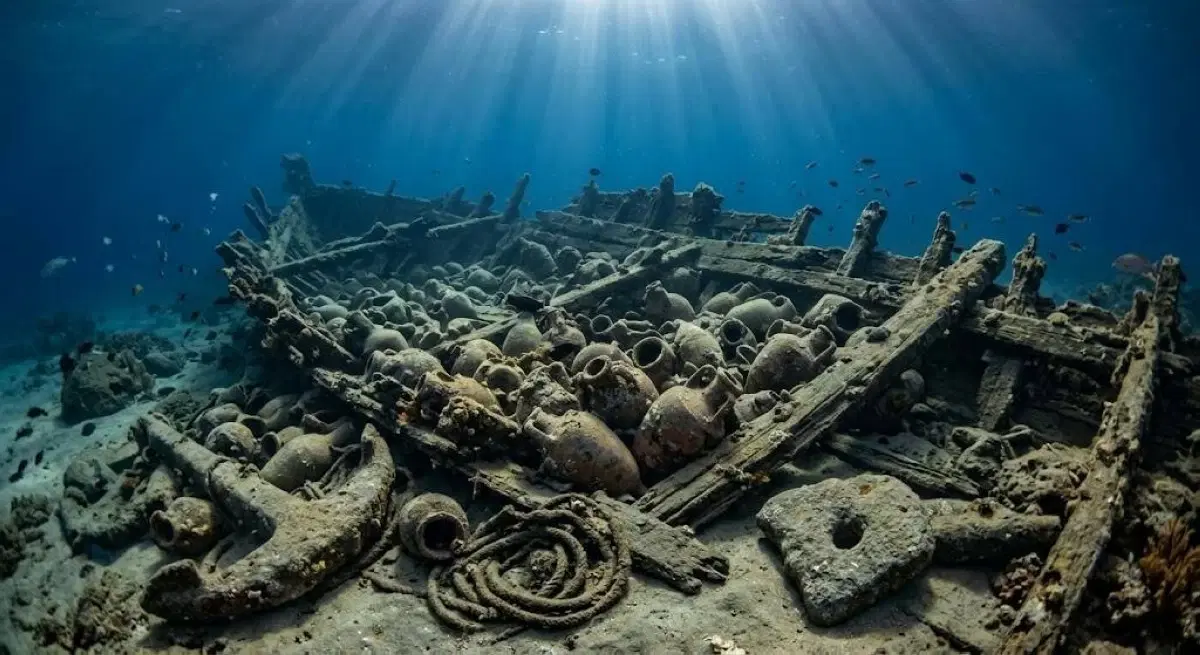
Archaeologists suggest that a shipwreck discovered off the coast of Kekova, near the city of Antalya in southern Turkey, dates back to between 2700 and 2400 BC, which could make it the oldest known shipwreck in the world, at approximately 4,500 years old.
This discovery is expected to contribute to redrawing the picture of maritime trade in the Eastern Mediterranean during the Early Bronze Age and shed light on trade links between Ancient Egypt, the Levant, and Anatolia.
A discovery that began with information from sailors
The search operations were led by Turkish archaeologist Hakan Öniz, an associate professor at Akdeniz University, who found the wreck in 2024, benefiting from information provided by local sailors. In 2026, he enlisted the help of researcher Karin Sowada, a specialist in Egyptology and director of the Australian Centre for Egyptology at Macquarie University, to assist in determining the age of the pottery jars discovered at the site.
Preliminary estimates indicate that the ship dates back to between 2700 and 2400 BC, but the dating still requires further scientific tests and analyses. The results have not yet been published in a peer-reviewed scientific journal, so the description of the wreck as the oldest in the world remains a possibility that needs confirmation.
Pottery jars storing the secrets of the past
Although most of the ship's wooden structure has disappeared due to the passage of thousands of years, parts of its cargo remained stuck between rocks on the seabed. Over four months, divers worked to extract the pottery jars, amidst thick layers of barnacles and marine organisms attached to the rocks.
The cargo included large, oval-shaped jars with flat bases and two handles, some of which were distinguished by a prominent clay belt around their widest part. The shapes of the jars and their manufacturing methods helped in determining their potential origins and estimating their age.
Traces of the contents of some jars are still visible to the naked eye, while researchers await the results of analyses to determine the nature of the goods accurately. Possibilities include olive oil, wine, and tree resin, which are commodities associated with trade in the Eastern Mediterranean during that era.
Preliminary estimates indicate that some of the jars, or the clay used to make them, may have originated from the Middle Jordan Valley region, which reinforces the possibility that the ship collected its cargo from more than one port during its journey.
A potential link to the world of the Pharaohs
The importance of the discovery gains greater dimension because it dates back to the era of the construction of the Giza pyramids in Egypt. In the third millennium BC, Egypt exchanged goods with regions of the Eastern Mediterranean, through ports including Byblos in Lebanon, and imported materials that were not locally available, such as cedar wood, metals, oils, tree resin, lapis lazuli, and silver.
Researchers believe that the ship may represent important physical evidence of the expansion of navigation and trade networks at that time, networks whose details remain largely unclear, as their understanding relies heavily on ancient Egyptian texts and archaeological finds discovered in tombs and historical sites.
It is not yet known which port the ship was heading to, but its location between two islands off the southern coast of Turkey suggests that it was sailing along the coast, and perhaps sought refuge in the area to shelter from a storm before crashing into the rocks. Researchers also raise the possibility that its sailors were inhabitants of the Levantine coast.
Does the discovery change the history of navigation?
If subsequent studies confirm the age of the wreck, it may precede the wreck found off the Greek island of Dokos, estimated to be about 4,200 years old, to become the oldest shipwreck known to date.
The discovery, according to researchers, confirms the importance of Turkey's southern coasts as a rich archaeological record of the history of ancient navigation. It also opens the door to new questions about the nature of sea voyages and the paths of commodity exchange between Egypt, the Levant, and Anatolia about 4,500 years ago.
While the sunken ship awaits the results of scientific analyses, its pottery jars seem like a time capsule that may reveal a new side to the story of maritime trade in the ancient world.