The King affirmed that what is happening in Gaza can no longer be considered "temporary military measures or consequences of war," while the West Bank, according to His Majesty, is witnessing a radical shift represented by the expansion of settler violence, land seizure, settlement expansion, and the displacement of Palestinians, stressing that Gaza and the West Bank are "two sides of the same Israeli strategy."
His Majesty pointed out that the international community possesses tools to act, including sanctions, asset freezes, imposing embargoes, and diplomatic isolation, but he said that decisions regarding Israel remain "ink on paper," warning that the expansionist ambitions of the Israeli government have become a regional threat, and of the repercussions of Israeli incursions into southern Syria and the imposition of new facts on the ground.
The King stressed that any threat to Jordan's northern borders or its water security is a threat to national security, saying: "Jordan will not look away; rather, we will protect our security, our water, and the interests of our people," while confirming at the same time the Kingdom's continued commitment to combating terrorism and drug smuggling, strengthening its defense capabilities, and building its economic, trade, and technological ties with the region.
His Majesty renewed Jordan's commitment to a just peace and support for the steadfastness of the Palestinian people and UNRWA, and the continuation of carrying the trust of the Hashemite Custodianship and preserving the historical and legal status quo of the Islamic and Christian holy sites in Jerusalem, emphasizing that Jordan's adherence to diplomacy does not supersede its commitment to humanitarian values, and should not be misconstrued as weakness.
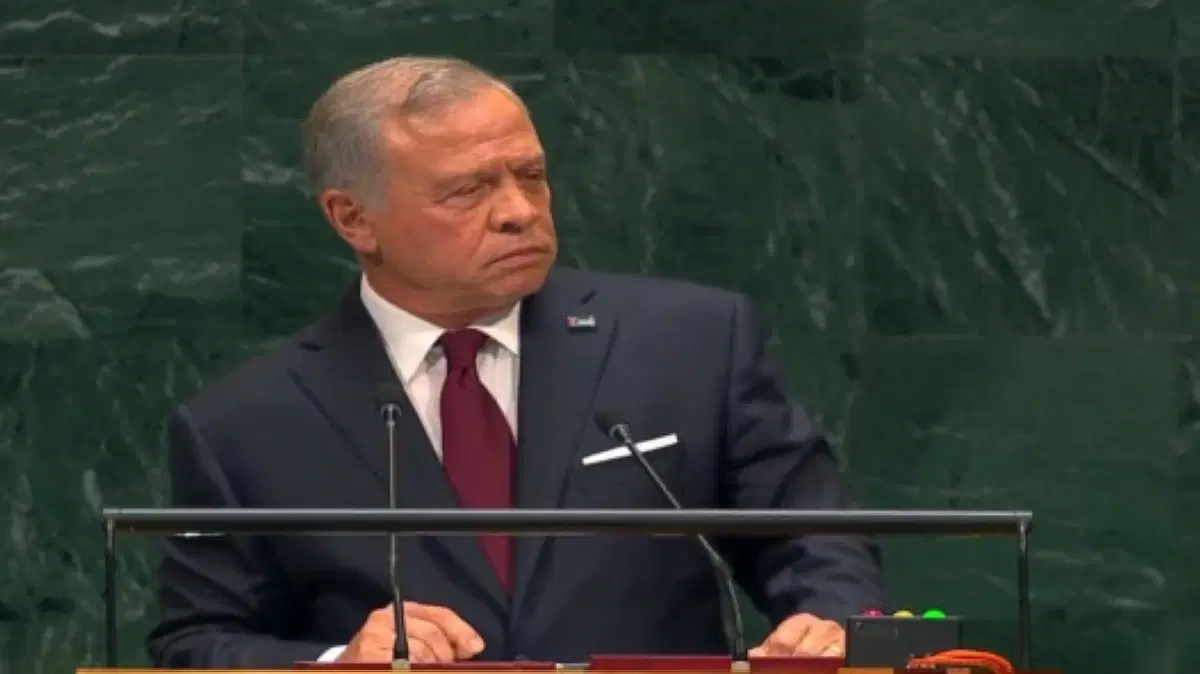
The following is the text of His Majesty King Abdullah II's speech:
In the name of God, the Most Gracious, the Most Merciful
Mr. President,
Mr. Secretary-General,
Your Excellencies,
Every generation believes it faces unprecedented challenges, and perhaps that is indeed true for us.
We are living in an exceptional moment in history; the world has never before witnessed such a massive volume of knowledge and such an accelerating pace of change. Every day brings with it a new crisis, a new tragedy, and a new emergency that demands our attention.
One study indicates that the average attention span of an individual while watching a screen has dropped from two and a half minutes in 2004 to just 47 seconds now.
There is no doubt that the screen does not reflect the entire world, but this change reflects a broader truth about our era today: our attention has become a scarce resource, and choosing what we give our attention to has become more important than ever before.
In this hall, attention is not just a cognitive resource, but it is also a geopolitical resource.
What we choose to pay attention to determines which conflicts receive sustained diplomatic efforts and which recede to the margins of the agenda, and it determines whether a ceasefire in one place will last after the camera lens departs, whether humanitarian suffering in a region will remain unacceptable or turn over time into something familiar, and whether the world will move to stop a crisis or turn its back and move on.
History rarely catches us off guard; most of the time, events unfold while we are busy with other matters that capture our attention.
The challenges we face, such as economic inequality, food insecurity, and climate change disasters, did not appear overnight. The warnings were clear, but the question is: will our attention last long enough to address these challenges?
For what we neglect today often shapes our future.
Your Excellencies,
We are witnessing the consequences of this neglect every day; in my region, from Lebanon to Yemen, through to Sudan, protracted conflicts are exacerbating humanitarian suffering.
And if anyone has the slightest doubt that the crisis in our region remains contained within it, they only need to look at the energy and food bills of ordinary families in various parts of the world: from Mumbai to Madrid to Minnesota.
The Iran war has shown how quickly instability can disrupt trade, investment, and people's lives outside the region's borders.
And let us not forget Gaza.
For decades, I have stood before this General Assembly and warned of the dangers of leaving the Palestinian-Israeli conflict unresolved, but the international community chose to contain the conflict rather than address its resolution.
And every new Israeli violation is treated as a temporary matter, which diverts attention from the reality that is being gradually imposed on the ground, until the temporary has become permanent, and the permanent has become a policy.
Of course, this is not the only injustice in the world, but the continuation of one of the world's longest occupations poses a fundamental question: if international law can be ignored for decades, what remains of its value? And how can we apply it if we do not even acknowledge its violations?
In Gaza, the evidence is overwhelming: in the first 300 days of what was called a ceasefire, at least 300 Palestinian children were martyred. The Jordanian field hospitals there were targeted. President Trump made strenuous efforts to achieve peace and find a path to end this war, but the current Israeli government continues to ignore the agreement, continue its attacks and destruction of civilian infrastructure in the Strip, refuses to withdraw, and tightens the noose on Palestinians to confine them to what barely reaches a third of Gaza's area.
It is no longer possible to consider all of this as temporary military measures or consequences of war; accountability begins when we call things by their true names: an attempt to erase the Palestinian presence and impose a new reality in Gaza.
And while the world is preoccupied with the events in Gaza, the West Bank is witnessing extremely dangerous developments.
Some might think that the same scene is repeating itself: settlements, violence, and displacement, but what we are witnessing is not just an escalation, but a radical shift in the situation in the West Bank.
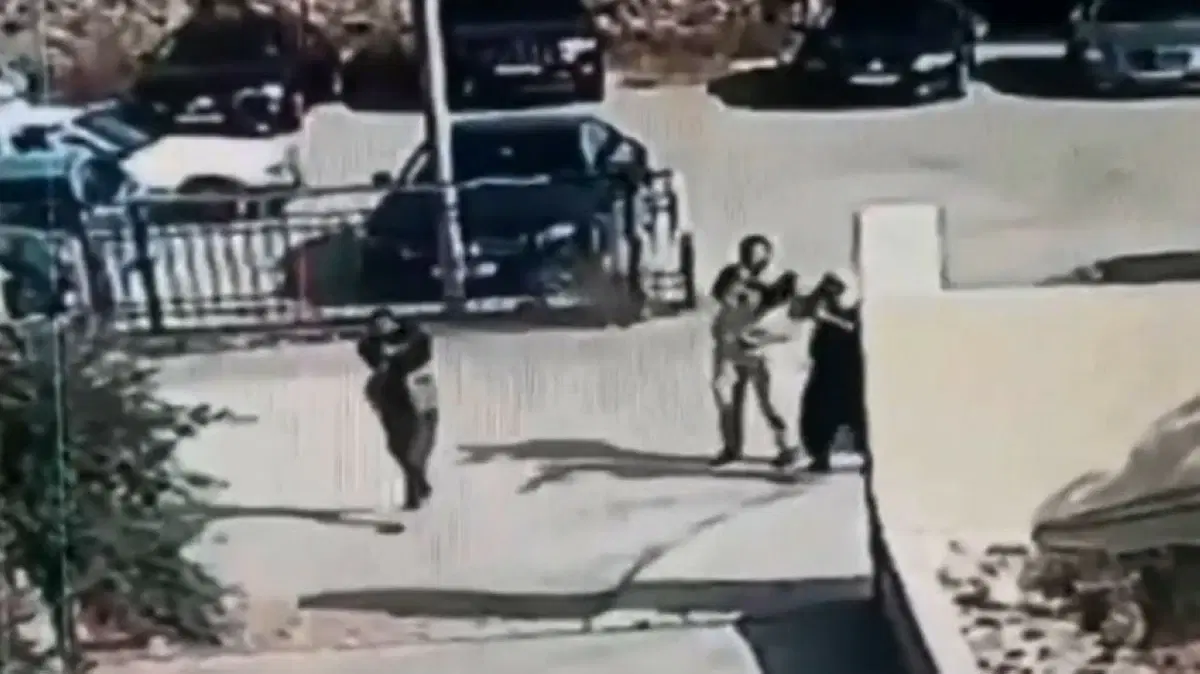
What was once a gradual process has today become a more aggressive approach; the scope of settler violence is expanding significantly, and Palestinians are being beaten, shot at, and intimidated, just as their homes are being burned, their property destroyed, and families displaced from their lands.
Israel is tightening its grip on the West Bank; it is seizing land, expanding settlements, and expelling Palestinians.
The time has come for the world to face the truth of what is happening, for when words do not reflect the gravity of actions, the unacceptable becomes familiar.
Demolishing Palestinian homes to expand illegal settlements is not "law enforcement," but forced displacement.
And seizing occupied land is not "land registration," but de facto annexation.
And the system of checkpoints and suffocating barriers is not "security" infrastructure, but a repressive system.
And the systematic attacks on Palestinian population centers are not "settler riots."
The Israeli government criticizes acts of violence in international forums, describes those responsible for them as a "handful of rioters," and assures us that Israel is a state governed by the rule of law.
However, what is happening on the ground contradicts this; Israeli soldiers often stand by as bystanders while Palestinians are subjected to settler attacks, and they often protect the aggressors or join them. They also prevent ambulances from reaching the wounded and target international journalists who were trying to report the truth.
When soldiers stand by as bystanders to acts of violence against civilians, or allow them to be committed, or even participate in them sometimes, the matter can no longer be reduced to a "handful of rioters."
And the question is no longer about a group of extremists violating the law, but the question becomes: is this really the behavior of a democratic state governed by the rule of law?
What is currently happening across the West Bank is not a series of separate events, but a set of interconnected practices that form part of a single policy aimed at forcing an entire people to leave their land.
And there is a clear term to describe this policy: forced displacement, which is a war crime.
Your Excellencies,
If we want to resolve the Palestinian-Israeli conflict, the world must abandon some illusions, foremost among them the belief that Gaza and the West Bank are separate stories. They are in reality two sides of the same Israeli strategy: on both fronts, Palestinians are being killed, and on both fronts, work is underway to impose a new reality on the ground; through destruction in Gaza, and through the de facto annexation of land in the West Bank.
And the goal is one: to make the establishment of a viable Palestinian state impossible.
And there is another illusion represented by the belief that the Israeli leadership's rejection of a Palestinian state is a position that can be changed. It will not change; rather, it is being entrenched on the ground.
This government has accelerated settlement operations and land confiscation. However, these measures did not begin recently. Since the Oslo Accords, the map has been changing bit by bit, settlement after settlement.
But the most dangerous illusion is the belief that Arab states never sought peace. The Arab Peace Initiative, in 2002, offered Israel the normalization of relations with 57 Arab and Muslim countries, including Iran and Iraq at the time, in exchange for peace and the establishment of a Palestinian state.
This offer remained on the table for more than twenty years; the obstacle was never the absence of a partner for peace, but the lack of an Israeli government willing to accept it.
This Israeli government understands the power of attention, and lately, it has not liked the attention its actions have been receiving.
When confronted with evidence of its aggressions, instead of changing course, it seeks to distract attention by questioning the credibility of its critics.
It has also sought to portray the conflict as a war of religions: Islam on one side, and Judaism and Christianity on the other. But it is not a religious conflict. It is a struggle over whether Palestinians—Muslims and Christians—deserve the same rights that others enjoy.
But attempts to distract attention are no longer effective, as people around the world are paying close attention to the conflict.
The question now remains: Will we act?
Because global political inaction is not the result of a lack of options. Let us call things by their names: this inaction is a choice.
We possess the tools: such as sanctions, asset freezes, embargoes, and diplomatic isolation. And we have a track record of using them... in other cases.
But when it comes to Israel, decisions remain where they began: ink on paper.
The result is a state without a deterrent.
This government’s sense of impunity has reached terrifying levels; it no longer even feels it has to ask, "Can we get away with this?" because it already knows the answer. It is precisely for this reason that no one in this General Assembly should believe that its ambitions will stop at Palestine.
The expansionist ambitions of this Israeli government have become a regional threat. Today, Syria represents a warning that the international community chooses not to pay attention to. There are repeated incursions, geographical expansion, and new facts being imposed on the ground, some of which affect vital water sources.
With one calculated step after another, Israel tests how far it can go. And every time the international community looks away, Israel concludes that it can go further and exceed geographical boundaries and laws.
As for Jordan, the matter is as clear as the sun: any threat to our northern borders or our water security is a threat to our national security. Jordan will not look away; rather, we will protect our security, our water, and the interests of our people.
The question here is, if Israel continues its aggressive approach in southern Syria, will the international community let it continue without lifting a finger?
Your Excellencies,
There are things that require our immediate attention, and there are things that require our sustained attention; as for injustice, it requires both. And Jordan understands this well.
We know what it means to live in a region where one crisis begins before the previous one has ended.
And we know that we cannot choose between responding to an urgent crisis before us and building the future. Therefore, we are moving along both paths together.
We are strengthening ties from the Gulf to the Mediterranean region through our role as a hub for trade, industry, and technology, while addressing urgent humanitarian crises.
We are tackling terrorism in the region and beyond, while developing our defense capabilities to remain a front against threats such as drug smuggling.
We are protecting Christianity—its communities and heritage—in its original and historical home, while defending the true image of Islam in the face of voices of hatred.
Throughout all of this, we will not abandon our commitment to a just peace. We will continue to support Palestinian steadfastness. And we will continue to support UNRWA.
And we will continue to carry the trust of the Hashemite Custodianship and preserve the historical and legal status quo of the Islamic and Christian holy sites in Jerusalem.
Above all, Jordan seeks to build a different model... a model based on values and principles, characterized by openness and stability, in a time when certainty is rare and political calculations change from one day to the next.
Jordan is a country the world can rely on: loyal to its principles, committed to its positions, ready for dialogue with everyone, and ready to work with all who seek peace.
But our adherence to diplomacy does not supersede our commitment to human values, and no one should take it for granted, or misinterpret it as weakness.
My friends,
Whether in Gaza, Sudan, Ukraine, or anywhere people are experiencing war, displacement, and fear... whether it is a conflict that began weeks ago or has lasted for decades... our principles cannot change with the shifting attention of the world.
And military force cannot provide effective solutions. It does not feed the hungry, nor does it guarantee the return of the displaced, nor does it build peace. Nor can it repair our planet, manage migration waves, or lead technological development.
All of this requires institutions that have legitimacy, and it requires the existence of trust... trust between nations, trust in agreements, and trust that laws will be effectively applied.
When this trust collapses, challenges become more difficult, and when we maintain it, cooperation becomes possible.
In a world competing for our attention, we must be aware of where we direct it, and be vigilant against those who try to distract it, for the future is shaped not only by what we do, but also by what we choose to ignore.
Peace be upon you, and the mercy and blessings of God.