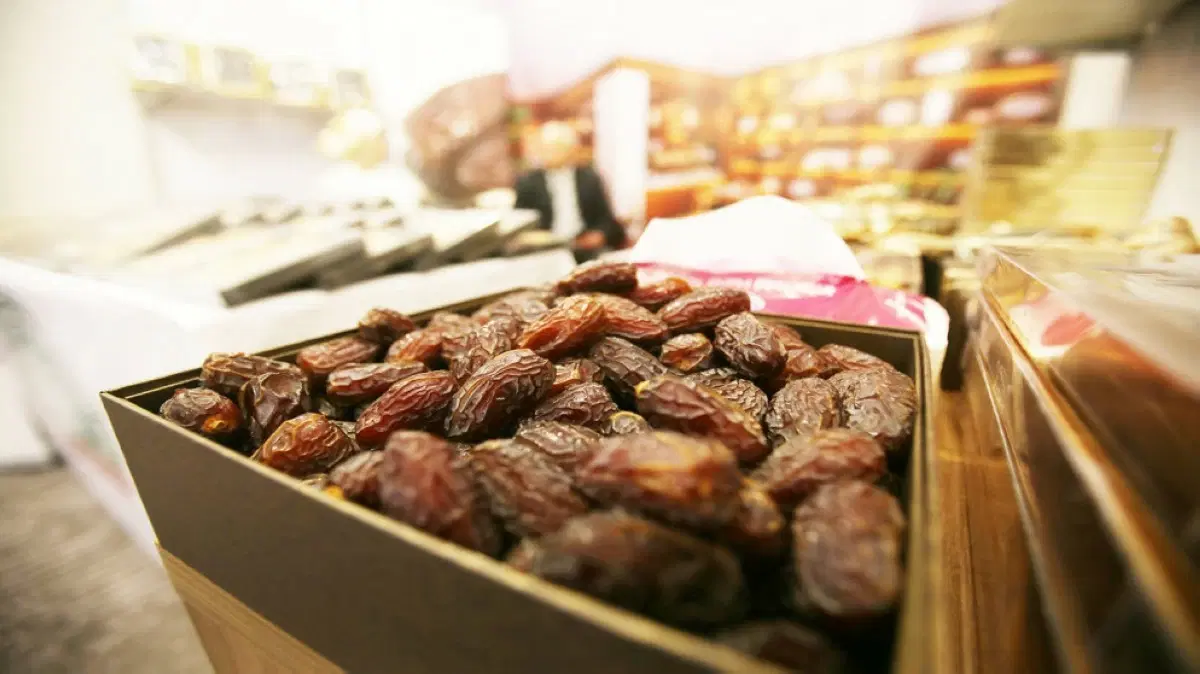
"Jordanian Dates Association": About 65% of Jordan's date production is exported
Amman7 min read
Share
The Chairman of the Board of Directors of the Jordanian Dates Association said that Jordan has nearly one million date palms, more than 85% of which are of the unknown variety, about 10% of the Barhi variety, and the remaining 5% for other varieties, while the number of farms exceeds 700 farms, with an area of more than 56 thousand dunams and production exceeding 37 thousand tons.
Haddad's speech came during a session held by the Jordanian Economic Forum, within the economic salon entitled "Jordanian Dates": promising opportunities and a growth driver" to discuss the reality of the sector, its development, investment and export opportunities, and the challenges it faces.
Haddad pointed out that the sector provides more than ten thousand job opportunities, with women accounting for more than 40% of them, and includes 15 operators with a production capacity of 20 thousand tons annually, while investments exceeded half a billion dollars, and the average consumption of an individual Jordanian of dates is 4 kilograms annually.
Haddad estimated exports at about 65% of production, with a value of nearly 60 million dinars annually, expecting its value to rise to 150 million dinars after all cultivated areas are fully in production.
Haddad explained that most exports are of the unknown variety, with increasing demand for the Barhi, reviewing the development of production and areas, noting that they reached, respectively, 1321 tons and 2640 dunams in 2000, then 3965 tons and 6560 dunams in 2006, 10417 tons and 18400 dunams in 2012, 26190 tons and 32740 dunams in 2018, reaching about 37 thousand tons and 56000 dunams in 2026.
He explained that exports reached 720 tons worth 473 thousand dollars in 2001, 2209 tons worth 3.651 million dollars in 2006, then 2704 tons worth 5.551 million dollars in 2012, 6603 tons worth 19.781 million dollars in 2018, and 20083 tons worth 71.946 million dollars in 2024.
Regarding the emergence of the sector, Haddad explained that commercial cultivation of dates of the unknown variety, originally from Morocco, began in the early 1990s, and the trees began to bear fruit in 1999 and 2000, before the expansion of palm cultivation during the next quarter century.
He pointed to the spread of farms along the Jordan River, in the north, center, and south of the valley and the area of the baptism, in addition to Al-Azraq and Aqaba, stressing that the location, climate, and environment are key factors in the characteristics of the Jordanian product, and that the unknown dates ripen naturally on the mother tree.
Haddad reviewed a study conducted in 1995 on varieties and their cultivation potential, which recommended the unknown due to the suitability of the Jordanian environment for its growth, and said that the study was conducted at the Agricultural Credit Institution by a national team of 11 researchers under his chairmanship and with multiple specializations, funded by 15 thousand dinars from the Ministry of Planning.
He pointed out that the expansion of palm cultivation was based on a scientific basis, reviewing publications that dealt with the strategy and positioning of Jordanian date products, reflecting the role of research and knowledge in establishing and developing the experience.
Haddad linked the quality of the fruits to the environment of the Jordan Valley, describing the area as ideal for palm cultivation as it is the "lowest spot in the world" and enjoys, according to his presentation, the highest natural atmospheric pressure and oxygen content, and this climate allows for complete ripening.
Haddad explained the environmental impact on the formation of the flesh of the fruits, the taste, flavor, shape, and color.
He said that the experiment showed, according to his assessment, that Jordan has the most suitable areas for cultivating and growing the unknown variety globally, based on the characteristics of the climate that affect the quality of the fruits, and there is no equivalent to the Jordanian environment in the Agwar for cultivating this variety.
Haddad explained that most of the seedlings used later for cultivation were tissue seedlings imported from reliable sources, and that the sector relied on a standard specification for Jordanian dates and a national strategy for cultivating date palms in Jordan for the period 2020-2030.
He explained that the unknown and Barhi represent the main varieties for commercial production; the unknown is characterized by a large to medium size, a brownish color, and a sweet taste, while the Barhi is characterized by a large size, a yellow color, and a high sweetness, and is eaten in the green or ripe stage.
In agricultural practices, Haddad pointed to modern irrigation networks and methods, well-studied irrigation, fertilization, and protection programs, flower pollination methods, fruit thinning and separation, and bagging, keeping pace with production and marketing technologies, using modern workshops and packaging machines, and obtaining quality certificates and applying global standards.
Haddad explained that the applications began using digital applications in farm management, and these applications will include on a large scale, God willing, the use of satellite systems and vegetation health indicators "NDVI", aerial survey images, remote farm management, smart irrigation and fertilization systems, soil and leaf sensors, smart insect traps, and pest detection devices, and he confirmed that currently artificial intelligence is being used in grading, sorting, packaging, and packaging.
Haddad explained that labor accounts for about 70% of the production cost, stressing that technological development will contribute to reducing costs, improving production quality, and increasing efficiency in the sector.
He said that property owners have turned to investing in the sector, and more than 90% of palm farmers hold academic degrees of at least a bachelor's degree, while the state provided easy financing through the Agricultural Credit Institution.
He reviewed the distribution of palm holdings in the Jordan Valley, explaining that more than 60% of the holdings fall within the category of medium holdings, and the percentage of large farms exceeding 250 dunams does not exceed 2%. Haddad pointed to the large expansion of palm cultivation in the Wadi Araba area, which is still outside these calculations, and these areas are new and depend on groundwater in that area, and they were leased with long-term contracts with the Jordan Valley Authority
In marketing, he explained that quality, appearance, taste, packaging, and price form the core factors influencing the purchase of dates, followed by health considerations, product origin, and variety, noting the importance of these elements with the expansion of global competition and the increase in unknown production in multiple areas of the world, and the variation in product characteristics according to its environment.
He identified the challenges as the abundance and quality of water, the availability of trained labor and its costs, insects and epidemic diseases, indiscriminate expansion, instability of agricultural policies, and marketing and global competition difficulties.
In contrast, he presented opportunities including the increase in global demand for dates and organic products, awareness of their nutritional value, interest in food security, the impact of the fourth industrial revolution on quality, rapid technological development, alternative and solar energy, in addition to awareness of climate change and consumer tastes, as factors that open new fields for Jordanian date production.
Deputy Chairman of the Board of Trustees of the Forum, Omar Malhas, who moderated the session, confirmed that the date sector in Jordan is one of the promising sectors in the Kingdom, pointing to the high production volume of unknown dates in Jordan.
He pointed out that the session shed light on the reality of the sector and its stages of development, and getting to know the investment and export opportunities available to it, alongside the challenges facing farmers and producers.