Friendly match between Al-Nashmaa and Syria.. The result raises questions
Amman7 min read
Share
The 1-1 draw against the Syrian national team in the first appearance of the Al-Nashmaa team under the leadership of Moroccan coach Badou El-Zaki was not the result that the Jordanian fans were expecting, especially since the match was held on their home ground and among their fans, and after the historic participation in the 2026 World Cup, but reading the confrontation cannot stop at the number it ended with, as it is not possible to ignore the observations that emerged from the match, whether in terms of performance or technical options and deployment.
Zaki entered the match with a clear task; to get to know as many players as possible, test new options, and try different ideas before the team faces official obligations.
For this reason, the participation of 19 players during the national football team match against the Syrian guest carries an important positive aspect, because it gave the technical staff a wider opportunity to watch the players in international match conditions, instead of being content with what they show in training.
According to the lineup and substitutions, Zaki made a series of changes during the match, including the first appearance of goalkeeper Alik Samir, while a number of players received important playing minutes to prove their presence in the new phase.
A clear technical message
One of the most prominent aspects of the match was Zaki's adoption of the 4-3-3 formation, in a clear shift from the diagram that the Nashmaa were accustomed to during the previous phase, which was more associated with the 3-4-3 formation.
It is here that the value of the friendly match appears; the new coach does not only inherit a group of players, but also inherits a system of play that has become familiar, and therefore needs time to test the suitability of his ideas to the capabilities available to him.
The transition to four defenders, three midfielders, and three attackers is not just changing numbers on a formation sheet, but imposes adjustments to the way of building play, pressure, counter-attack, and the shape of the team when in possession and out of possession of the ball. Therefore, simply trying the new formation can be considered one of the important messages carried by the match, even if the picture is not complete.
More importantly, Zaki now has a real match through which to review the details and find out which positions need to be fixed and which need additional options.
Ample space for discovery
From a technical standpoint, involving 19 players confirms that the match was not only intended to find the best possible lineup, but was closer to a real laboratory for the new coach.
This is logical at the beginning of Zaki's mission, especially since the list included new names or players who had not previously received sufficient opportunities, alongside experienced elements that form the backbone of the Nashmaa.
But the experiment does not become valuable just by involving the player, but when the player is tested in the position that serves his abilities and gives the technical staff a real picture of his capabilities.
Here one of the most important observations carried by the match stands out.
Al-Awadat's position!!
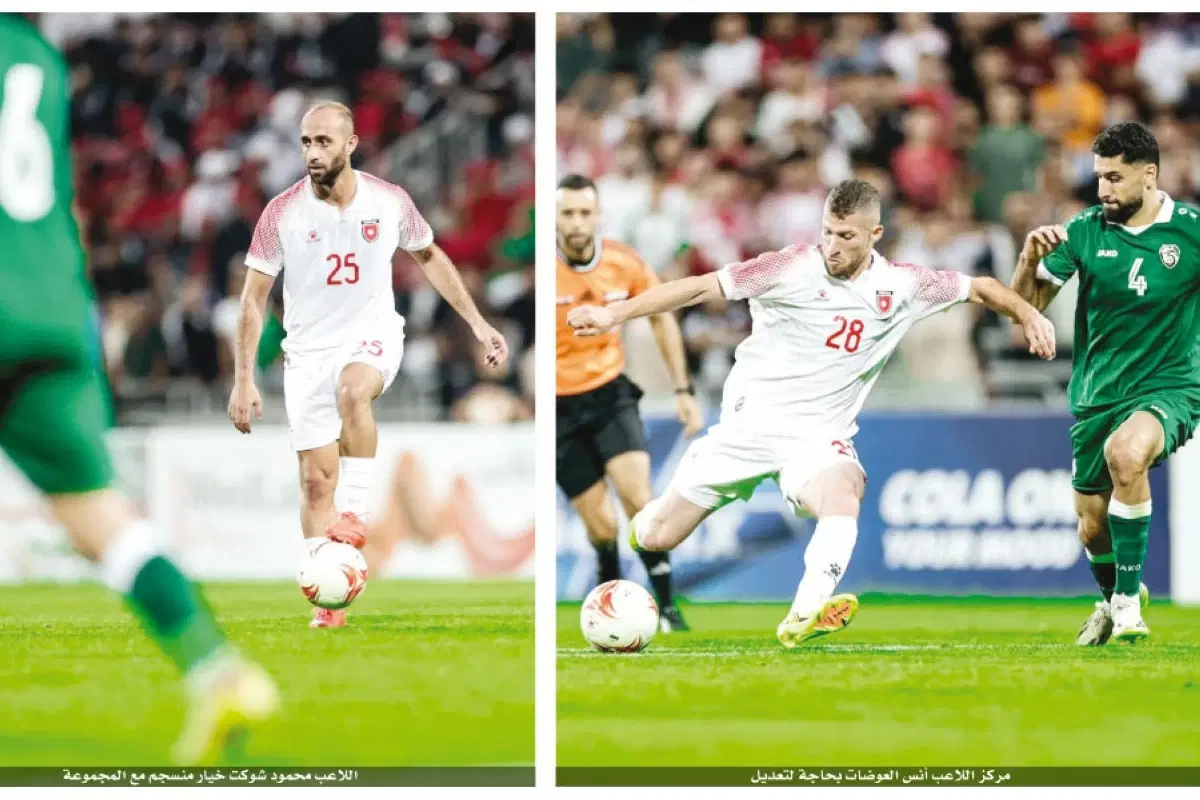
During the match, the deployment of Anas Al-Awadat in the position of striker number (9) and the attempt to reach him through cross balls drew attention.
Al-Awadat has different characteristics; he is a player of spaces, skilled in moving in the gaps and launching behind the defensive line, and benefits more when there is space in front of him that allows him to use his speed and movements.
However, placing him as a striker and waiting for cross balls to reach him, pushes him into aerial duels and physical struggles with the defenders' hearts, which are not necessarily the circumstances that show the best of him.
In other words, the problem is not in testing Al-Awadat, but in the way the test itself is conducted.
This is an important point for the technical staff; because the goal of friendly matches is not only to find out if the player is able to play, but to discover where and how he can be more effective.
Another side of the picture
On the other hand, we cannot ignore that the draw against Syria is a result less than the Jordanian ambition.
The Nashmaa entered the match as the higher-ranked team, while the Syrian national team is ten places lower according to the latest official FIFA ranking before the match; Jordan was ranked 73rd and Syria 83rd.
The ranking does not necessarily mean that the match will proceed according to the order of the teams, but it provides a general framework for expectations, especially when the Nashmaa are playing on their home ground after the World Cup experience.
Also, the Nashmaa were ahead in the first half with a goal by Ali Alwan in the 38th minute, before the Syrian realization of the draw in the 52nd minute by Jean Mustafa.
Here another observation can be recorded: the Nashmaa had the opportunity to maintain their lead and turn the advantage into a victory, but at the same time the match revealed that the team still needs more work in managing the course of events, especially after the lead, and in how to deal with the Syrian transitions and pressure.
A useful experience
Perhaps the result of the draw is not satisfactory, but it does not deserve to turn into an early source of concern.
Zaki has not started a phase of stability, but a phase of research.
The coach needs to know the players, and the players need to understand his ideas, and the system needs time to transition from the training field to an international match.
More importantly, mistakes appear now, in friendly matches, before their price becomes greater in the Asian Cup.
Therefore, the real value of the Syria match will not be in the point of the draw, but in how the technical staff deals with the observations that appeared during it.
The Nashmaa need to invest the phase to test alternatives, determine positions, raise the quality of harmony, and rebuild some tactical details, without meaning to abandon the elements that made the recent achievements.
Other gains
Among the positives that can be built upon is the re-emergence of Ali Alwan in an influential manner, after scoring the lead goal in the 38th minute, while Fakhuri provided a decisive pass for the goal, indicating the possibility of continuing to give opportunities to elements capable of making a difference.
The match also saw the debut of Alik Samir, which is important in the process of expanding the range of options, in addition to giving a number of players international minutes they need to prove their ability to compete.
This is precisely one of the benefits of friendlies; that the coach has a larger bank of options, instead of the national team being tied to a limited number of names.
What is required now
After Syria, the question should not only be: Why did the Nashmaa draw?
The most important question: What did Zaki learn from the match?
Did he succeed in discovering new players? Did the 4-3-3 method give him positive indicators? Where did the gaps appear? And which player proved that he deserves a greater opportunity? And which player needs a different deployment to show his true potential?
These are the questions that should accompany the next phase.
Experiments are required, but necessary, but the value of the experiment is measured by its ability to produce new knowledge for the technical staff.
With the approach of the Asian commitment, the Nashmaa do not need experiments just for the sake of experimenting, but rather smart experiments that reveal the best version of each player, and ultimately reach a combination capable of leading the national team to a new phase.
The draw with Syria is not the result that the sports street was hoping for, but by nature of things it is not a judgment on Zaki's experiment.
It is just the first line in a new phase, and the most important thing now is for the technical staff to read this line well, before writing the next lines in the face of stronger and more serious tests.