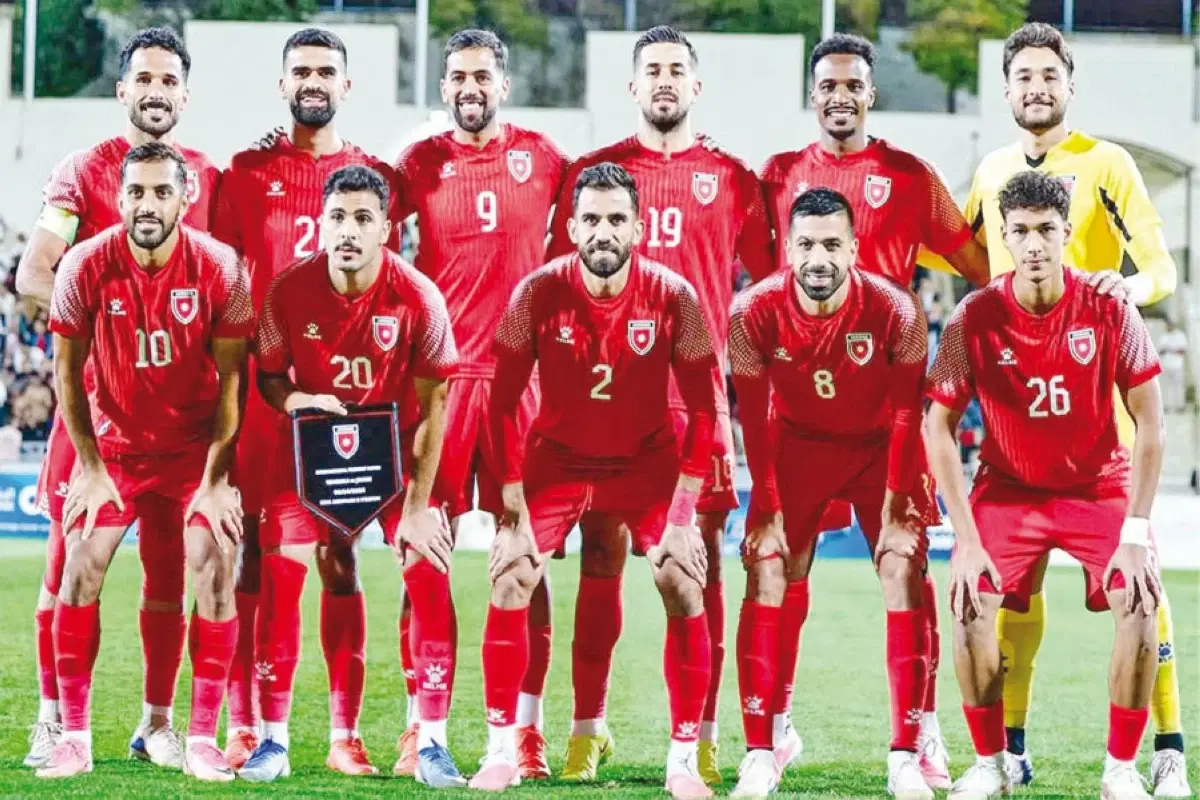
Al-Nashama.. Analysis and Treatment Before the Difficult Stages
Who benefits from the friendlies against Syria and Venezuela.. Badou Zaki or the national team?
Amman9 min read
Share
The recent international break was not an ordinary one for the national football team; it was the first under the leadership of Moroccan head coach Badou Zaki, and also the first following the historic participation in the World Cup. Therefore, it was natural for all eyes to be on every small and large detail in the team's new appearance.
The break has ended, and the Al-Nashama left the pitch with a tally that holds neither a victory nor a defeat, but rather two draws: 1-1 against Syria and 0-0 against Venezuela. These two matches were held at the King Abdullah II Stadium, with a relatively long period between them that could have allowed for at least a third match, similar to what other teams did during the same window.
This international period also resulted in the Al-Nashama advancing one spot in the world rankings issued by FIFA yesterday, reaching 72nd place globally.
This is precisely where the real assessment begins: did the outcome of the break serve Zaki more, or the team, or did both get what they wanted to varying degrees?
The reality is that Zaki emerged with more information than results, while the team emerged with some positive indicators, but left behind question marks that cannot be ignored.
Zaki's List
From the very first moment, it was clear that Zaki did not enter his project with the logic of breaking away from the previous phase, but rather chose to build on what had been achieved.
The first list included 28 players, before a group of elements was added later, reaching 29 players. It showed a clear mix between experienced elements and young ones seeking to establish their presence with the Al-Nashama.
The list included familiar names such as Yazid Abu Laila, Abdullah Al-Fakhouri, Yazan Al-Arab, Abdullah Nasib, Saad Al-Rousan, Ihsan Haddad, Noor Al-Rawabdeh, Nizar Al-Rashdan, Mousa Al-Taamari, Mahmoud Mardi, and Ali Olwan, alongside young names such as Alec Samir, Hadi Al-Hourani, Ahmed Ersan, Yousef Qashi, Anas Badawi, Tamer Bani Odeh, Ahmed Assaf, and others.
If there is a first message that can be drawn from Zaki's choices, it is that he does not want to reshape the team from scratch. This is logical; the team that reached the World Cup for the first time and finished as runners-up in the Asian Cup and the Arab Cup does not need a revolution as much as it needs to develop its tools, increase the depth of its roster, find real alternatives for positions, and raise the level of competition among players.
Zaki chose to see as many players as possible, which was clearly reflected in the Syria match, when he fielded 19 players, before continuing the policy of rotation and experimentation against Venezuela.
Here, it can be said that Zaki gained more from the break than he lost, because he received a first dose of information about his players in match conditions, not just in training.
The Beginning That Raised Questions
The 1-1 draw against Syria was not convincing to the Jordanian fans, as the Al-Nashama took the lead through an Ali Olwan goal, before the Syrian team equalized in a match where the hosts did not appear in the form the fans expected after the World Cup participation.
After that, criticisms focused on the attacking performance, the way some players were utilized, the substitutions, and the lack of effectiveness in some stages of the match. However, it was difficult to demand that Zaki present a fully formed team in his first match, especially since he entered it wanting to get to know as many elements as possible and test his options. Therefore, the Syria match can be described as a test for the coach more than a test of the result.
Even goalkeeper Alec Samir got his first chance, which confirms that Zaki was looking beyond the result of the match. But the problem is that the team, regardless of the nature of the match being a friendly, remains required to maintain its identity, and this is what made the draw raise questions.
The Venezuela Experience
If the Syria match left an uncomfortable impression, the confrontation with Venezuela presented a better picture from a technical point of view, even if it ended in a goalless draw.
Here the paradox appeared: the Al-Nashama did not score, but they were more capable of reaching the goal of a stronger opponent in terms of ranking.
The team also appeared faster in transitions and bolder in reaching the attacking third, and they had chances that could have changed the result of the match.
Zaki himself did not hide his satisfaction with the performance, confirming that the Al-Nashama controlled and created chances from various sides, and that the problem was in the final touch, noting that the team deserved a better result.
But Mousa Al-Taamari, one of the most prominent experienced elements, gave the most frank reading, as he considered that the first half was not at the required level, before the team improved in the second half. However, he stressed that wasting chances is not allowed in the Asian Cup, confirming that the goal is to reach the continental semi-finals. This message perhaps summarizes the entire next phase.
What did they say about the Al-Nashama?
Interestingly, the goalless draw was not read outside Jordan as a completely negative result, as the match was described as a strong test, and that the Al-Nashama performed with a fast pace despite the difference in ranking, while Arab media outlets dealt with the match as the second appearance of Zaki, who is still looking for his first win with the team.
As for Venezuela, which was also looking for a win after its loss to Japan and its draw with South Korea during its Asian tour, it left Amman with a draw after facing a Jordanian team that was able to put it under pressure at different times of the match.
Here comes the value of the match for the Al-Nashama; not every draw is necessarily negative, just as every good performance does not mean that the work is complete.
On the Jordanian Street
The Jordanian fans did not reject Zaki, but they did not give him a blank check either.
After the Syria match, clear criticisms appeared regarding the performance, choices, and utilization, while others demanded giving the coach time, considering it his first match. There were fan opinions that saw that gradual change needs matches and experiments, not a quick judgment from 90 minutes.
After Venezuela, the tone changed partially: the better performance, the attacking courage, and keeping a clean sheet against a higher-ranked team were all factors that restored some reassurance, but the absence of a win in both matches kept the space for criticism open... and this is normal.
The fans who watched the Al-Nashama in the World Cup are no longer satisfied with just participating; they want a team that continues to develop.
A Long Break
The current break period extended from the end of last September until yesterday, and yet the Al-Nashama played only two matches.
It is true that the quality of the opponent is more important than the number of matches, and it is true that the frequency of matches is not an end in itself, but having a period of this size could have allowed for a third experiment, especially with Zaki's need to get to know a larger number of players and address aspects that appeared against Syria and Venezuela.
From Experimentation to Stabilization
Now the Al-Nashama are approaching the two matches against Indonesia and Australia on November 13 and 17 in Amman, according to the announced program, before entering a more sensitive phase as the Asian Cup approaches. Here, Zaki's calculations must change.
If September and October were a space for getting to know and experimenting, then November must be a space for narrowing the circle of options. Zaki needs to define the backbone, stabilize the style of play, address the scoring problem, identify the appropriate substitute in each position, and raise the degree of harmony between the elements that will form the core.
It is also required that the experience of Al-Taamari, Yazan Al-Arab, Ihsan Haddad, Al-Rawabdeh, Al-Rashdan, and others turn into a base that leads the group, while the youth get their chance within a clear system, not just for the sake of participating.
Neither Reassuring nor Disastrous
After two matches, it cannot be said that Zaki succeeded or failed, and it cannot be said that the Al-Nashama presented something that causes concern or that they have reached the required level. The numerical tally says: two matches, two draws, one goal scored by the team, one goal conceded, and a clean sheet against Venezuela.
In contrast, the numbers do not summarize everything, as Zaki gained broader knowledge of the players, tested new elements, maintained a large part of the previous structure, and began introducing young blood.
The team also gained two matches against opponents different in style, tested its options, and showed better ability to create chances against Venezuela.
On the other hand, the scoring crisis remained present, a final technical shape has not yet appeared, and the victory has not been achieved, while the Syria match in particular was below the ceiling of expectations.
Consequently, the real judgment is postponed, and the Al-Nashama today do not need a coach who redefines them, but a coach who knows how to add to what has been achieved. Zaki does not need open-ended time, but he needs sufficient time... and there is a big difference between the two. The historic participation in the World Cup raised the ceiling of ambition, and the upcoming Asian Cup will not be a station to experiment with what has been built, but a real test of what Zaki has added to a ready team that had already covered an important distance before his arrival.
The first assessment, therefore, says: no victory... and no disappointment. There is work that has begun, there are positive indicators, and there are errors that appeared early, and most importantly, Zaki has a chance to correct them.
But from now until the Asian Cup, questions must turn into answers, experiments into options, and opportunities into goals.
For in the Asian Cup, a draw alone will not be enough to satisfy Al-Nashama or their fans.