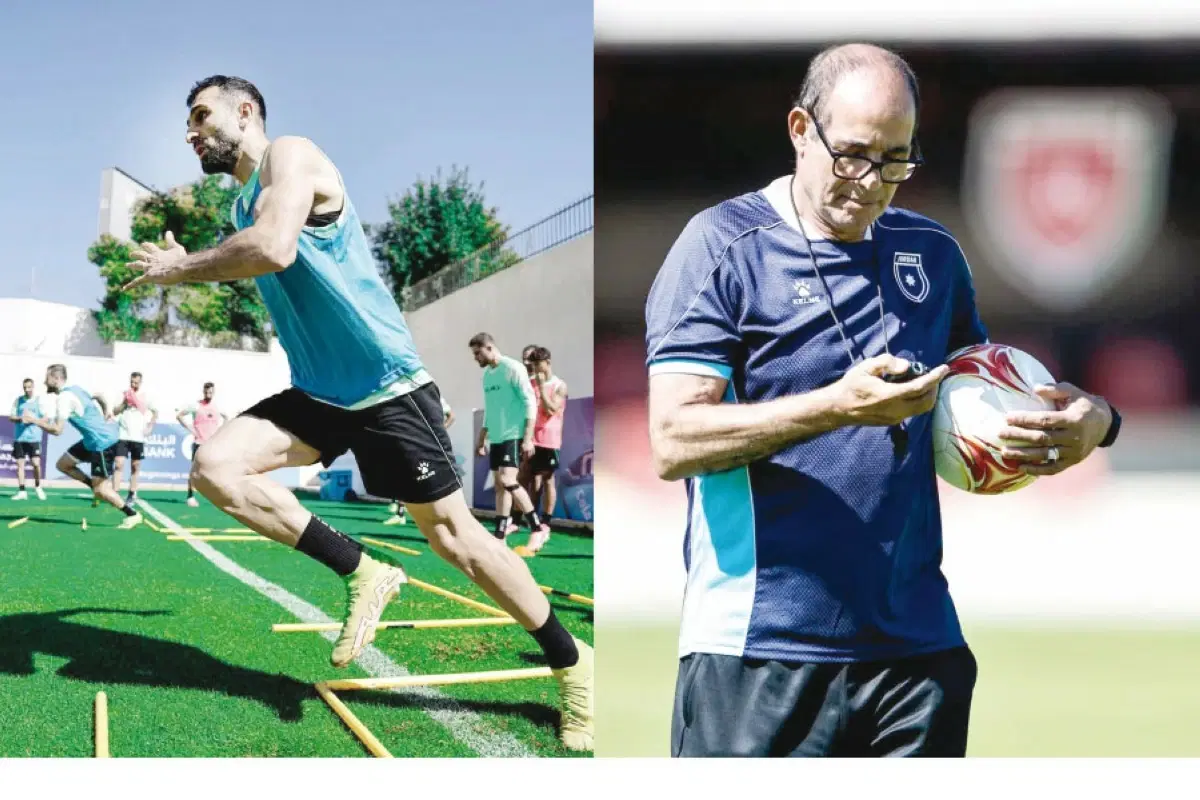
The confrontation, which comes within the preparatory program for the 2027 Asian Cup finals, will be the first for Al-Zaaki since he took over the task from his compatriot Jamal Al-Salam, who left the team after a historic stage during which he led Al-Nashami to the 2026 World Cup finals, after Hussein Amuta laid the foundation by reaching the 2023 Asian Cup final, before Salam continued the journey and achieved the World Cup qualification for the first time in the history of Jordanian football.
Accordingly, the match against Syria practically represents the point of transition from one stage to another, without in any way meaning the abandonment of previous gains or making a comprehensive and sudden change in the identity of the team.
Gradual change
Since his first press conference, Al-Zaaki was keen to emphasize that the change process within the ranks of Al-Nashami will be gradual, and that his choices were based on monitoring the players' levels and the number of their participations, along with mixing between experienced elements and young faces.
The Moroccan coach was also clear in emphasizing that the door of the team will remain open to everyone, and that the performance inside the field will be one of the most important criteria for selection, alongside working to find a balanced combination that gives Al-Nashami multiple options in various positions.
This approach seems logical in light of the nature of the task that Al-Zaaki has taken over; Al-Nashami is not facing a project that starts from scratch, but rather a team that has emerged from one of the most important stages in its history, participated for the first time in the World Cup, and is now preparing for a new Asian entitlement with greater ambitions.
Therefore, the real test for Al-Zaaki will not be in the number of new names he introduces, but rather in his ability to develop details, address weaknesses, maintain the team's personality, and add new ideas that suit the players' capabilities.
Expected technical features
Tactically, Al-Zaaki historically tends to use 4-3-3, and the coaches' databases clearly show this tendency, with the use of different formations also being recorded according to the nature of the competitor and the available group.
From here, the possibility of Al-Nashami adopting a form close to 4-3-3 against Syria seems likely, especially with the presence of wings capable of rapid transformation, and midfielders who possess the ability to build the game, alongside defensive elements with extensive international experience.
However, Al-Zaaki will not be forced to adhere literally to this drawing, as the team can turn into a more offensive shape during possession of the ball, or into 4-2-3-1 in some phases of the match, according to the positioning of the midfielders and the location of Mousa Al-Taamari and the way the wingers and the striker move.
The most important thing in the first appearance will be to get to know the principles that Al-Zaaki wants to establish: speed of ball transfer, exploitation of spaces, pressure when losing it, and improving the transition from defense to attack, while maintaining balance and not giving the opponent free spaces.
Between experience and youth
The current list of Al-Nashami includes 29 players after the call-ups, and combines names that have accompanied recent achievements and others seeking to establish their presence in the next stage.
The list includes: Yazid Abu Layla, Abdullah Al-Fakhuri, Alik Samir, Ahmed Jaaidi, Yazan Al-Arab, Abdullah Nasib, Muhammad Abu Al-Nadi, Saad Al-Roussan, Hadi Al-Hourani, Mohanad Abu Taha, Ihsan Haddad, Ahmed Assaf, Anas Badawi, Nour Al-Rawabdeh, Nizar Al-Rashid, Ibrahim Saada, Youssef Qashi, Amer Gamous, Mahmoud Shawkat, Youssef Abu Jalbush, Mousa Al-Taamari, Mahmoud Marzi, Tamer Bani Awdah, Ahmed Arsan, Ali Azaizeh, Awad Al-Fakhuri, Muhammad Abu Zariq, Ali Alaawan, and Anas Al-Awdat.
The group features a number of names that have formed the backbone of Al-Nashami in recent years, led by Al-Taamari, Al-Arab, Nasib, Al-Rawabdeh, Al-Rashid, and Haddad, alongside Alaawan and Arsan.
In contrast, Al-Zaaki gives space for testing to a number of faces that can become part of the team's future.
As for the goalkeeping position, the coach has opened the competition for the basic position, confirming that training and matches will determine which goalkeeper he will rely on, at a time when the presence of Alik Samir provides an opportunity to closely monitor him.
In the forward line, the absence of Yazan Al-Naimat is one of the most prominent files, as Al-Zaaki confirmed that the technical staff is following the developments of his injury in coordination with the player and the medical staff, without setting a specific date for his return.
For this reason, the call-up of Anas Al-Awdat came to give the technical staff an additional option in the attacking third, especially as Al-Zaaki had indicated the need for a player with the characteristics of a striker, and the continued search for the appropriate solution for this position.
As for Mahmoud Marzi, his participation against Syria remains undecided, according to what Al-Zaaki explained yesterday morning, with his final position to be determined according to his readiness.
The opponent with a Spanish mind
In contrast, the Syrian team enters the match under the leadership of Spanish coach Jose Lana, who has been in charge since August 2024 with a contract extending for three years.
Lana is not unfamiliar with the Spanish football school; he has worked in the Spanish age-group national teams and led the Spanish Under-19 team to the European Championship title in 2024 before moving to coach Syria.
The coach has a clear inclination towards 4-2-3-1 according to the coaches' databases, with the ability to change the drawing according to the circumstances of the match.
What is striking in Lana's experience with Syria is that he did not limit himself to relying on the traditional defensive style, but showed in his early days a desire to present a more offensive football, and one of his most prominent achievements was leading Syria to the title of the 2024 Friendly Confederations Cup, after defeating Mauritius and then India, and also led the team to qualify for the 2027 Asian Cup.
Among the strengths that the Syrian team can rely on against Al-Nashami are organization and the ability to play as a team, along with the presence of elements with international experience, led by the striker Omar Al-Souma, who returned to the list for the two matches against Jordan and Uzbekistan.
As for the point of testing for Syria, it will be represented by its ability to deal with the Jordanian pressure, especially when Al-Nashami tries to raise the pace of play on the flanks and exploit the spaces behind the full-backs, in addition to how the Syrian back line deals with quick transitions.
Thus, it will be a confrontation between two coaches belonging to relatively different schools; Al-Zaaki with his long experience in Moroccan and African football, and Lana with his Spanish background and previous work in the Spanish age-group national team system.
Long memory
Today's match carries a long history between the two teams, as Al-Nashami previously faced Syria in 49 matches according to the expanded record of confrontations that includes official and friendly matches.
The statistics indicate Syria's superiority in the number of victories, with 20 wins compared to 15 for Jordan, while 14 matches ended in a draw, in a series that began in the 1950s.
The largest Syrian loss to Jordan is linked to the memory of Al-Nashami when the Jordanian national team won 4-0 in 1999, while the old confrontations witnessed significant Syrian victories, including a 6-1 win in 1957. The numbers of the confrontations differ between databases according to the inclusion of some old and non-classified matches among international 'A' matches or not.
The last match between the two teams was in September 2022, and ended with a 2-0 win for Al-Nashami in Amman.
Thus, Syria returns to Al-Quwaismeh after four years, while Al-Nashami looks forward to using the occasion to build a new launch.
From Salami to Al-Zaaki
If Salami succeeded in leading Al-Nashami to the World Cup after years of continuous Moroccan work, then Al-Zaaki takes over the task with a different equation: preserving the achievement, developing the team, and opening the door to new blood, without affecting the identity created by the current group.
Al-Zaaki knows well that changing the technical staff does not necessarily mean changing everything, so his first list was largely conservative in terms of the basic structure, with the introduction of new names and redistribution of participation opportunities.
The coach had confirmed that the selection of players was not based on age, but on technical level, and that the competition among those present will create a positive situation within the team.
This message seems directed to everyone, where there is no guaranteed seat, no name outside the calculations, and the priority is for whoever presents himself in training and matches.
Another picture of the scene
In a scene reflecting the expansion of the presence of Jordanian football, the presence of a number of Jordanian players in global e-football games also stands out, including Mousa Al-Taamari, Yazan Al-Arab, Ibrahim Sabra, and others according to EA FC game databases and their updates.
The game databases show Mousa Al-Taamari and Yazan Al-Arab as EA FC players, linked to their clubs, while other Jordanian names are present according to the game's different updates.
At first glance, the issue may seem far from Syria's match, but in reality, it reflects the widening interest in the Jordanian player, especially after the historic World Cup presence of the Nشامى, and the accompanying rise in the value of players and the spread of their names outside the region.
The second test
After Syria, Al-Zaaki will not have much time to rest, as he faces the Nشامى against Venezuela at eight in the evening on Tuesday, October 6.
The second match will be important because it will provide the technical staff with an opportunity to try different elements and ideas, and measure the team's ability to deal with an opponent from another football school, after the Syrian team represents an Arab and Asian test that is close to the nature of continental competitions.
This comes within a plan announced by the Football Association to hold a series of friendly matches in Amman during international breaks, with the aim of providing as much stability as possible for the technical staff and giving the fans a chance to closely follow the preparations.
According to the FIFA calendar, it extends from the current window until October 6 and allows teams to play more matches, before the November window from 9 to 17, and then the Nشامى will directly enter the atmosphere of the Asian Cup at the beginning of next year.
The road to Saudi Arabia
The ultimate goal of all these details is clear, which is the 2027 Asian Cup.
The Nشامى will be in Group Two alongside Uzbekistan, Bahrain, and North Korea, starting the journey against Uzbekistan on January 8, then Bahrain on January 13, before facing North Korea on January 17.
The first two matches will be held in Jeddah at the King Abdullah Sports City Stadium, while the match against North Korea will be held in Riyadh at Imam Muhammad bin Saud University Stadium.
The tournament will be held in Saudi Arabia from January 7 to February 5, 2027, with the participation of 24 teams, in three main cities: Riyadh, Jeddah, and Al-Khobar.
If the previous participation created a historic continental runner-up for the Nشامى, and then the qualification for the World Cup confirmed that the Jordanian team has become a figure that cannot be easily surpassed, then the fans' aspirations naturally rise today.
The dream is no longer just participation, nor even reaching the advanced stages, but the Jordanian fans are now looking forward to competing for the Asian title, establishing the presence of the Nشامى among the elite teams of the continent, up to improving the position on the Asian and world rankings.
Here, the value of the stage that Al-Zaaki begins becomes clear.
Today, the result alone will not be the headline, as victory will give the fans an important morale boost, and a draw or loss will not be a final judgment on an experiment that began only days ago, because the real value of the match lies in what will appear in terms of character, organization, ideas, cohesion, and the ability to absorb the instructions of the new coach.
Al-Zaaki himself realizes that time is short, and that the Asian Cup is not far off, which is why the match against Syria and Venezuela will be a preliminary laboratory to determine the shape of the next stage.
From here, the starting whistle today will announce more than a friendly match; it will announce the beginning of the countdown to a new stage, titled the Nشامى, heading to Saudi Arabia, with the ambition that Jordan remains present among the continent's greats, after reaching the summit has become a legitimate dream for fans who are no longer satisfied with mere participation.