Zaki puts his final touches.. and the return of Al-Awadat enriches the squad
Al-Nashama national team increases the pace of preparation
Amman7 min read
Share
The national football team has entered the final stage of its technical and physical preparations in anticipation of facing its Syrian counterpart in a friendly match at 8:00 PM tomorrow, Sunday, at King Abdullah II Stadium, in the first appearance of the team under the leadership of Moroccan head coach Badou Zaki, as part of the preparation program for the most important upcoming event, the 2027 AFC Asian Cup in Saudi Arabia.
The match carries more than one theme at this stage; on one hand, it is the practical beginning for Zaki after taking over the task of leading Al-Nashama, succeeding Moroccan Jamal Sellami, and on the other hand, it represents an opportunity for the new technical staff to assess the readiness of the players more accurately and draw the first features of the next phase following the historic participation in the 2026 World Cup.
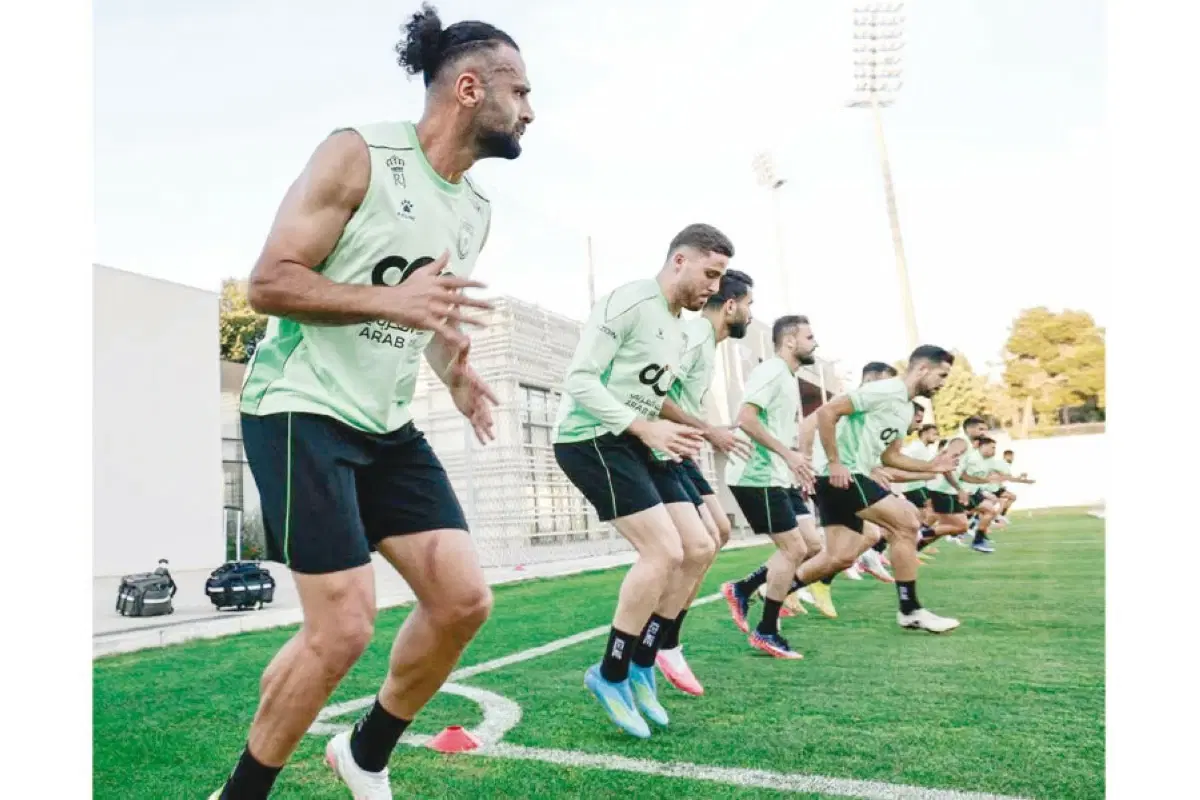
Al-Nashama continued their training at the Al-Nashama Preparation Center under Zaki's leadership, with the team's ranks complete after the past few days saw local and professional players join successively, at a time when the technical staff called up midfielder Anas Al-Awadat, bringing the squad to 29 players.
The squad includes: Yazid Abu Layla, Abdullah Al-Fakhouri, Alec Samer, Ahmed Jaidi, Yazan Al-Arab, Abdullah Nasib, Mohammad Abu Al-Nadi, Saad Al-Rousan, Hadi Al-Hourani, Mohannad Abu Taha, Ehsan Haddad, Ahmed Assaf, Anas Badawi, Noor Al-Rawabdeh, Nizar Al-Rashdan, Ibrahim Saadeh, Yousef Qashi, Amer Jamous, Mahmoud Shawkat, Yousef Abu Jalboush, Mousa Al-Tamari, Mahmoud Mardi, Tamer Bani Odeh, Ahmed Ersan, Ali Azayzeh, Odeh Al-Fakhouri, Mohammad Abu Zrayq, Ali Olwan, and Anas Al-Awadat.
The initial test
The Syria match comes at an important time for Zaki, who began his mission amidst a high ceiling of expectations, after Al-Nashama became a permanent fixture in the continental and Arab spotlight following their remarkable results in recent years, leading up to the World Cup.
Setting aside calculations related to the match result, the confrontation seems like an opportunity for the technical staff to examine a wide range of options, especially since the list includes a mix of experienced players and young elements, in addition to a number of faces that have established their presence during the past period.
The match also opens the door for the coach to test his first tactical ideas and determine the extent of the players' ability to grasp his style and requirements, given the short period separating the team from the Asian Cup.
The technical staff also attaches importance to the physical condition of the players, in light of the different stages of readiness among the team's members, especially the professionals coming from different leagues, in addition to the local league players.
It is scheduled that Al-Nashama will hold an open training session for the media at 10:00 AM today at the Al-Nashama Preparation Center in the presence of the media, as an opportunity to check on the final preparations before the Syria match.
Al-Somah returns and Khribin is absent
On the other side, the Syrian national team is in Amman with similar preparatory ambitions, as the technical staff led by Spaniard José Lana treats the confrontation with Al-Nashama as an important station in building the team, which is in turn preparing for upcoming commitments.
The Syrian team began its preparations in Amman over the past few days, where it conducted its first training sessions under the leadership of Lana and his technical staff, amidst the successive arrival of professional players before its ranks were completed for the match.
Lana announced a squad of 23 players for the matches against Jordan and Uzbekistan, and the list witnessed the return of veteran striker Omar Al-Somah, in the most prominent headline of the Syrian camp, in addition to the presence of a number of players who were absent from previous call-ups.
The return of Al-Somah stands out in particular, as the 37-year-old player returns to his national team's ranks after a long absence, at a time when he also returned to the Syrian League with Al-Wahda Damascus club on a two-season contract, after an absence from Syrian stadiums since leaving Al-Fotuwa in 2011. Al-Somah has 22 goals in 41 matches with the Syrian national team in his international record, according to recent media reports.
On the other hand, striker Omar Khribin, the UAE's Al-Wahda player, is absent after apologizing for not joining the team for personal reasons, according to Syrian and Arab media outlets.
The Syrian squad included a number of professional names, in addition to local elements, most notably goalkeepers Elias Hadaya, Ahmed Madania, and Shaher Al-Shaker, defenders Aiham Ousou, Abdullah Al-Shami, Omar Midani, Abdulrazzaq Mohammad, Ahmed Faqa, and Khaled Kourdaghli, in addition to Mohammad Osman, Almar Ibrahim, Mohammad Al-Hallaq, Mahmoud Al-Aswad, Noah Shamoun, Mahmoud Al-Mawas, Ahmed Al-Dali, Jan Mustafa, Mustafa Abdullatif, and Alaa Al-Dali, as well as Al-Somah.
According to what was published by the Syrian press, the confrontation constitutes the first stop of this gathering, before the Syrian team heads to Tashkent to meet Uzbekistan on October 1st, which gives Lana two consecutive matches to test his formation and options before the upcoming commitments.
The second station
Al-Nashama's program does not stop at the Syria match, as the team moves to the second station in the current gathering when it meets its Venezuelan counterpart at 8:00 PM on Tuesday, October 6th, at King Abdullah II Stadium.
The Venezuela confrontation gains additional importance as it gives Zaki a different test in terms of football school and the nature of the opponent, after facing Syria, which has an Arab-Asian character.
Information currently published indicates that Venezuela is linked to a busy program during this window, as it is scheduled to face Japan on September 28th, then South Korea on October 2nd, before arriving in Jordan to face Al-Nashama on the 6th of the same month. As of the preparation of this material, there is no reliable official information that definitively determines the arrival date of the Venezuelan national team delegation to Amman, and therefore the logistical details of its arrival remain linked to an announcement by the Venezuelan or Jordanian Federation.
Available data also indicates that the Venezuelan team is led by coach Oswaldo Vizcarrondo, while its squad includes a number of experienced elements, led by captain Tomás Rincón, which makes the October 6th confrontation a different station from the Syria test.
From Amman to Saudi Arabia
Between Syria and Venezuela, Zaki effectively begins building the new phase for Al-Nashama, at a time when the Asian Cup is only a few months away.
The finals draw placed Al-Nashama, the runner-up of the last edition, in Group B alongside Uzbekistan, Bahrain, and North Korea, in a group that requires gradual and balanced preparation, especially since the team enters the next tournament after a global experience that is the first in its history.
Al-Nashama begins its Asian journey by facing Uzbekistan on the evening of Friday, January 8th, at King Abdullah City Stadium in Jeddah, before facing Bahrain on the evening of Wednesday, January 13th, at the same stadium, then concludes its group stage matches against North Korea on the evening of Sunday, January 17th, at Imam Muhammad bin Saud University Stadium in Riyadh.
The AFC Asian Cup finals will be held in Saudi Arabia from January 7th to February 5th, 2027.
Hence, the matches against Syria and Venezuela do not seem like mere friendly stops on Al-Nashama's calendar, as much as they represent the practical beginning of a new phase, titled: getting to know Zaki's ideas, expanding the base of options, and redistributing roles within the team, leading to forming the clearest image of the team that will enter next year carrying with it the experience of the World Cup, the memories of being Asian runner-up, and the ambition to continue its presence among the continent's giants.
The most important thing at this stage remains for the technical staff to invest the gathering period in reading the reality of the team away from the pressure of results, and to give the friendly matches their true value as a space for experimentation and correction, especially since the time available before the Asian date is not long, and every minute of training and every match has become part of the process of building Al-Nashama for the next phase.