Experts: Royal Diplomacy opens the doors of global capital to Jordan
Jordanian-Emirati relations are a platform to attract investments and stimulate growth
Amman12 min read
Share
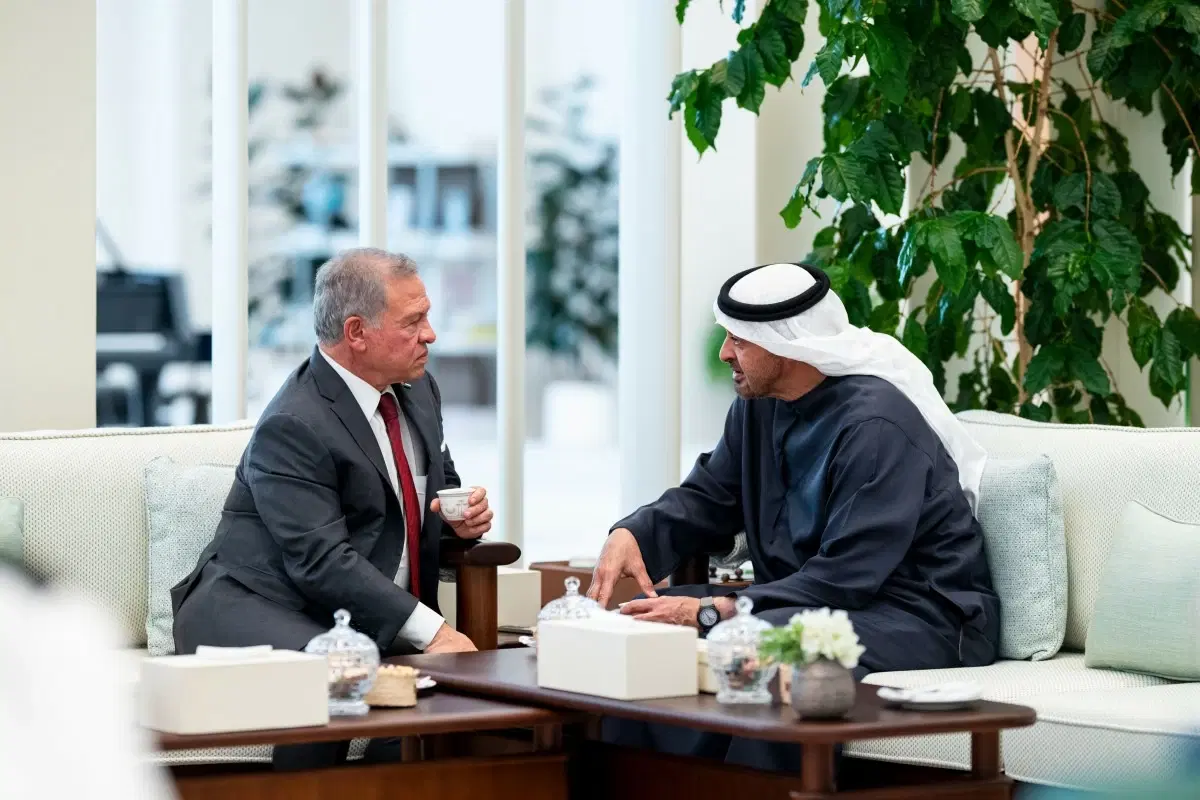
Economic experts emphasized that the visit of His Majesty King Abdullah II ibn Al Hussein to the United Arab Emirates reflects the depth and strength of the fraternal and strategic relations between the two brotherly countries, and the continuous keenness of the leaderships of both countries to develop and build upon these relations, particularly in economic, investment, and commercial fields.
In statements to (Alrai), the experts pointed out that Jordanian-Emirati relations constitute an advanced model for Arab partnership, and that the United Arab Emirates is one of Jordan's most prominent economic and investment partners, providing a strong foundation to elevate economic relations to broader levels during the coming phase, especially in industrial,
productive, and investment sectors with high added value.
The former president of the Jordan and Amman Chambers of Industry, Eng. Fathi Al-Jaghbir, affirmed that the visit of His Majesty King Abdullah II ibn Al Hussein to the United Arab Emirates reflects the depth and strength of the fraternal and strategic relations between the two brotherly countries, and the continuous keenness of the leaderships of both countries to develop and build upon these relations, particularly in economic, investment, and commercial fields.
Al-Jaghbir stated that Jordanian-Emirati relations constitute an advanced model for Arab partnership, and that the United Arab Emirates is one of Jordan's most prominent economic and investment partners, providing a strong foundation to elevate economic relations to broader levels during the coming phase, especially in industrial, productive, and investment sectors with high added value.
He pointed out that commercial relations between the two countries have witnessed notable development, drawing attention to the strong growth recorded by national exports to the Emirati market during the recent period; they rose during the first half of 2026 by 29% to reach about 197 million dinars, compared to about 152 million dinars during the same period in 2025, which reflects the opportunities available for Jordanian products to enhance their presence in the Emirati market.
Al-Jaghbir explained that despite this positive development and remarkable growth in Jordanian exports, the trade balance between the two countries still clearly leans in favor of the United Arab Emirates; Jordan's imports from it amounted to about 613 million dinars during the first half of 2026, which confirms the existence of wide space to enhance national exports to the Emirati market. He expressed his hope that the coming phase will witness greater growth in Jordanian exports and diversification in their commodity base, and benefit from the momentum provided by the distinguished relations between the two countries to open new opportunities for national products, contributing gradually to narrowing the trade gap and achieving a greater balance in trade exchanges.
He indicated that the Emirati market represents an important and promising market for Jordanian industry, not only due to its purchasing power and diverse demand, but also because the United Arab Emirates represents a global commercial and logistical hub and an important gateway to access regional and global markets, which affords broader opportunities for Jordanian products and enhances the possibility of building commercial and productive partnerships between companies in the two countries.
He added that the royal visit constitutes an important opportunity to build upon the existing momentum in bilateral relations, attract more Emirati investments to Jordan, and direct a portion of them toward industrial and productive projects geared toward export, benefiting from the Kingdom's diverse industrial base, human competencies, and the network of free trade agreements that allow products manufactured in Jordan to reach a wide number of global markets.
Al-Jaghbir pointed out the importance of building upon the existing cooperation between the two countries in sectors with a direct impact on the competitiveness of the economy and industry, foremost among them being energy, infrastructure, transport, and logistics, due to the role these fields play in lowering production costs, improving the business environment, and enhancing the Kingdom's attractiveness for industrial and export investments.
He stressed that the Jordanian private sector looks forward to translating the distinguished relations led by His Majesty the King with the United Arab Emirates into further practical economic opportunities through intensifying communication between business communities, stimulating joint investments and partnerships, linking companies in the two countries, and opening new fields for national exports.
Al-Jaghbir concluded by emphasizing that the efforts led by His Majesty the King in his external economic relations represent an important lever for the national economy, and that the coming phase requires building upon these efforts and translating them into new investments, projects, partnerships, and export opportunities, so as to enhance growth, provide job opportunities, and contribute to achieving the targets of the Economic Modernization Vision.
The former president of the Zarqa Chamber of Industry, Eng. Faris Hammoudeh, said that economic relations between Jordan and the UAE are at their peak, supported by the strength of the political and fraternal relations laid down by His Majesty King Abdullah II, may God protect and preserve him, affirming that periodic meetings between His Majesty the King and the President of the United Arab Emirates strengthen relations between the two countries at various levels.
Hammoudeh indicated that the Comprehensive Economic Partnership Agreement between the Kingdom and the United Arab Emirates, which entered into force in the middle of last year, aims to increase the volume of trade exchange between the two countries and enhance investment, as national exports to the United Arab Emirates during the first half of the current year alone rose by 16% to exceed 600 million dinars.
Hammoudeh pointed out that the economic partnerships between Jordan and the United Arab Emirates have been reflected in many developmental and economic projects in the Kingdom, which are characterized as being projects in strategic sectors, such as infrastructure and service projects like transport, energy, and logistics, which will contribute to raising the competitiveness of the national economy over the coming years.
Hammoudeh added that the economic relations between the two countries are considered an example of the Arab economic integration we aspire to, and increase the opportunities for organized investment directed toward national priorities for mega projects that require funding from global investment funds.
Hammoudeh also indicated that the United Arab Emirates is considered one of the largest investing countries in Jordan, with a declared investment volume exceeding 16 billion dollars, which is considered a high added value to the national economy given the nature of the strategic and developmental projects funded by these investments.
Hammoudeh also stressed the necessity of focusing on linking the Kingdom and the UAE as key logistical hubs in the Arab region and the Middle East, by taking advantage of the strategic geographical location of the two countries between the eastern and western parts of the Arab region.
Financial and economic expert Dr. Mohammad Al-Hadab Al-Sarhan affirmed that the visit of His Majesty King Abdullah II ibn Al Hussein to the United Arab Emirates and his meeting with his brother His Highness Sheikh Mohammed bin Zayed Al Nahyan opens an opportunity to transition economic relations between the two countries to a more advanced stage, based on "investment engineering"—meaning turning the strength of the political relationship into a path that begins with a targeted company, a specific project, financing, and a partner, and ends with a productive investment on the ground, rather than being satisfied with general promotion of opportunities.
Al-Sarhan explained that the two countries possess a strong foundation to build upon; the package of agreed-upon investment projects amounts to about $5.5 billion, most notably the Aqaba Railway project with an investment of approximately $2.3 billion. The Comprehensive Economic Partnership Agreement also provides a broader framework for trade and investment between the two countries. The question in the coming phase is not how many agreements we signed, but rather how many projects we can turn into production, and how many other investments each project can generate around it.
Al-Sarhan pointed out that the first step in investment engineering is the transition from a "list of opportunities" to "ready-made projects." A limited portfolio of priority Jordanian-Emirati projects can be prepared, each having a semi-completed file specifying the land, energy, water, licenses, financing model, potential partner, market, and timeline. The large institutional investor does not just need us to tell them an opportunity exists; rather, they need a project close to an investment decision.
He added that the UAE should not be viewed merely as a source of Emirati capital, but also as a platform for global capital. During 2025, it attracted about $48.3 billion in foreign direct investment and recorded 1,562 new greenfield foreign investment projects, reflecting the volume of international companies and capitals gathered there. Hence, Jordan can prepare a "Global Investor Map in the UAE" identifying foreign companies actually present in Abu Dhabi and Dubai whose activities intersect with the priorities of the Jordanian economy, and then link each company to a specific Jordanian opportunity.
Al-Sarhan indicated that this approach is more efficient than general promotion; instead of searching for the global investor in dozens of countries, an important segment of them can be targeted from a nearby platform with which Jordan has strategic relations. One can start with companies in transformational mining, pharmaceuticals, food, technology, data centers, clean energy, logistics, and advanced industries, so that the question becomes: What company do we want? What Jordanian project suits it? And what is required to lead it to an investment decision?
He stressed that the goal is not to compete with the UAE for existing companies and headquarters, but rather to build economic integration with it. The regional headquarters, financing, and market management could remain in the UAE, while Jordan attracts production, engineering, technology, and service chains in which it holds a competitive advantage. Here, a new equation can be built: “Jordan + UAE to the world”; Emirati capital and business networks, along with Jordanian production capacities and competencies, and a final market that goes beyond both countries.
Al-Sarhan said: “Our ambition should not be limited to increasing trade between Jordan and the UAE; rather, we should forge, in partnership with the UAE, new trade and investments with the world,” especially since Jordan's trade agreements grant production from the Kingdom the ability to access broad markets, while the UAE possesses global financing, investment, and logistics networks that can enhance this advantage.
Al-Sarhan pointed out that the Aqaba Railway project offers another application of investment engineering. The project should not be viewed merely as a railway to transport phosphate and potash, but rather as the nucleus of an economic corridor linking mining and production, Ma'an, Aqaba, and external markets. What is required from now on is to prepare a map of the investments that can emerge around this corridor in transformative mining, storage, logistics, maintenance, engineering, industry, and export services.
He explained that this changes the way mega-projects are evaluated; instead of measuring the railway project solely by the length of the line or the volume of goods transported, the volume of private investment it has stimulated around it can be measured. He suggested adopting a simple indicator for strategic projects: “For every billion dollars we invested in infrastructure, how many additional billions of private investment were we able to attract around it?”, because a successful strategic project must be a generator of investments rather than an isolated project.
Al-Sarhan indicated that the most important dimension relates to what happens after the Royal visit. His Majesty the King opens doors for Jordan at the highest levels of political and investment decision-making, and here the responsibility of the economic apparatus begins in turning this access into results. Every company, fund, or strategic project discussed can have an executive file that defines the opportunity, potential value, next step, obstacle if any, the entity responsible for addressing it, and the target date for decision-making.
He added that this allows for measuring what can be called the “economic return of investment diplomacy” after 12 and 24 months: How many companies moved from interest to feasibility study? How many projects reached the investment decision and financial closure? How many began implementation and production? And how much additional capital was mobilized? Thus, the criterion of success becomes the rate of converting the opportunity opened by economic diplomacy into actual investment.
Al-Sarhan noted that Emirati capital can also play the role of catalytic capital; the entry of a major Emirati fund or company into a Jordanian project may encourage other international investors, banks, and funds to participate. Therefore, Emirati investment should not be measured solely by its direct volume, but also by its ability to mobilize additional investments around it, an impact that may double the economic value of the original project.
Al-Sarhan concluded by emphasizing that His Majesty the King's visit provides an opportunity to apply the concept of investment engineering practically, saying: “Royal diplomacy opens the door, and investment engineering begins the next day; we identify the company, prepare the project, build the partnership, close the financing, and then follow up until production begins.”
He added: “The UAE is not only a source of capital, but also a platform for global capital as well. If we combine this strength with Jordanian production capacities and competencies, and turn our mega-projects into corridors that generate other investments, we transition from attracting investment to engineering it; and from measuring the value of a project to measuring what it generated in terms of investments, production, exports, jobs, and income within the Jordanian economy.”