Environmental experts and specialists emphasized that effective local participation in climate action is not complete by merely listening to communities, but rather when their priorities find their way into planning, funding, and decision-making, and when they receive clear responses and feedback on what has been achieved.
They stressed that the role of climate media does not begin when a disaster occurs or when the COP31 conference starts, nor does it end with the conclusion of coverage; rather, it extends to prevention, preparedness, interpreting and verifying information, highlighting local solutions, monitoring commitments and results, and holding relevant authorities accountable for them.
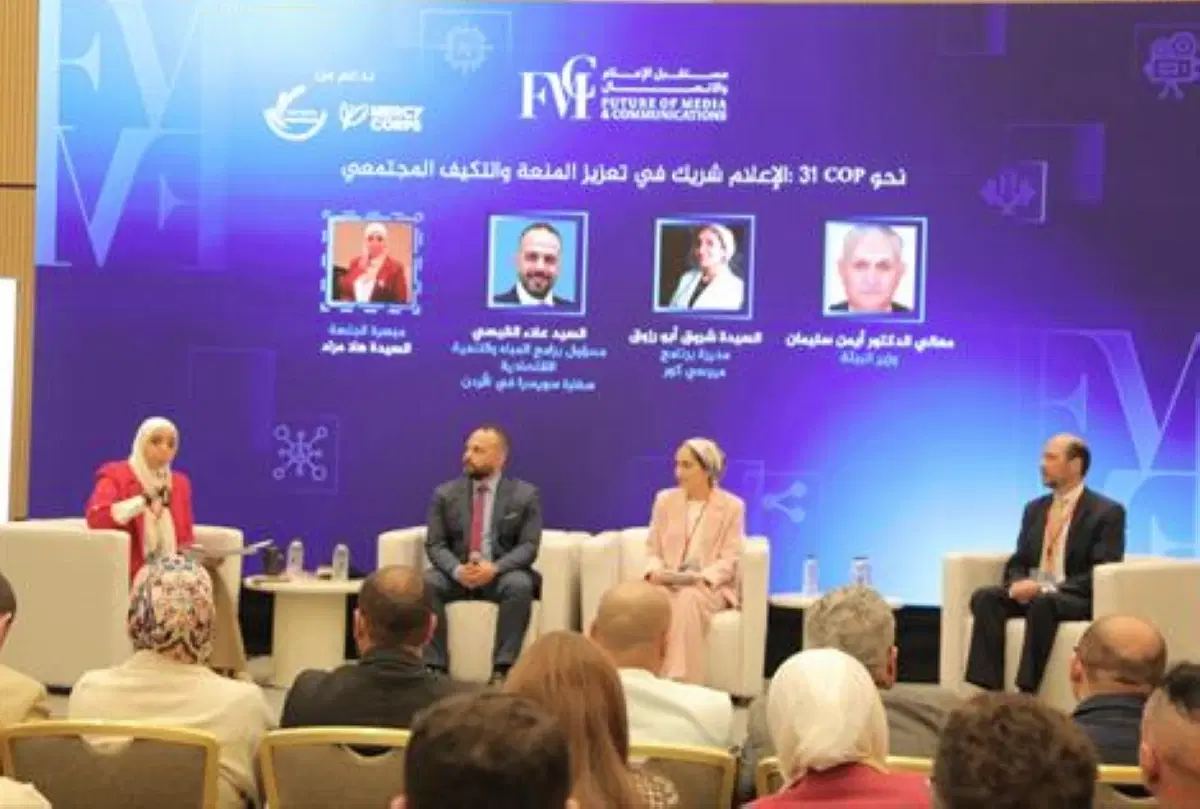
This came during the session "Towards COP31: Media as a Partner in Climate Resilience and Adaptation," held at the Landmark Hotel in Amman as part of the Future of Media and Communication (FMC) forum, organized by the Center for Defending Freedom of Journalists.
The session was hosted by Mercy Corps through the "Tabeea" project, in partnership with the Dibeen Association for Environmental Development, and with the support of the Zurich Foundation and the Swiss Embassy in Jordan. The dialogue was moderated by the association's Executive Director, Hala Murad, with the participation of the Director of the Climate Change and Green Economy Directorate at the Ministry of Environment, Bilal Al-Shaqarin, who attended on behalf of the Minister of Environment, Dr. Muawieh Radaideh, the "Tabeea" program manager at Mercy Corps, Engineer Shorouq Abu Razzouq, and the Water and Economic Development Program Officer at the Swiss Embassy, Engineer Alaa Al-Qaisi.
Al-Shaqarin stated that the media is one of the most powerful authorities in any country, but the issue of climate change requires "permanent media programs" rather than seasonal presence. He pointed out that the new generation does not know much about local and national experiences, such as the water system in Petra and its importance, nor about traditional knowledge in reading the weather, which even developed countries might not grasp.
Al-Shaqarin explained that Jordan is among the countries whose emissions constitute only a tiny fraction of global emissions, and it is therefore more affected by climate change than it is a contributor to it. This necessitates raising resilience in all sectors, starting from the local level, through plans for municipalities of various classifications based on prior planning and understanding what is changing due to the climate.
He indicated that the door for participation in the working groups for Nationally Determined Contributions (NDCs) is open to everyone, whether an institution or an individual, through the websites of the Ministry and the United Nations Development Programme (UNDP).
For her part, Abu Razzouq pointed to the necessity of asking communities about their needs, as they are a primary partner in defining and implementing solutions, which ensures that the solution is sustainable and addresses real needs. She noted that the project, under the auspices of the Ministry of Environment, launched a leadership program in advocacy targeting three community committees, in which more than fifty community leaders are participating, and each committee has prepared a plan targeting a realistic need in its community. She added that the most significant shift was the transition of the discussion from describing the problem to proposing realistic solutions and building networks with entities capable of helping to implement them, citing Wadi Musa, where the talk about the danger of floods threatening Petra is no longer limited to warnings, but has expanded to include the required early warning system and how to partner in developing it.
Regarding the role of the media, Abu Razzouq considered it essential in climate action because climate change is often presented as a global or scientific matter, while people live its effects daily in heatwaves, floods, and the impact on water and livelihood sources, especially for farmers and herders. She called for continuous coverage that goes beyond the event to the proposed solutions and their results on the ground, and for monitoring whether the proposals were implemented, who contributed to their implementation, what lessons were learned, and the possibility of transferring them to other communities. She invited the media to engage with communities and members returning from the conference in reading between the lines of official statements: what the decisions mean for Jordan and its communities, and how they can be utilized.
As for Al-Qaisi, he considered the role of the media in development to be very important, but he noted that many projects were implemented without a clear role for the media beyond announcing the start and end of the project.
He said that the media should be a partner in implementation and in changing behavior, which is one of the priorities of climate action, through a strategy aligned with national strategies that translates technical language into a language that people understand.
Regarding funding, he pointed out that the scarcity of funding and global political and economic changes have made considering priorities a necessity rather than a luxury. He held funders responsible for ensuring that funding addresses the fundamental problems of local communities, calling for listening to those whose voices are not usually heard, such as small farmers, women, and children, not just engineers, educated people, and large-scale farmers.
Al-Qaisi explained that the "Tabeea" project is an example of flexibility in funding and implementation, as the agreement was signed before any field activity began and without a precise prior vision of the activities, leaving the implementing entity to work with local communities to determine priorities.
He added that regional and climatic changes, including floods in areas where they were not expected, changed the needs of farmers and their access to imported agricultural materials, so the implementing entity adjusted its plans. He emphasized that the funder believes in responding to reality rather than to a plan that was set two or three years ago. He viewed the partnership between the Swiss Embassy as a public entity and the Zurich Foundation as a private sector entity as allowing the project to be viewed from two different angles.
At the conclusion of the session, the dialogue moderator, Hala Murad, summarized what was discussed in three main messages: first, that effective local participation is not complete by listening, but by priorities reaching planning, funding, and decision-making; second, that the role of climate media does not begin when a disaster occurs and does not end with the end of coverage; and third, that the value of participation in COP31 is complete when it is part of a continuous path that starts from the community and its priorities, reaches the international discussion, and then returns to the community with knowledge, partnerships, opportunities, and tangible impact. She said that the road to COP31 "does not start from the conference hall, but from the community that lives the danger and contributes to creating the solution, and it is not complete until the decision returns to it with an effect that can be seen and monitored."