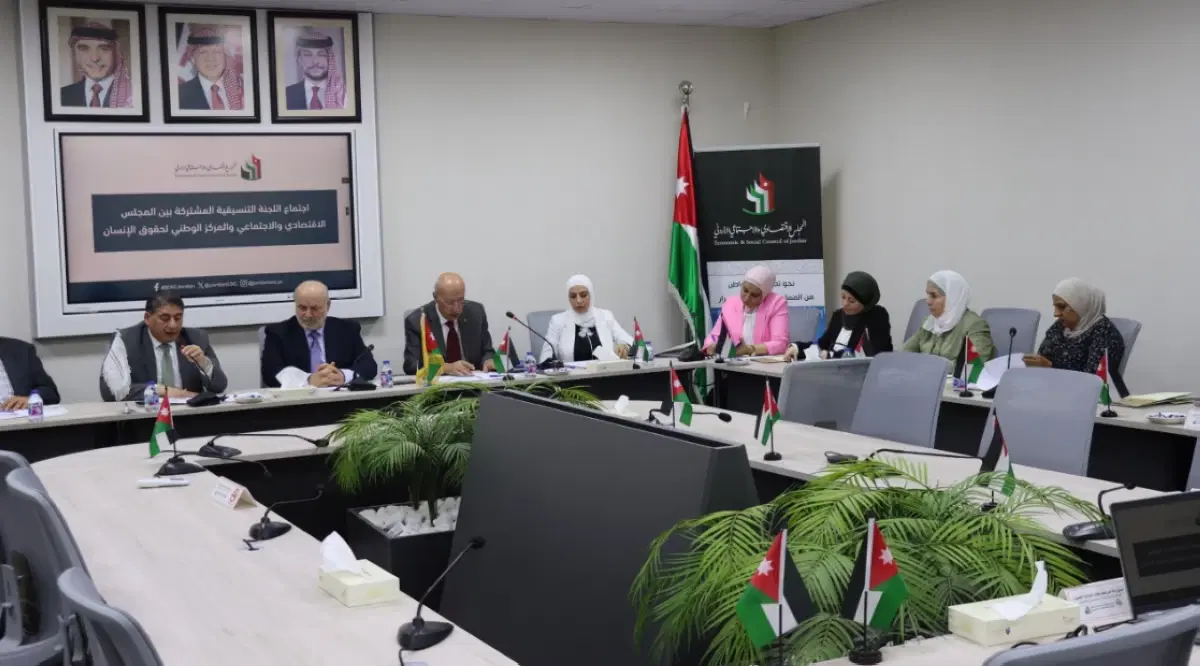
"Economic and Social" and "National Center for Human Rights" discuss following up on the recommendations of the Center's annual report
Amman5 min read
Share
The Economic and Social Council and the National Center for Human Rights discussed mechanisms for following up on and implementing the recommendations contained in the Center's annual report, in order to transform them into studies, policy papers, and specialized dialogues that contribute to developing policies and legislation and enhancing the protection of human rights, particularly economic and social rights.
This came during a meeting that focused on identifying common issues between the mandates of the two institutions, integrating priority recommendations into the work plans of the Council's 6 committees, and establishing clear mechanisms for monitoring them and measuring their impact, in a way that enhances the response to economic, social, and human rights challenges.
The President of the Council, Dr. Musa Shtaiwi, emphasized the importance of building on the results of the cooperation between the two institutions, in light of the intersection between the Council's mandates and the issues addressed by the Center's annual report, noting that the Council, despite not having executive powers, plays a fundamental role in providing recommendations and contributing to decision-making and the development of public policies.
He explained that many economic and social issues, foremost among them unemployment, are closely linked to human rights, which calls for identifying priorities that require further work, whether at the legislative or service level.
He indicated that the Council will work to follow up on these issues through its six committees and the General Secretariat, and include them within existing studies, in addition to preparing specialized studies on them, in preparation for agreeing on work priorities during upcoming meetings.
He stressed the importance of reviewing legislation that shows a need for development or addressing the problems associated with it, through dialogue and coordination with the concerned authorities, including legislation related to labor and women, leading to practical recommendations that support the development of relevant policies and legislation.
For his part, the Commissioner-General for Human Rights, Jamal Al-Shamayleh, emphasized the importance of faith in the homeland and the philosophy based on real construction as a foundation for national work, pointing to the security, stability, and impartial judiciary that Jordan enjoys, and the economic and national achievements it has attained over the years.
Al-Shamayleh stressed the necessity of looking at national achievements in a balanced manner and moving away from self-flagellation, stating that the problems that may appear do not detract from Jordan's path and achievements, and that the Kingdom possesses more opportunities to continue work and progress.
He pointed out that the Economic and Social Council constitutes an added value to national efforts through the exchange of ideas and the identification of priorities in the fields of investment, economy, and the political sector, confirming the convergence of the two institutions' goals in serving the nation, strengthening institutional work and national values, and achieving sustainable results with a tangible impact.
In turn, the Secretary-General of the Council, Nathir Al-Awamleh, confirmed that the meeting comes within the framework of following up on the recommendations contained in the annual report of the National Center for Human Rights, which is considered one of the most prominent national reports due to the issues and recommendations it contains that are submitted to His Majesty the King, constitutional authorities, and state institutions.
Al-Awamleh explained that there is a clear intersection between the Center's role in protecting human rights and the Council's mandates, particularly in the areas of economic and social rights, which calls for unifying efforts and benefiting from the resources and expertise available to both sides, in a way that contributes to improving the quality of life for citizens and enhancing the foundations of a decent life.
He added that the Council possesses research tools that can be employed in following up on the recommendations, through studies, research, policy papers, and specialized dialogues, emphasizing the importance of cooperation with the Center to identify priority recommendations and transform them into practical, implementable outputs that support the efforts of government and legislative bodies in adopting and enforcing them.
He indicated that the studies, policy, and committee team at the Council worked on reviewing the recommendations and identifying those that fit the mandates of the six committees, in preparation for addressing them through specialized studies, national dialogues, or policy papers, with a focus on comprehensive and integrated recommendations that achieve a tangible impact in the short and long term.
Al-Awamleh emphasized the importance of identifying the priorities of each committee and linking them to the recommendations contained in the annual report, and defining the requirements for their implementation within a clear plan and a specific timeframe, in addition to setting quantitative and qualitative indicators to measure progress and evaluate impact, which helps in addressing problems and limiting their escalation.
He stressed the necessity of strengthening partnerships with national institutions and relevant authorities, in light of the need for many recommendations to integrate roles and coordinate efforts between more than one party, especially in issues related to the rights of women, children, persons with disabilities, and female workers in the agricultural sector.
He pointed to the importance of considering timeframes and the alignment of recommendations with the Economic Modernization Vision and national reform frameworks, and activating institutional cooperation mechanisms to ensure reaching practical, implementable, and measurable outputs.
The meeting addressed the importance of arranging recommendations according to clear priorities, identifying common issues between the two institutions, mechanisms for integrating them into the work of the Council's committees, and strengthening the national partnerships necessary for their implementation, in a way that ensures the integration of efforts and their focus on the most urgent and impactful issues.
The two sides agreed to continue coordination and joint work to identify the priorities of the next phase, and to employ studies, research, policy papers, and specialized dialogues in following up on the recommendations, in a way that supports national efforts to protect human rights, enhances the response to economic and social challenges, and contributes to improving the living conditions of citizens.